
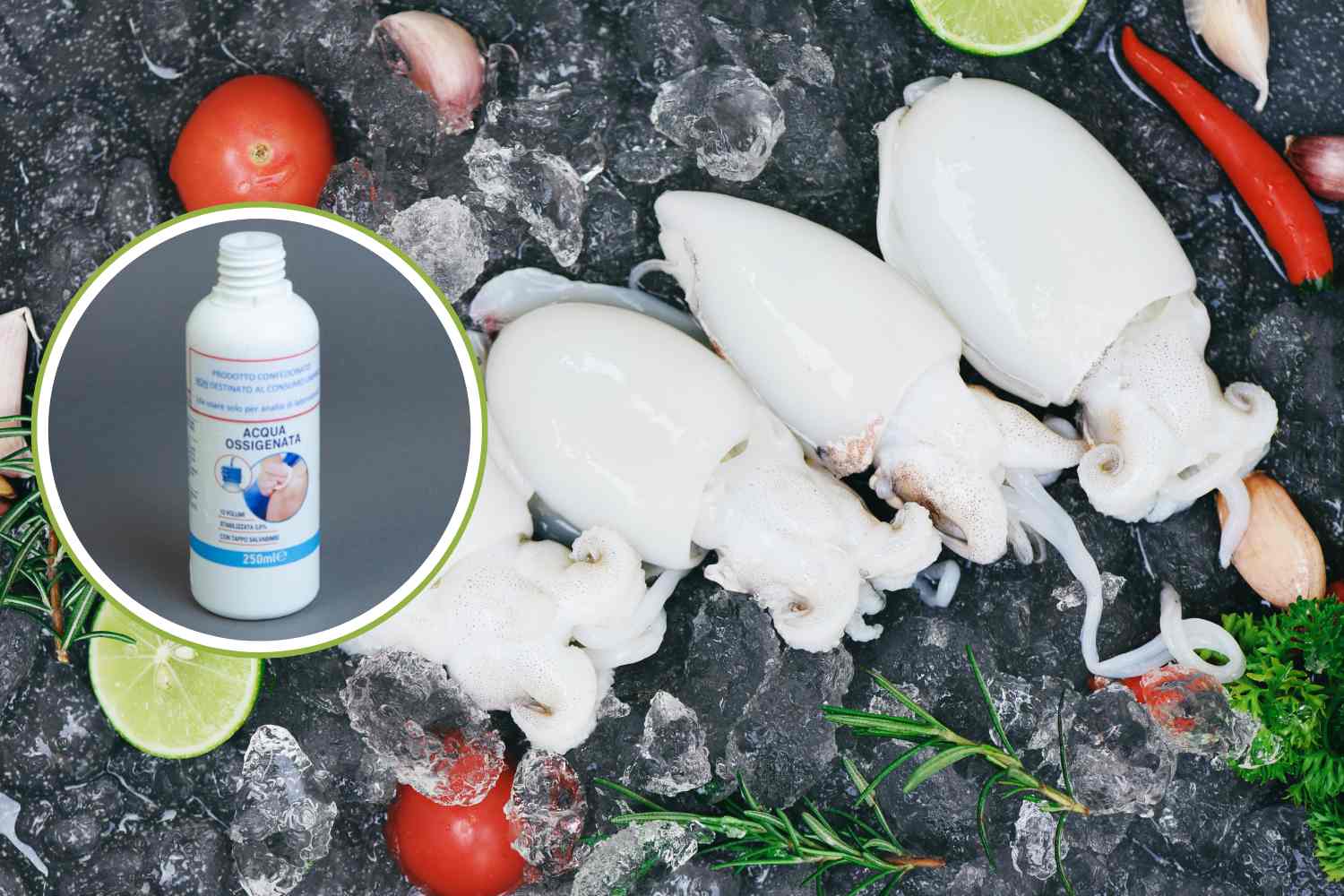
When we buy cuttlefish, squid or octopus at the supermarket, we hardly imagine that these molluscs may have been treated with a substance that we normally use to disinfect the wounds or lighten the hair: the oxygenated water. A legal but controversial practice that raises important issues on food transparency and the quality of the fish products that we bring to the table.
A European practice arrived in Italy
Since 2016 also in our country, following the example of Spain and other European states, the use of oxygenated water to treat cephalopods has been allowed. As the agronomist Daniele Paci explains,
“Oxygenated water is so excellent as bleaching that it is also used to whiten cephalopod molluscs”. But why resort to this treatment? The reason is purely aesthetic: the fish preserved over time tends to stain and develop bad smells, problems that oxygenated water “solves in a cosmetic way”.
We must understand that this process does not return freshness to the product. As the expert clarifies,
We removed the bad smells, we removed the spots, but we cannot change the bad preservation of a fish
Indeed, poorly preserved cephalopods can develop histamine, a substance that in large quantities can cause the so -called mackerel syndrome, with symptoms similar to those of a food poisoning.
The gray area of the legislation
The critical point of this practice lies in the regulatory classification of oxygenated water. Not being recognized as an additive by the European Union, it is used as “technological coadiuver”, a definition that allows you to not indicate it on the label. This creates a legislative shadow area: if the goal is to disinfect, the treatment is lawful as a technological adjuvant, but if the purpose is whitening and eliminating smells, then it would be configured as a prohibited additive.
The road to the current regulation was not linear. In 2010, the Italian Ministry had clearly forbidden the use of oxygenated water on cephalopods. However, in 2016 there was a “back married”: in order not to penalize Italian producers with respect to European competition, the Ministry admitted the use as a technological adjuvant, aligning itself with the provisions of the European Union.
The right of the consumer to transparency
The central question is not so much the danger of residual oxygenated water, which if used correctly remains in minimal quantities and turns into water and oxygen. The real problem is the lack of transparency towards consumers. As Paci points out, “you are masking me a bad quality of the raw material” and “on the label I don’t go to indicate”. This prevents consumers from making aware choices on the quality of the product they are buying.
How to recognize the treated cephalopods
For careful consumers there are some signals that may indicate a possible treatment with oxygenated water. A completely white mollusk, even without the smallest natural spots, should arouse suspicion. In the same way, the total absence of marine smell can be an alarm bell, since it eliminates that characteristic of the sea note that should be present in a fresh fish product.
The solution for safe purchases
There is an infallible strategy to avoid treated products: buy still whole cephalopods. As the expert explains,
“You cannot do the treatment except on animals that have already been eviscerated”.
So, choosing seppies and unrelated squid and possibly asking the fishmonger to prepare them at the moment, you are sure to bring home a product not treated with oxygenated water.
Don’t you want to lose our news?
