
Canned tuna is one of the most consumed foods in Italy and in the world, but it is also one of the most discussed. In fact, for some time it has been at the center of debates especially for two reasons: the environmental impact of intensive fishing and contamination from Metilmercurio, a highly toxic substance for the human body.
Today we focus in particular on the Mercury issue. This substance, issued in the environment mainly through industrial processes such as coal combustion, accumulates in the seas, where it is transformed by some microorganisms into methylmercurium. This organic form is concentrated in predatory fish through the food chain. Tuna, in particular, can contain significant quantities, especially if large or caught in polluted areas.
Once ingested, the Metilmercurio is distributed in the body, can reach the brain by crossing the blood-brain barrier and damage the nervous system, the heart, liver, kidneys and the reproductive system. The effects are even more serious in fetuses and small children, so it is essential to limit the exposure.
But how much mercury do they really contain tuna cans? This question tried to answer a new test conducted in Germany, which analyzed several brands. The results, not exactly reassuring, are also worthy of attention from Italian consumers. The references analyzed are in fact typical of the German market, but the species of tuna tuna is widely used also in Italy and in many other European countries. Mercury contamination in tuna is therefore an international problem, which concerns all of us.
How much mercury is there in tuna boxes?
Precisely for its potential danger, regulatory entities such as EFSA (European Food Safety Authority) have set security limits for the weekly consumption of Mercury. But how long do the tuna products really on the market allow us to return to such limits?
To find out, ÖKO-TEST He carried out an investigation between April and May 2025 on 29 tuna products of the Skipjack species (Katsuwonus Pelamis), or the striped tonnetto, the most commonly used to produce canned tuna.
Exclusively natural products have been chosen, excluding those stored in oil or with other ingredients such as vegetables, to maintain the analysis as homogeneous as possible.
The goal was to measure the total presence of Mercury and, in particular, of Metilmercurio, the most toxic form and easily absorbed by the body. The analyzes were conducted in a specialized laboratory using international certified test methods (DIN EN 15763 for total mercury and IC-ICP-MS for Metilmercurio).
The results
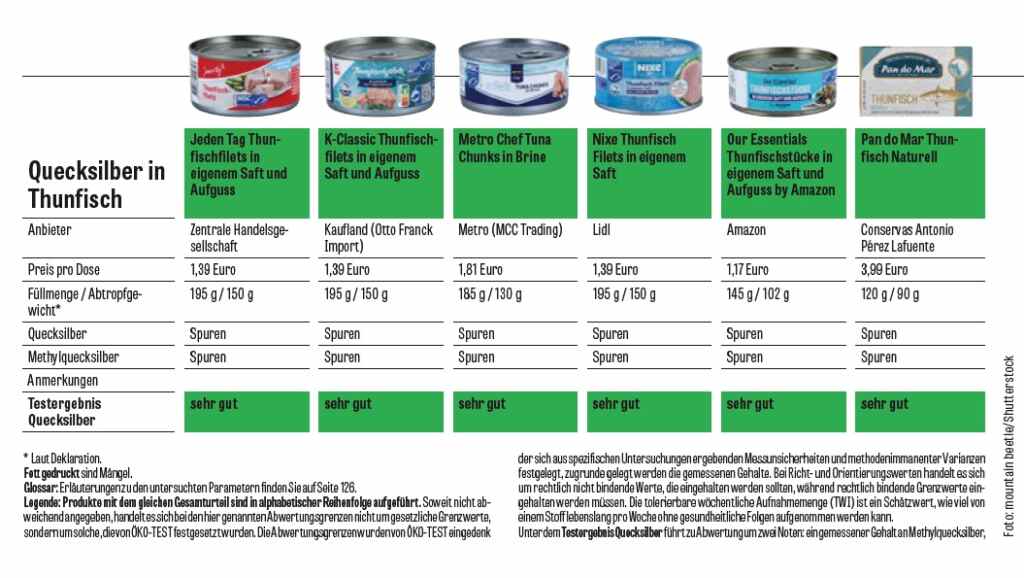
The test detected traces of mercury in all the packages analyzed. Despite this, most of the products obtained an overall “good” evaluation, since the concentrations were generally low and, assuming the consumption of one can per week, did not exceed the tolerable weekly dose (Twi) of 1.3 μg for kg of body weight established by EFSA.
Only two products – both from German Marche – were penalized in the final evaluation, as they had levels of methylmercurium levels so high as to exceed the weekly safety threshold in the case of regular consumption by an adult of 60 kg.
It should be noted that no sample has exceeded the legal limits provided for the content of mercury in food products. However, the two penalized, if consumed frequently, approached values that could represent a risk to health, in particular for the most vulnerable categories as pregnant women, breastfeeding and young children.
The Italian and European health authorities carry out constant monitoring of mercury levels in fish, but this test highlights the need to intensify controls and to provide consumers with more transparent information on potential risks. At the same time, it reiterates the importance of diversifying the consumption of fish, avoiding to concentrate too much on species that can accumulate greater quantities of contaminants.
The mercury in the striped tonnetto
Among the different species used for canned tuna, the striped tonnetto (Katsuwonus Pelamis) tends to contain less mercury than other varieties such as yellow fin tuna or red tuna. This is due to biological and ecological characteristics: it is a smaller species, with a shorter life cycle and placed lower in the food chain, factors that limit the accumulation of methylmercurium.
However, “less” does not mean “without”. As highlighted by the test, in fact, all the packages analyzed contained Mercury and in some cases at levels deemed high.
The Italian and European health authorities regularly monitor mercury levels in fish, but this test underlines the need for even more accurate control and clear communication to consumers on potential risks. In addition, he confirms how important it is to vary the consumption of fish, avoiding always focusing on the same potentially more contaminated species.
How the test was conducted
The analyzes were conducted in specialized workshops using certified international methods (DIN EN 15763 for total mercury, IC-ICP-MS for the Metilverrurio).
The results were compared with the tolerable weekly dose (Twi) for the mercury established by the EFSA, assuming a consumption of a can or sachet per week by an adult of 60 kg.
The test applied more restrictive security limits than those of the law, also considering the uncertainties of the measurements, and has attributed a “high” judgment for higher values of 50-100% to the Twi, with consequent downgrading.
Don’t you want to lose our news?
