
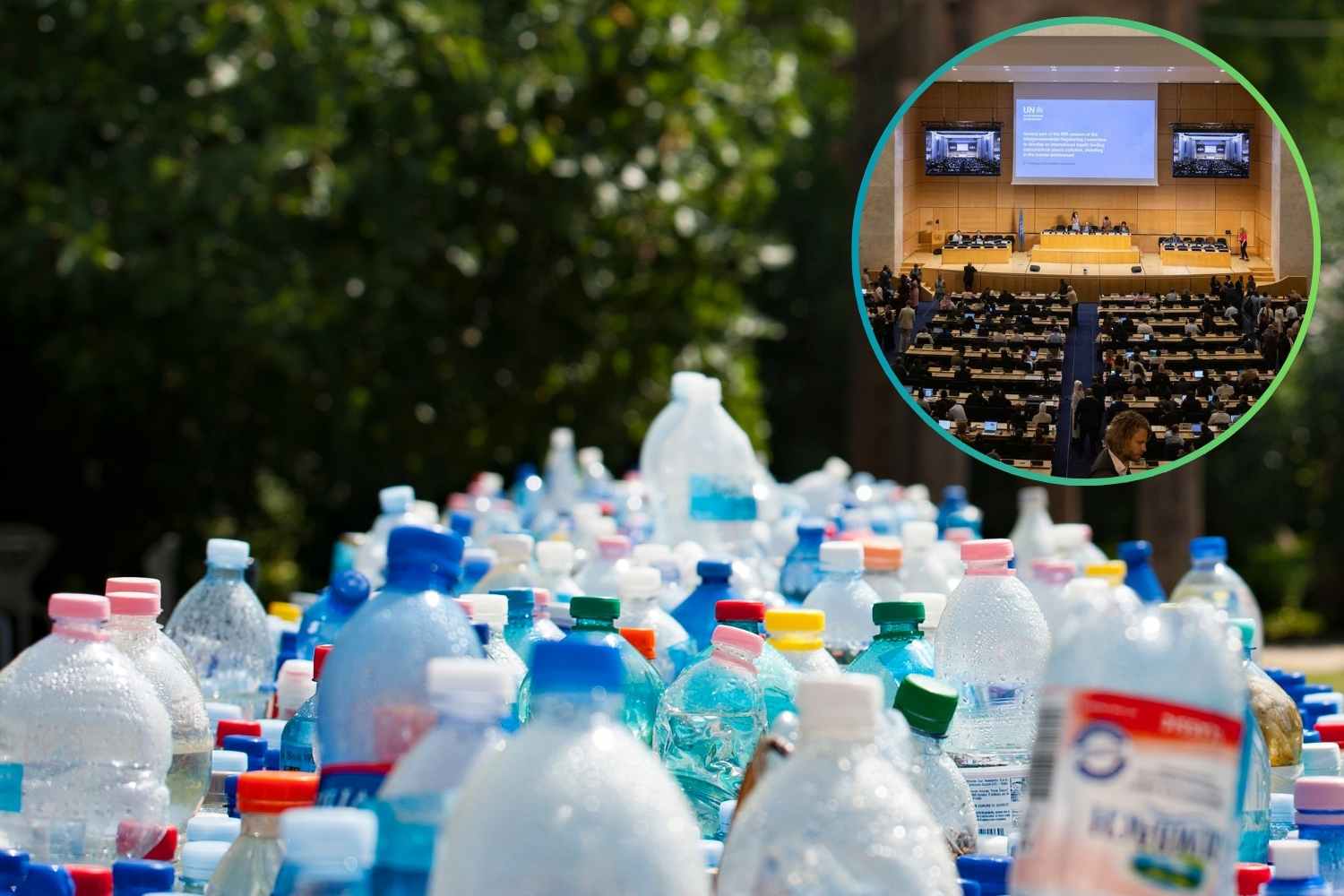
It is a race against time the one in progress in the UN headquarters in Geneva: four days are missing at the end of the second part of the fifth session of the intergovernmental negotiation committee (inc 5.2) and the risk of returning home with nothing in fact is concrete. On the table, a legally binding international treaty to face plastic pollution, also in the marine environment, which has been expected for two and a half years of negotiations.
The problem is not the lack of awareness: all 184 participating countries recognize that plastic is now everywhere – from the Himalayan peaks to the ocean pens, to our lungs and blood. The problem is the “how”.
“We’re Running Out of Time!”
Procedural discussions dominated the #Plasticstreaty Morning Plenary, with delegations Calling for the Talks to “Shift Gear” in Order To Make Progress on the Draft Treaty Text
Highlights https://t.co/qwlyea9phg#Inc5 #Inc5_2 #plastic pic.twitter.com/dqikoeva3z
– Earth negotiations bulletin (@iisd_enb) August 9, 2025
Two irreconcilable visions
On the one hand, a heterogeneous group of states – including Saudi Arabia, Kuwait, Russia, Iran, Malaysia, India and the United States – which pushes to concentrate the treaty mainly on waste management and recycling, leaving the production of virgin plastic intact.
On the other, the so -called “High Ambition Coalition”, which brings together over 60 countries (EU, many African and Latin American nations, Australia, Canada, the United Kingdom, Switzerland and small island states) and asks for drastic measures: global and binding reduction in production, gradual elimination of the most dangerous chemicals and management of the entire life cycle of plastic.
For the insular countries, already suffocated by the waste that arrive by sea, the question is existential. “We will not stay to look while our future is traded in a stalemate,” Palau said on behalf of the 39 Small Island Developing States.
The node of consent
To complicate the picture is the UN rule of consent: only one opposite country is enough to block the agreement. According to the expert in environmental law Alexandra Harrington, “this makes it extremely complex to find a unanimous agreement on each element of the treaty”, reads on Mongabay. The regulation allows in theory to move to a qualified majority vote (two thirds), but this option – provided for by article 38 – has never been formally adopted and continues to be contested, in particular by plastic producers.
Many observers, such as Magnus Løvold of the Norwegian Academy of International Law, warn that the use of vote could be the only way to overcome obstructionist tactics. A strong treaty, even without everyone’s adhesion, would still have a global impact by reducing the market of the most polluting plastics.
A stall text
The draft of the treaty, which passed from 22 to 35 pages in a few days, is scattered with almost 1,500 square brackets – a sign of unresolved disagreements. In the background, the forecast that world plastic production can triple by 2060.
NGOs ask not to settle for a compromise down. “The incineration or recycling will not be sufficient-warns Grid-Arendal-. It is also necessary to reduce the amount of plastic produced and ensure that it is safe and sustainable”.
Last call
From Tuesday 70 ministers and 30 high officials are expected to try to unlock the situation. Jessika Roswall, European Environment Commissioner, has launched an appeal to “Don’t miss this historical opportunity”.
The president of the Committee, Luis Vayas Valdivieso, continues to focus on dialogue: “We are not preparing for one vote, our mentality is to reach an agreement in a cooperative way”. But with time running and positions so distant, the question remains: in a few days the world will really have a treatise capable of stopping the tide of plastic, or will it be limited to a watered document, without binding rules?
Don’t you want to lose our news?
You may also be interested in:
