

In recent years, more and more people have been abandoning bottle water in favor of that of the tap. The choice is not only dictated by environmental reasons – avoid disposable plastic and reduce the impact of transport – but also by growing attention to health. You probably remember the scandals related to the contamination of mineral waters, such as the one that involved Nestlé Waters with famous brands such as Perrier, Contrex and Hépar, who have sensitized consumers (in particular French ones) on the importance of knowing the origin and quality of the water they drink.
Given the renewed popularity of the devices to purify tap water, the magazine 60 Millions de Consommateurs He decided to test carafe and domestic filters to understand which they really work.
The investigation involved various models to evaluate their ability to remove contaminants such as nitrates, heavy metals, pesticides and PFAS, as well as improving the flavor and microbiological safety of the water. In total, 9 devices were tested: five filter carafe, two tap filters and two natural filter materials (ceramic pearls and active carbon).
The test had a variable duration between 21 and 29 days, depending on the type of device, and demineralized water was used, enriched with contaminants at concentrations close to the regulatory limits, to simulate real conditions of pollution.
The test results
The tap filters showed higher performance than the filtering carafe. In particular, the Hydropure filter has reached an efficiency of 94.6% in the removal of nitrates and 97.4% for nitrite. Heavy metals such as lead and nickel have also been significantly reduced. Instead, the removal of the PFAS is limited, with residual concentrations above 120 µg/l.
The filtering carafe showed contrasting results. The Hydropure carafe has distinguished itself for the effectiveness in the removal of nitrates and nitrites, but had a lower performance in the reduction of heavy metals and PFAS. The British bottle showed a low nitrite removal capacity (14.1%) and heavy metals. In general, no carafe has shown a significant ability to remove PFAS.
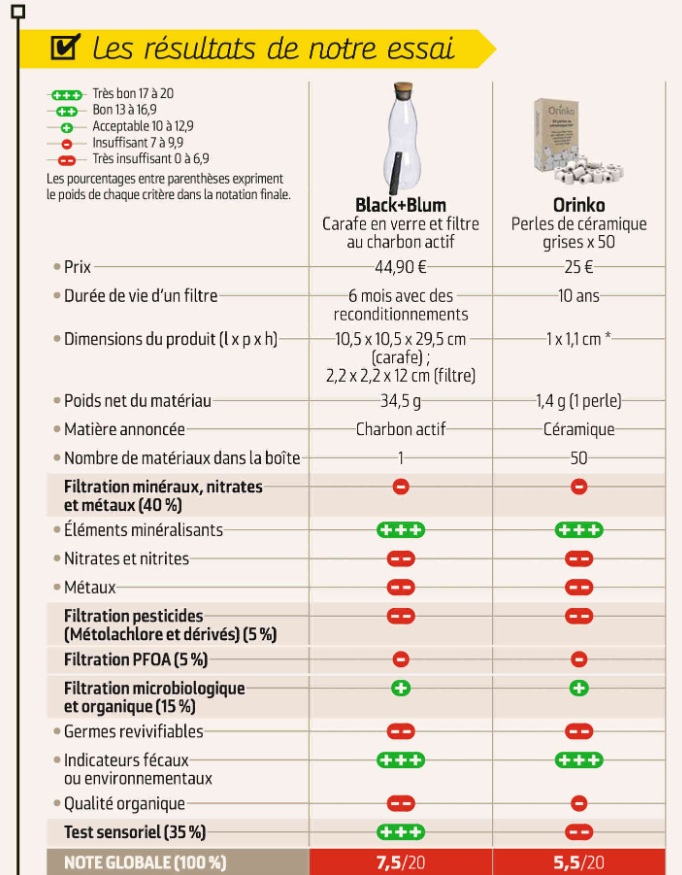
Natural devices, i.e. the ceramic pearls and the Binchotan (Japanese active carbon), showed a minimal efficacy in the removal of contaminants. Second 60 Millions de Consommateursthese devices do not offer significant benefits and are not recommended for the purification of tap water.
And what about pesticides? Also in this case the test results show a mixed picture. The tap filters, like Hydropure, obtained excellent performance, managing to remove the S-Metolaclor almost completely, a herbicide still present in some aquifers. Among the filtering carafe, on the other hand, the effectiveness varies considerably: some models, such as Brita, eliminate over 90% of the pesticide, while others, such as Homeside, only reach 62%.
Another hot theme is the presence of bacteria in filtered water. The microbiological analyzes showed important differences between the carafes: the Homeside brand has distinguished itself, producing water without germs, pathogens or environmental, followed by the British bottle, also effective against pathogenic germs. On the contrary, the Aarke model highlighted revitalizing germs and coliform bacteria already to the first use, before rinsing; The contamination of coliform bacteria disappeared only after the preparation of the filter according to the producer’s indications, while revitalizing germs remained high up to the 29th day.
Some caraf filters, such as Hydropure, released small quantities of organic coal dissolved in the water, while the Hydropure model for tap filters did not present this problem and guaranteed clean water also from the microbiological point of view. British filters, on the other hand, showed an abundant bacterial flora during filtration, a sign that contamination can also derive from the environment or from the management of the filter at home.
The test therefore confirms how important it is to choose a good filter and always respect the correct use and maintenance.
The more or less effective products to filter the water
Among the products analyzed, the best results were obtained from the Hydropure tap filter, which reached a score of 13.5/20 thanks to an excellent filtration, a long duration of the filter of 1500 liters and the advantage of not requiring electricity (necessary for other arrangers as purifiers with reverse osmosis or ionizers, not taken into consideration by this test). This filter is also found in Italy.
Good performance also for Brita on tap, with 12/20, appreciated for the ease of installation and the good flow of water, but with a chemical filtration considered only media. British filter bottle instead gets 12.5/20 as it is practical and portable, even if it does not excel in filtration.
Among the less effective products, we find the British carafe which obtains only 9.5/20, penalized by insufficient filtration and high price (€ 59.90). The Aarke model, with 9/20, also positions itself among the worst: the filter is expensive (€ 125) and the filtration does not fully satisfy, limiting itself to the microbiological one.
As already mentioned, the tested natural devices, the Black+Blum carafe and the Orinko ceramic pearls, have obtained very low scores (7.5 and 5.5/20 respectively).
In conclusion, the French experts remember that it is important to choose devices with appropriate certifications and follow the manufacturer’s instructions to ensure effective purification of the water.
Don’t you want to lose our news?
