
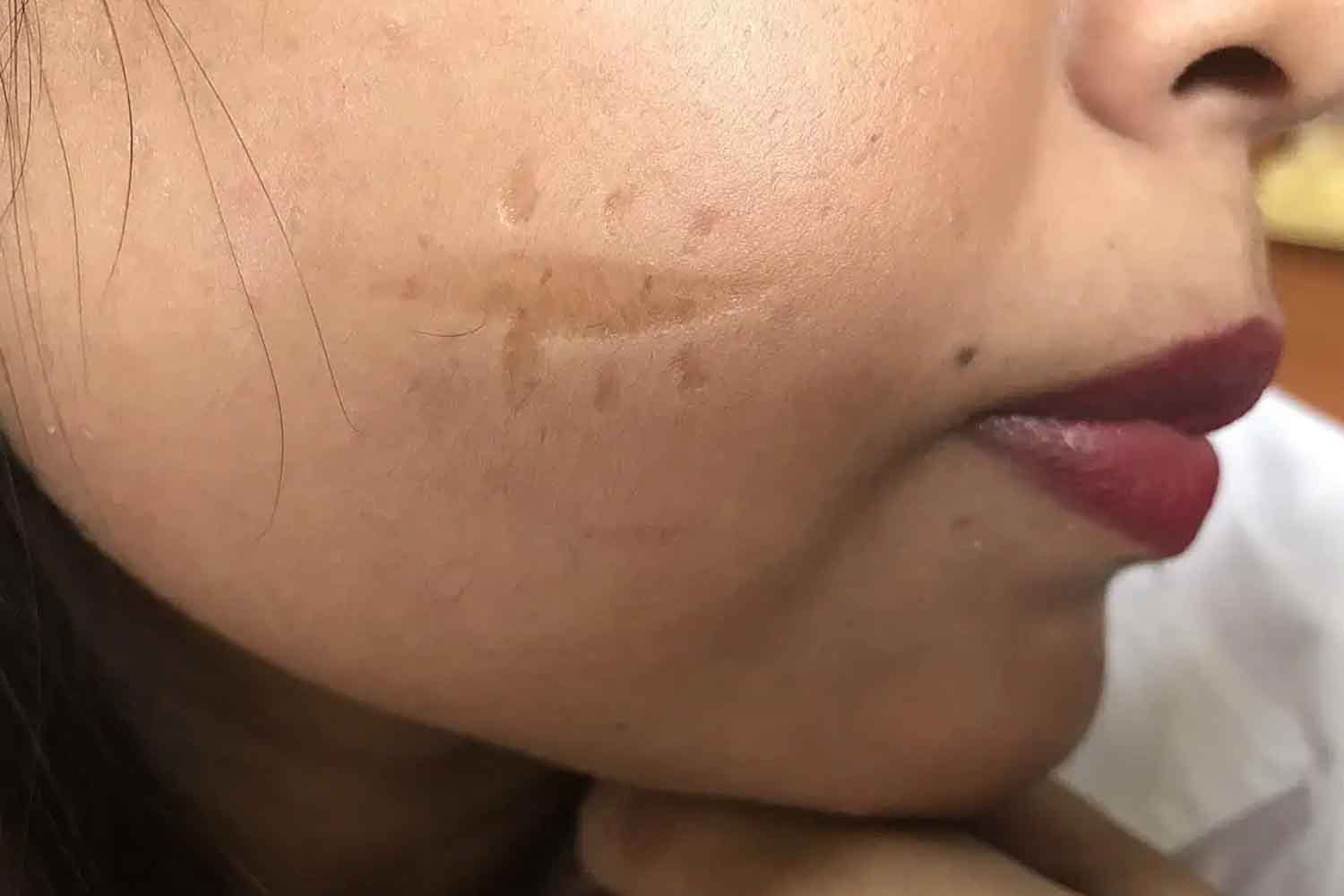
The scars often accompany us throughout their lives. Some tell stories, others would simply like to not see them anymore. But if a cream could really change the appearance of older scars, acting under the surface of the skin, without scalpel or laser?
It seems almost science fiction, but this is what they are trying to make a group of Australian researchers. In a newly published clinical study, they tested an experimental cream that promises to reduce the rigidity and visibility of the scars already formed, stimulating the fabric to regenerate in a more natural way.
What is the pxs-6302 cream
The cream is called PXS-6302 and was developed by the Australian Biotech Syntara, in collaboration with the University of Western Australia and the Fiona Stanley Hospital. It is not a simple cosmetic, but a topical drug designed to change the molecular structure of the scars.
In detail, he acts on Lisil Oxidase enzymes, proteins involved in the production and organization of collagen. In normal conditions, these enzymes help the skin to heal. But when they work too much – as happens in the scars – collagen accumulates in a disordered way, making the skin harder, thick and less elastic.
Applied regularly, the cream would reduce this enzymatic activity, making the scar more similar to healthy skin. It is a new approach, which not only aims to cover the damage, but to repair it in depth.
What emerged from the first clinical test
The study, published in the magazine Science Translational Medicineinvolved 50 adult people with mature scars, formed for at least a year. The treatment was tested on small areas of 10 cm², in two modes:
The most important result? In the participants who used PXS-6302, a 66% reduction of the Lisil Oxidase activity was observed, a sign that the drug mechanism was working.
But that’s not all. The analyzes showed a decrease in excess collagen and a reduction in protein density in the treated area, two key indicators of the fact that the skin was remodeling. Some tests also detected an increase in blood microvases: an important signal, because the scar tissue normally has a very poor vascularization.
Minimum side effects and new perspectives for those who live with visible scars
None of the participants reported serious side effects. Some had temporary redness or itching, but the symptoms disappeared just suspended the application. This is an important fact, especially if it compares with treatments currently in use, such as laser, surgery or corticosteroid injections, which can be expensive, painful and not always effective.
Another thing to clarify: the cream has not eliminated the scars, nor has it led to immediate visible aesthetic changes. The study had another goal: to understand if the skin could change structure internally. And in this respect, the results are very promising.
According to researchers, it is the first time that a drug shows that it can improve the molecular composition of an already stabilized scar. Now the next step is expected: a phase 2 clinical trial, with patients with more serious scars, such as keloids or hypertrophic scars, to test not only safety, but also the visual and functional efficacy of the treatment.
Changeable scars even after years?
The scars are formed when the skin, to quickly close a wound, produces excess collagen and in a disordered way. It is a life -saving mechanism, but often leaves lasting signs. To date, it was thought that these scars, once formed, were impossible to modify.
The PXS-6302 cream challenges this idea. It does not cancel the signs from evening to morning, but it shows that it is possible to intervene on the structure of the fabric even after a long time, making it more similar to the healthy one. If confirmed, these results could radically change the way we face scars, both from a medical and psychological point of view.
The road is still long, but for those who live with visible and annoying scars – on the face, on the hands, on exposed parts – it could represent a new concrete hope.
You may also be interested in:
