
At the heart of every electric car there is a crucial element: the lithium battery, a block that can weigh from 300 to 600 kg. It is she who provides the energy necessary to move the vehicle and makes cleaner mobility possible. But it is also the most vulnerable element in the event of a fire.
Lithium ion batteries, if subjected to impacts, short circuits or overheating, can experience a phenomenon called uncontrolled overheating. In practice, one cell gets too hot and transmits heat to the others, creating a chain reaction that can lead to a violent fire.
Once started, this process is very difficult to stop. Even for firefighters. The battery is often recessed low in the car, hard to reach and even harder to cool. And the fire, in these cases, is not easily extinguished even with water.
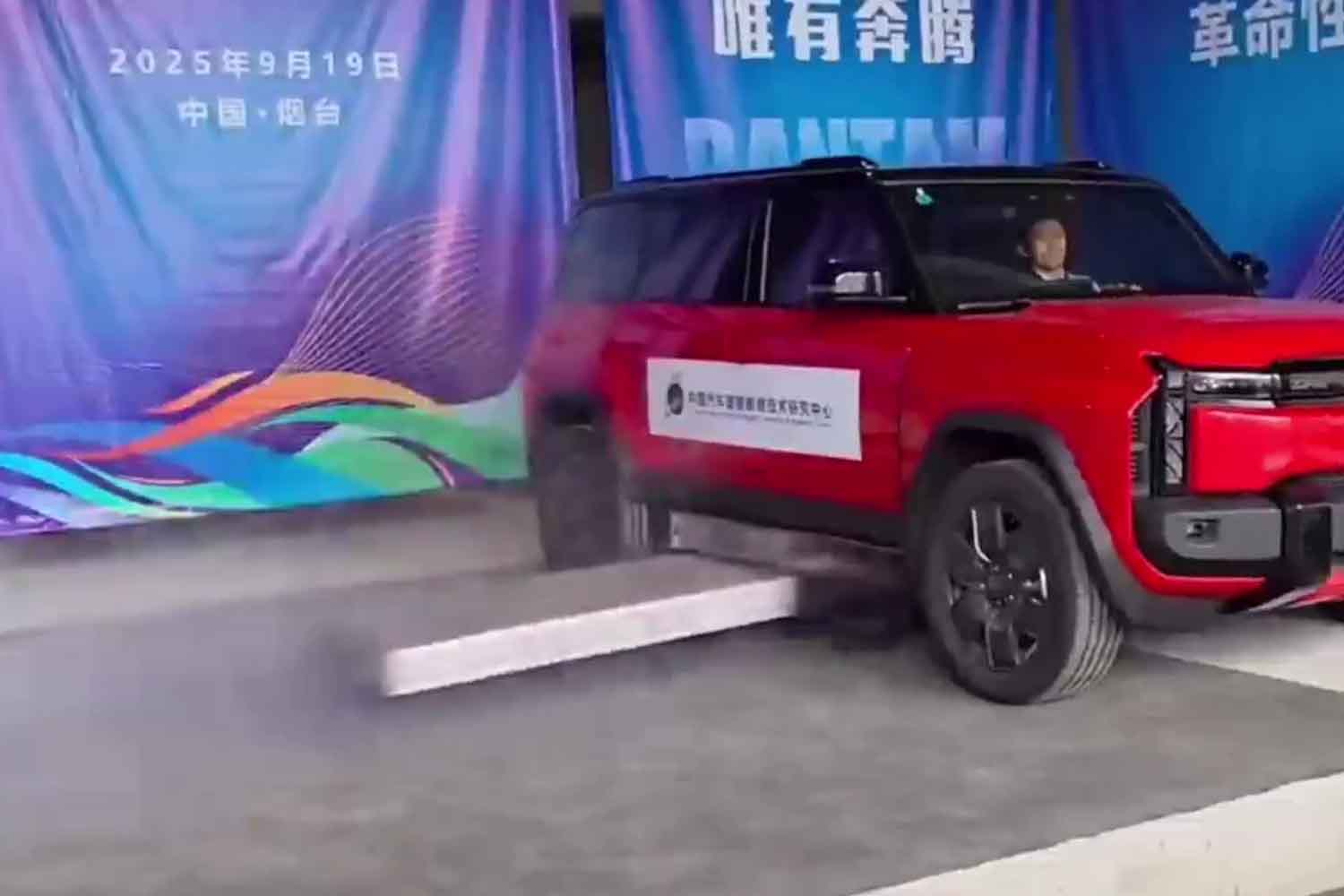
To prevent the worst, the China Center for Research on Vehicle Collision Repair has developed a system capable of ejecting the burning battery away from the vehicle, even while the car is moving. The estimated distance is between 3 and 6 meters. The idea is simple: separate danger from people.
The device made the rounds on social media after a demonstration video was published on X (formerly Twitter). You can clearly see the battery being launched out like a real emergency missile.
An extreme solution to a real problem, but the risk shifts elsewhere
The initiative was born from a clear intention: to save human lives and prevent catastrophic damage. But it raises important doubts, starting from a fundamental point: where does that battery go?
A battery thrown several meters away, with force and speed, can itself become a danger. Especially in urban scenarios or in heavy traffic situations. What happens if the car is in a traffic jam? What if there are pedestrians, cyclists or other vehicles around?
The system is not yet capable of guiding or controlling the trajectory of the launch. It doesn’t avoid obstacles, it doesn’t slow down before impact. And this is a problem. Because even if the source of the fire is moved away, a new accident could be created a few meters further away.
Not surprisingly, several online users and some car manufacturers said they were perplexed after the demonstration. The images are spectacular, but in reality the context is much more complicated. And a flaming object weighing hundreds of kilos, thrown at high speed, can cause serious damage.
An idea to be improved with artificial intelligence and clear rules
It must be said: the system is still in the experimental phase. The test was carried out in a protected area, equipped with a fire prevention system ready to intervene. And in that context everything worked as expected. But outside that perimeter, the unknowns increase.
To become truly effective and safe, this device needs an intelligent analysis system, perhaps based on artificial intelligence. The car should be able to recognize its surroundings and decide when, how and where to eject the battery safely. Not in the middle of the road, not towards another vehicle.
Another open question concerns infrastructure: parking lots, roads and highways are not designed to handle the flight of fiery batteries. Rules, safe zones, protocols will be necessary. And perhaps even an update of European regulations, to establish whether and how to welcome this type of technology on our roads.
This electric car that ejects its battery in case of fire is a radical idea, designed to respond to a real problem. Lithium battery fires are rare, but very difficult to control. Intervening before it’s too late is essential. But doing it without creating other risks is even more so.
The Chinese project points in the right direction: saving people first and foremost. But more tests, more technology and more rules will be needed to transform this emergency “missile” into a real security solution.
Joyson Electronics denied to Yicai today that it had developed a battery ejection technology in collaboration with the China Vehicle Collision Repair Technical and Research Center, after a video showing a car ejecting its battery during thermal runaway to avoid burning electric… pic.twitter.com/mMn9OfTWg9
— Yicai 第一财经 (@yicaichina) September 22, 2025
You might also be interested in:
