
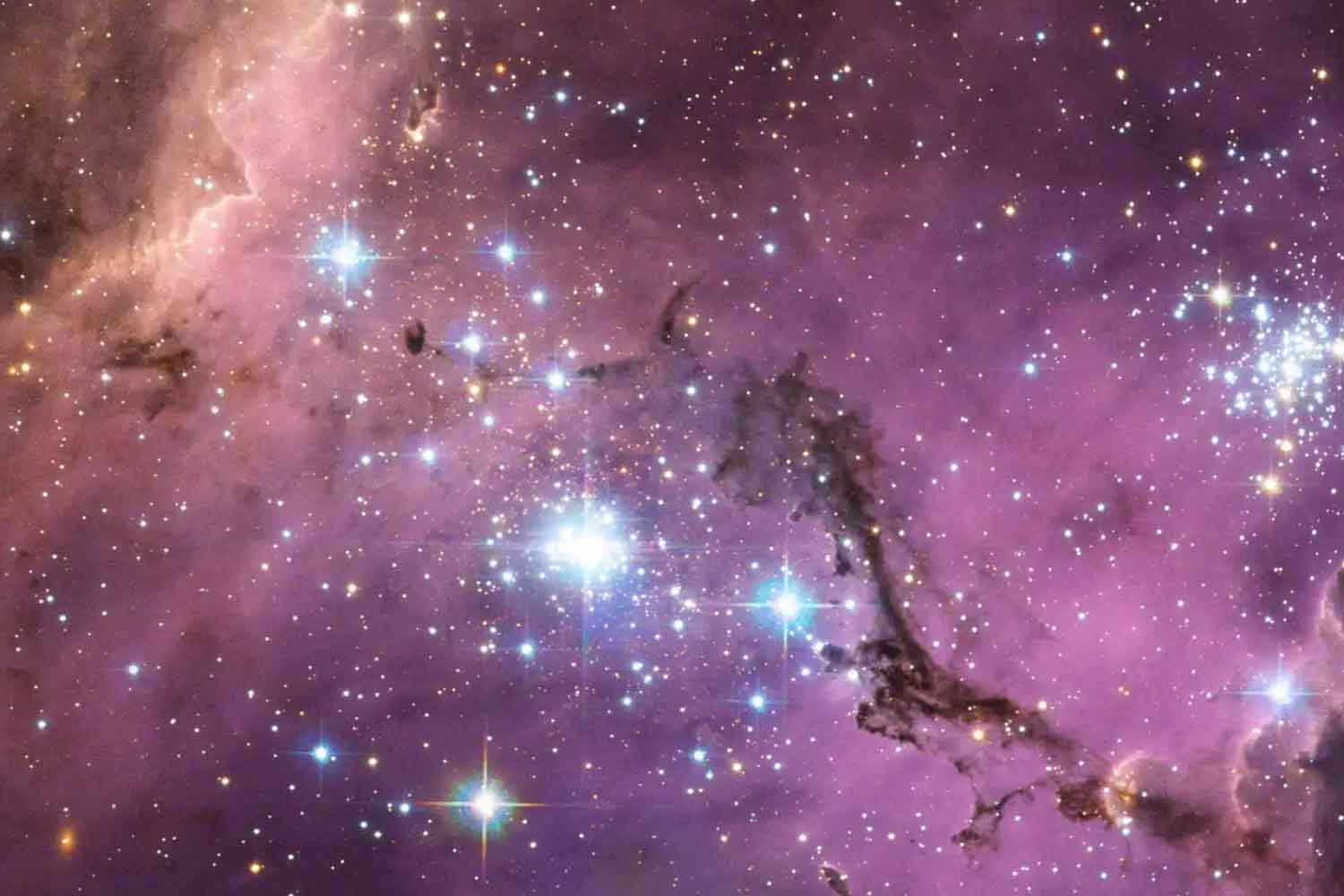
Not all stars are the same. Some, like SDSS J0715-7334they seem to come straight from the first chapter of the universe. It is a star so low in heavy elements that scientists consider it to be the most “pure” ever discovered. An absolute rarity, useful for understanding what the cosmos was like immediately after the Big Bang.
It was identified by a team led by Alexander Ji of the University of Chicagowhich published the results on the scientific portal arXiv. The star is found on the outskirts of the Milky Waybut the data collected tell a much more distant story, both in space and time.
An almost immaculate chemical composition
SDSS J0715-7334 is one red giantthat is, a star that has now passed the central phase of its “life”. But what really surprised scientists is his almost total absence of metals. In astronomy, all elements heavier than helium are called “metals”. So yes: oxygen, iron and carbon are also considered metals in this context.
This star has a lower amount of metals than any other ever observed so farreally twice as poor of the previous record holder. And if this is already rare, the fact that it is also low in carbon – an element that even the most primitive stars tend to have – makes it a practically unique case.
According to the research team, SDSS J0715-7334 it would have formed from a gas cloud enriched just by the remains of one Population III supernova – the first stars born in the universe, made up only of hydrogen, helium and a little lithium. In other words: this star is an authentic piece of primordial universe.
From the Magellanic Cloud to the Milky Way: a long migration in space
Thanks to data from the European satellite Gaiascientists could trace the path of the star over timediscovering that , but in the Large Magellanic Clouda satellite galaxy of ours. Over time, it migrated into our galaxy, without getting “dirty” with interstellar material often contaminating the surfaces of stars.
This “purity” is fundamental for astronomers, because it allows them to study it without external interference. Furthermore, SDSS J0715-7334 has an internal structure that mixes the materialpreventing layers with different compositions from forming: another plus point for those trying to understand what matter was really like immediately after the Big Bang.
There’s more. The researchers explain that this star is located below the “fine structure cooling threshold”. This is a limit that defines how much a gas cloud can lose heat to become cold and dense enough to form a star. In cases like this, where metals are absent, cooling is very difficult.
The discovery of SDSS J0715-7334 confirms that cosmic dust played a crucial role in cooling primordial clouds. It is an important clue, because it indicates that similar mechanisms could also be active in other galaxiesnot just in ours.
SDSS J0715-7334 is not just a star. It’s one silent witness of a very distant erawhich still tells us today about the origin of the stars, the elements and, ultimately, of our own cosmic origins. For astronomers, it is how to find a bottle with a message launched into the void over 13 billion years ago.
