
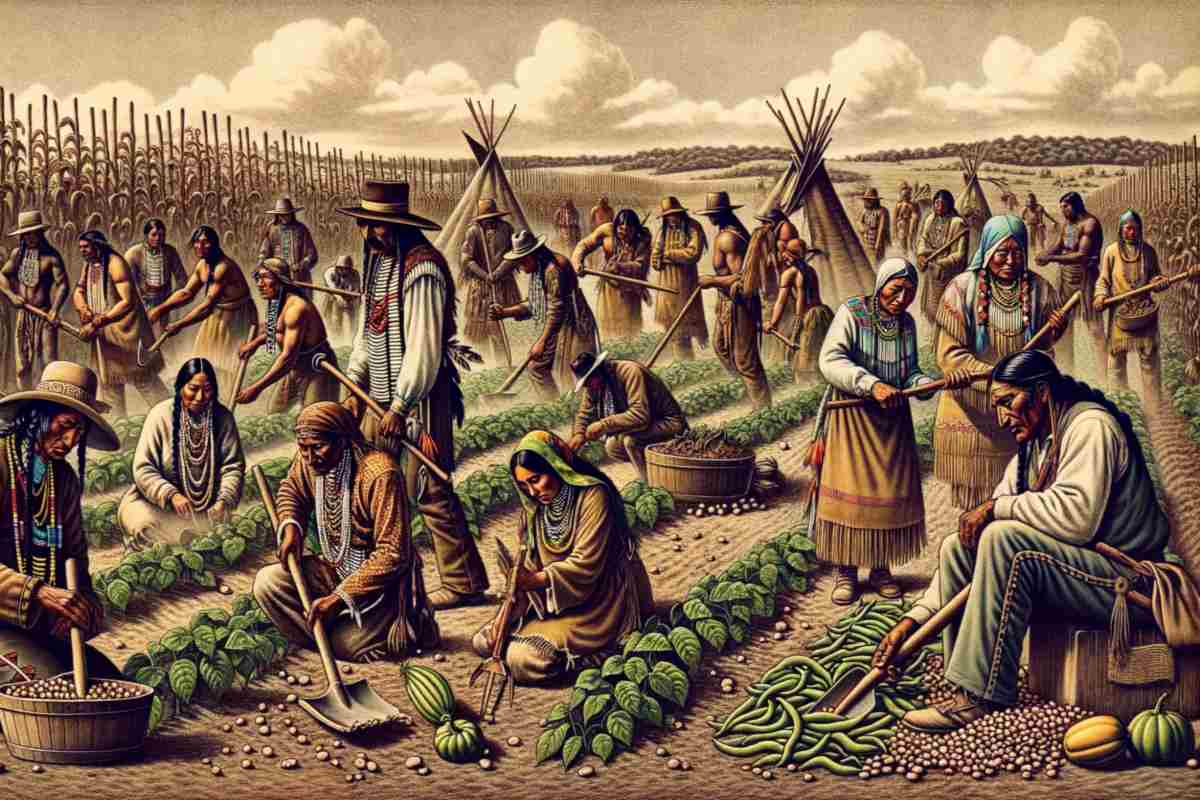
Today, as the agricultural world searches for solutions to address the growing climate crisis and soil degradation, traditional agricultural practices, such as that of the ‘Three Sisters’ of the Iroquois, are experiencing a new renaissance. These sustainable farming systems, passed down orally through generations of Native Americans, offer a concrete example of how agriculture can be in tune with nature, while promoting biodiversity and healthy soil.
According to a legend of the Iroquois, a native people of North America, corn, beans and pumpkin are three inseparable sisters who grow and develop successfully only when they are together. Hence comes the tradition of planting corn, beans and pumpkin together on the same plot of land.
Popular among Native American agricultural societies, it is a sustainable and complex system that ensures long-term soil fertility and a healthy diet across generations. Corn, beans, and squash were among the first major crops domesticated by ancient Mesoamerican societies.
Corn was the main crop, providing more calories or energy per hectare than any other. According to the legends of the Three Sisters, this must grow in association with other crops rather than alone, since it needs the beneficial company of its helpers
The Iroquois believe that corn, beans, and squash are precious gifts from the Great Spirit, each cared for by the spirits of the three sisters. During sowing, ceremonies are held in their honor and a festival commemorates the harvest of the first ear.
How this technique works
Through oral tradition, the telling of legend, and the annual rituals that continue to be performed, Native Americans have preserved the knowledge, use, and legacy of the Three Sisters through generations.
But how does this technique work? Corn provides natural support for climbing bean vines. Beans fix nitrogen in their roots, improving soil fertility and providing nitrogen for corn that will be planted in the future. Beans also help stabilize corn plants, making them less vulnerable to wind-induced falls.
Shallow rooting of pumpkins works as a living mulch, providing shade and inhibiting weed growth and preventing moisture loss through evaporation, thus increasing the crop’s chances of survival in dry years.
Squash thorns also help deter predators from approaching corn and beans. The large amount of plant residue from this plant combination can be incorporated back into the soil at the end of the harvest to strengthen organic matter and improve soil structure.
Corn, beans and pumpkin also complement each other from a nutritional point of view. Corn provides carbohydrates, while dried beans are rich in protein and make up for the corn’s amino acid deficiency. Finally, pumpkin provides both vitamins (in the fruit) and healthy, delicious oil from its seeds.
In addition to improving soil fertility, the association of corn, beans and pumpkin promotes greater biodiversity. Squash plants, for example, create a microclimate that not only conserves soil moisture but also supports beneficial wildlife, such as pollinating insects and natural pest predators. This type of symbiosis between plants and the environment reduces the need for pesticides and chemical fertilizers, increasing the resilience of the agricultural ecosystem.
The legend of the Three Sisters
Many legends have intertwined around the “Three Sisters”, which vary from tribe to tribe. One of these reads:
Long ago, three sisters lived together in the countryside. These sisters were very different from each other, both in stature and in the way they looked and moved. The smallest one was so young and round that she could only climb and was dressed in green.
The second sister wore a bright yellow dress. She had a very particular way of moving when the sun was shining and the light wind was blowing in her face. The third was the older sister, always very upright and tall compared to the other sisters, who watched over them and kept them away from danger. She wore a pale green blanket and had long yellow hair that swayed in the breeze.
There was only one thing in which the three sisters were alike. They loved each other very much and were always together. This made them very strong. One day a strange bird arrived in the field: a crow. He spoke to the horses and other animals and this attracted the attention of the sisters. Later that summer, the younger, smaller sister disappeared. The sisters became sad.
Again the crow returned to the field to gather reeds on the river bank. The sisters who were still together watched her tracks as she walked away and that evening the second sister, the one in the yellow dress, also disappeared.
Now only the older sister remained. He continued to stand in the field. When the crow saw how much she missed her sisters, she brought them back and they became strong again.
The Three Sisters are not only a combination of plants, but also a symbol of balance and interconnection in the Iroquois worldview. Their story represents the harmony between the land, humans and the spirits that protect them. Each year, Iroquois communities celebrate these sacred plants with ceremonies that honor not only the harvest, but also the spiritual bond that unites people with nature. In some tribes, the legend of the Three Sisters is considered a metaphor for life itself, where each element, despite being different, has a fundamental role in maintaining balance.
Today, many farmers are rediscovering the benefits of the Three Sisters system. These practices, which are based on cooperation between plants rather than competition, are being applied in modern agricultural contexts. Regenerative agriculture experts are exploring how the integration of corn, beans and squash can help improve soil health, reduce erosion and limit the use of chemical fertilizers, thus meeting the environmental challenges of our time.
You might also be interested in:
