
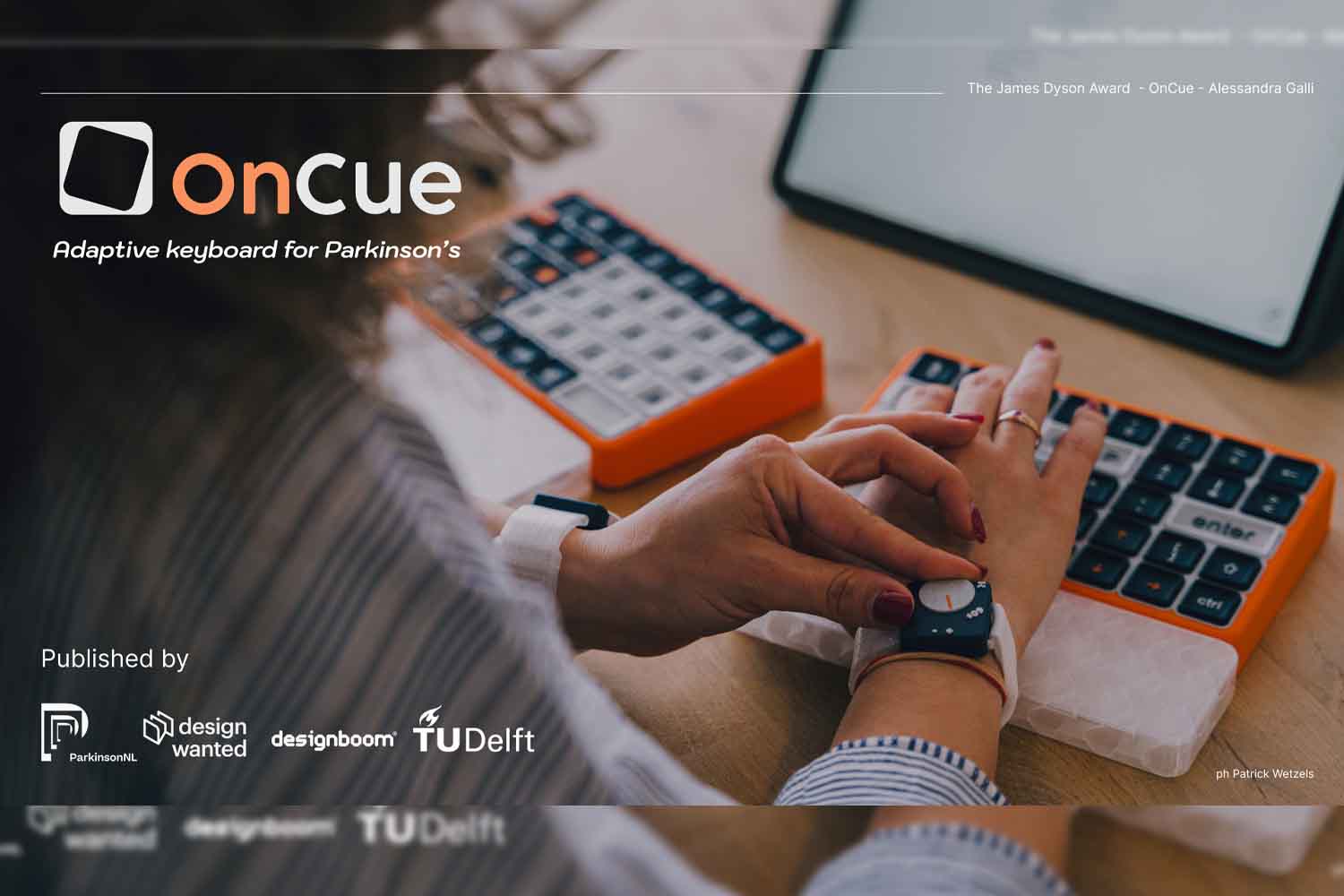
Sometimes a detail is enough to understand how complicated writing a message can become: a tremor that distorts the pressure on the key, a hand that no longer follows the intention. From this simple and daily observation it was born OnCuethe intelligent teclado created by the Italian designer Alessandra Galli during his course at Delft University of Technology.
Not a futuristic gadget, but a concrete tool, designed for those who live with Parkinson’s disease every day. A project so effective that it conquered the James Dyson Global Award 2025one of the most important awards dedicated to design that solves real problems.
OnCue: vibrations, predictive light and a split format
OnCue takes some principles of gaming claviers, but transforms them into a functional and intuitive aid.
Each key offers two types of support:
The result? Typing becomes smoother, errors decrease and the person feels like they are “driving” the movement again.
The keyboard is also adjustable: light intensity and vibrations can be changed based on the day, because those living with Parkinson’s know well that not all moments are the same.
The format, divided into two parts, is not an aesthetic quirk but a precise choice: during listening sessions with patients and occupational therapists, Alessandra discovered that a split keyboard relieves tension on arms and wristsmaking the experience less tiring.
A project born from listening
Before designing the prototype, the designer collected testimonies, observed movements, listened to doubts and difficulties. This direct comparison shaped every detail of OnCue.
«What for many is an automatic gesture, for those with Parkinson’s can become a continuous obstacle», he says. The goal was not to “normalize” the disease, but facilitate the gesturerestoring a bit of that autonomy that is often lost without realizing it.
With the funding received from the Dyson prize, Alessandra will now be able to perfect the keyboard together with associations and specialists, to really bring it into the homes of people who need it.
OnCue’s strength lies in its simplicity: no complicated functions, no unrealistic promises. Just a device that accompanies and makes safer gestures that should be within everyone’s reach. It is a technology that does not “do it for you”, but It puts you in a position to do betterand which puts the dignity of human movement back at the centre.
And if you are curious about the inventions that question our daily relationship with digital objects, there is even an iPhone cover for 2.7kgdesigned to limit phone addiction. A sign that design, when it observes reality carefully, can help us reflect and simplify life.
