
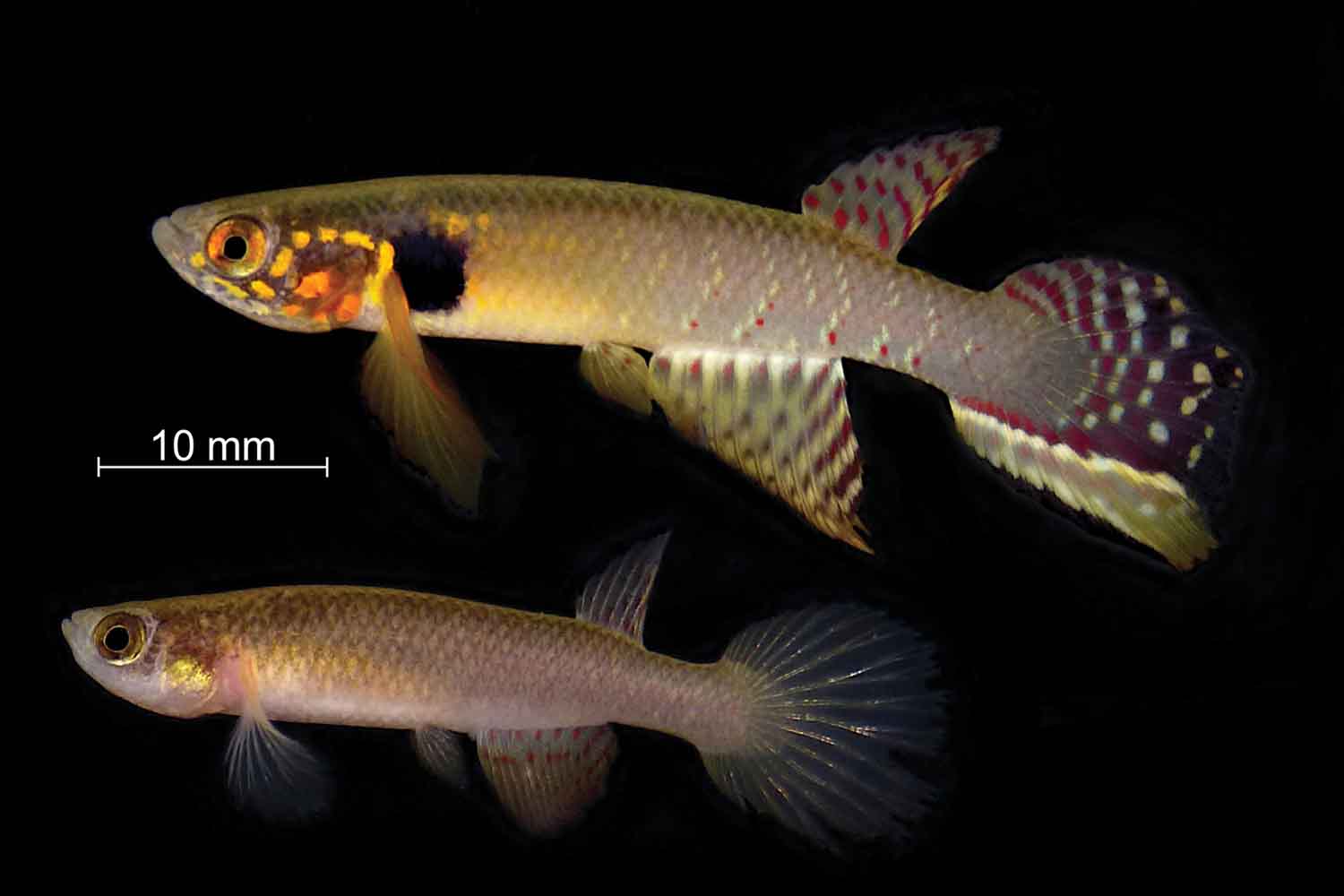
For over twenty years there was no trace of him. So, when scientists saw Moema claudiae, a tiny seasonal fish native to Bolivia, swimming again, they had the feeling of having found an old friend that everyone had already given up as lost. Not a miraculous apparition, however: just the signal that nature, when it can, still tries to resist.
The fish resurfaced in an ephemeral pond, filled by rain and closed in a strip of forest surrounded by agricultural fields. An environment that almost seems to whisper: “I’m still here, but I don’t know for how long”. Moema claudiae had disappeared from its original area, which has now been completely transformed into cultivated land. After years of fruitless research, it had been included among the Critically Endangered species, perhaps already extinct.
Then, the twist: thanks to the work of Heinz researchers Arno Drawert and Thomas Otto Litz, a small population reappeared in a temporary lake that remained intact by pure chance. In their study, published on Nature Conservationthe first photographs of the live animal and details of its behavior appear, information that did not exist until now.
The species bears the name of the wife of biologist Wilson Costa, and Litz does not hide his gratitude: behind every fish found, there are connections, collaborations, years of silent work.
A pond and seven species
Seasonal killifish have their own way of defying the weather: they live for a few months, lay eggs capable of resisting drought, then disappear as the pools dry out, reappearing with subsequent rains. A cyclical miracle that works as long as the landscape remains intact. When you drain it, level it, pollute it, that cycle breaks.
The real surprise is that the pond where Moema claudiae was found is home to six other species of killifish, creating the most diverse genetic community ever observed for fish of this type. A wealth made possible by the unique position of the area, where the Amazon meets the savannahs of the Llanos de Moxos. A crossroads of ecosystems which, today more than ever, requires protection.
Over the last twenty-five years, Bolivia has lost almost 10 million hectares of forests. The plains are converted into monocultures, the soils are compacted, the waterways are “straightened”. In this context, the small depressions in which killifish are born, grow and die are no longer able to form, as Drawert points out:
If we do not stop uncontrolled agricultural expansion in the Bolivian lowlands, we will lose key ecosystems, both terrestrial and aquatic.
The sentence is not alarmist: it is a fact. There is no well-being without the balance of the environments that make it possible.
Protecting a pool is not enough
Defending Moema claudiae means defending a group of small waters that communicate with each other like the rooms of a house. To do this, simple but essential actions are needed: leaving vegetation around the pools, limiting the passage of machinery in rainy seasons, avoiding pesticides near wetlands, mapping the ponds and understanding which ones communicate with each other.
And then, above all, recognize the value of these “ephemeral waters” in political choices: they are not just any puddles. They are reservoirs of life, support for insects, amphibians, birds and mammals who depend on those short cycles to feed and reproduce.
A lesson from Moema claudiae
Killifish are small, but they act as a litmus test for the landscape, true sentinels of the environment. Where they survive, the natural rhythm of rains and droughts also survives. When they disappear, it means that biological clock is broken. Moema claudiae teaches us one last thing: some species exist only in one place, in a single handful of square meters. Losing that population is equivalent to losing an unrepeatable evolutionary history.
This rediscovery is exciting, yes, but also urgent. There is only one known population left. All it takes is one year that is too dry, a bulldozer, or incorrect treatment in the fields to completely erase it. But it is not a story already written. Protecting the site, involving landowners and looking for similar ponds could transform what is now a fragile hope into a true rebirth.
You might also be interested in:
