
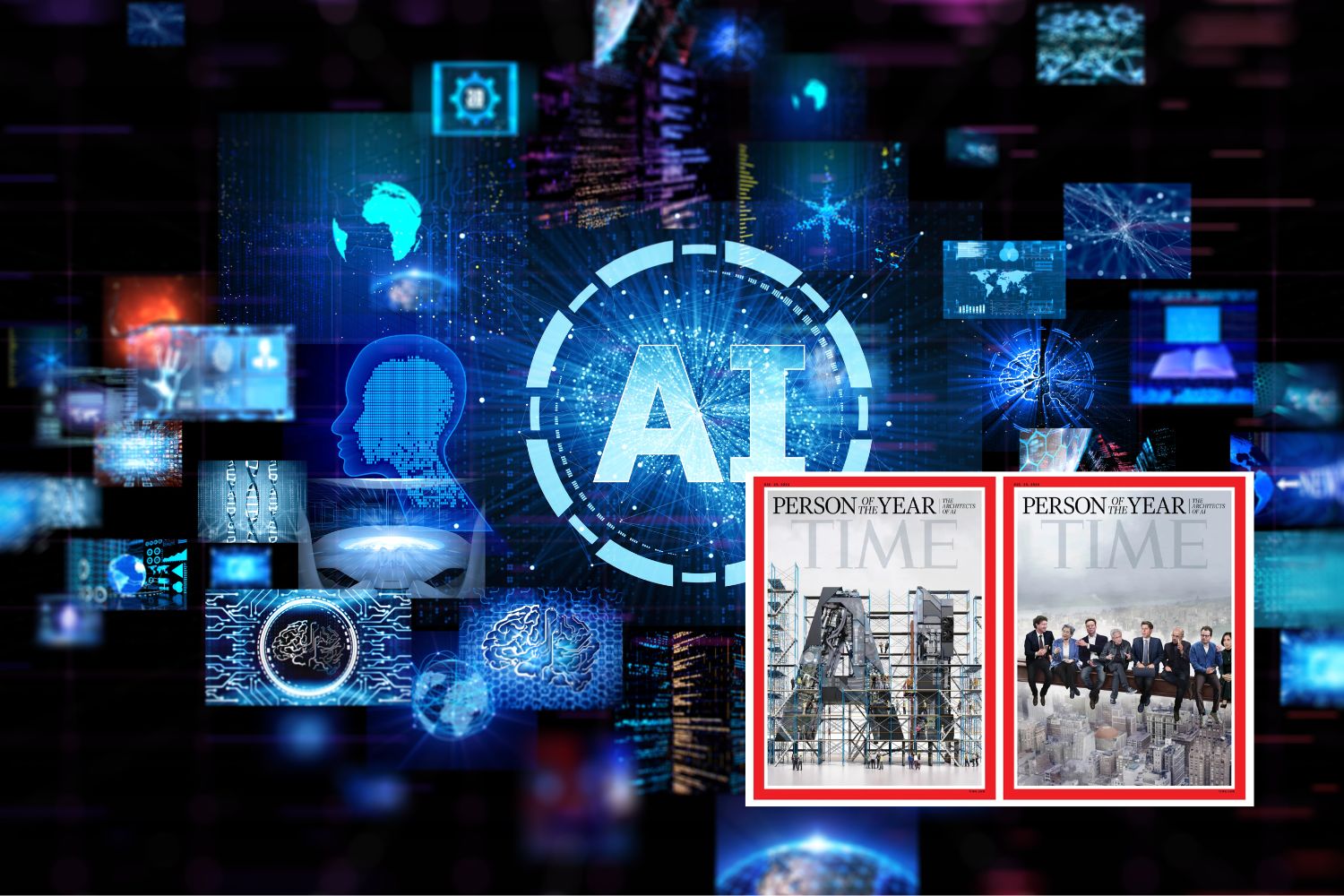
On the other hand, in ’82 it was the personal computer that was selected as “Machine of the Year” for the rapid transformation it marked in society, just as in 2006 there was “You“, “You”, as character of the year referring to the first users of social media as content creators. It should not scare us, therefore, if the Time editorial team chose Artificial Intelligence and its architects as Person of the Year 2025 and not just any Christian. Bad tempora currunt? Not exactly. It’s evolution, beauties. And we have to keep it, whether we like it or not.
The point is easily made: at the end of a terrible year, in the general tangle of wars and armed conflicts, of people with enormous egos, of genocides and fake peace agreements, what did we expect? Better to choose the parallel universe, right? (well even if the fact that only last year Time’s Person of the Year was Donald Trump proves me wrong and confirms that the title is given to the person or people who have most influenced the current world, not to those who have done good…).
2025 was the year in which the full potential of artificial intelligence exploded into the limelight and in which it became clear that there was no turning back – the magazine writes with great fanfare. For giving birth to the age of thinking machines, for astonishing and worrying humanity, for transforming the present and pushing the limits of the possible, AI architects are TIME’s 2025 Person of the Year.
Person of the year 2025
There are two covers to represent it: on the first, a steel beam dominates, as in the photo of the workers building skyscrapers in Lunch atop at Skyscraper probably made by Charles C. Ebbets, Mark Zuckerberg (CEO of Meta), Lisa Su (AMD), Elon Musk (Tesla, SpaceX), Jensen Huang (Nvidia), Sam Altman (OpenAI), Demis Hassabis (DeepMind), Dario Amodei (Antrhopic) and Fei-Fei Li (World Labs).
In the second, a structure in the shape of the letters A and I, surrounded by piers and scaffolding.
No one has had as great an impact in 2025 as “the individuals who imagined, designed and built AI – says the magazine’s editor, Sam Jacobs. Humanity will determine the future path of AI, and each of us can play a role in determining the structure and future of AI.
If Time chooses AI as Person of the Year, are we at a loss?
But no, come on. It is true, oh God, that in 2025, artificial intelligence has reached such a deep-rooted point of diffusion that it has become an integral part of our daily lives to the point that we don’t even notice it.
The question that will come naturally to you, after Time’s consecration, is: are we ready to live with AI? The rapid adoption of AI brings with it a mix of extraordinary opportunities and significant challenges. On the one hand, it promises to simplify complex tasks, improve efficiency and offer innovative solutions in many areas; on the other hand, however, the concerns are even further,
Many believe that, if not developed in an ethical and transparent way, AI would be poised to exacerbate inequalities and compromise privacy and intimacy. And even threaten jobs. Not to mention its impact on the environment in terms of energy consumption and resources needed for its training. Furthermore, the risk of dependence on technologies that are not fully understood or controllable could make us vulnerable to decisions that do not take into account our individual and collective needs.
It goes without saying, therefore, that whoever develops AI has a very big responsibility. It is utopian to think that the key to success lies in designing and using it so that it is aligned with human values, transparent in its operations and responsible for its social and economic effects. The challenge for the future will be to ensure that it not only improves our quality of life, but that it does so in an equitable and sustainable way. Therefore, if 2025 is to mark a turning point for the adoption of artificial intelligence, the next step must be to find a balance between innovation and caution, between immediate benefits and awareness of the risks.
Artificial intelligence is a powerful resource, but it is up to us to decide how and for what purposes to use it.
