
A one-of-a-kind phenomenon
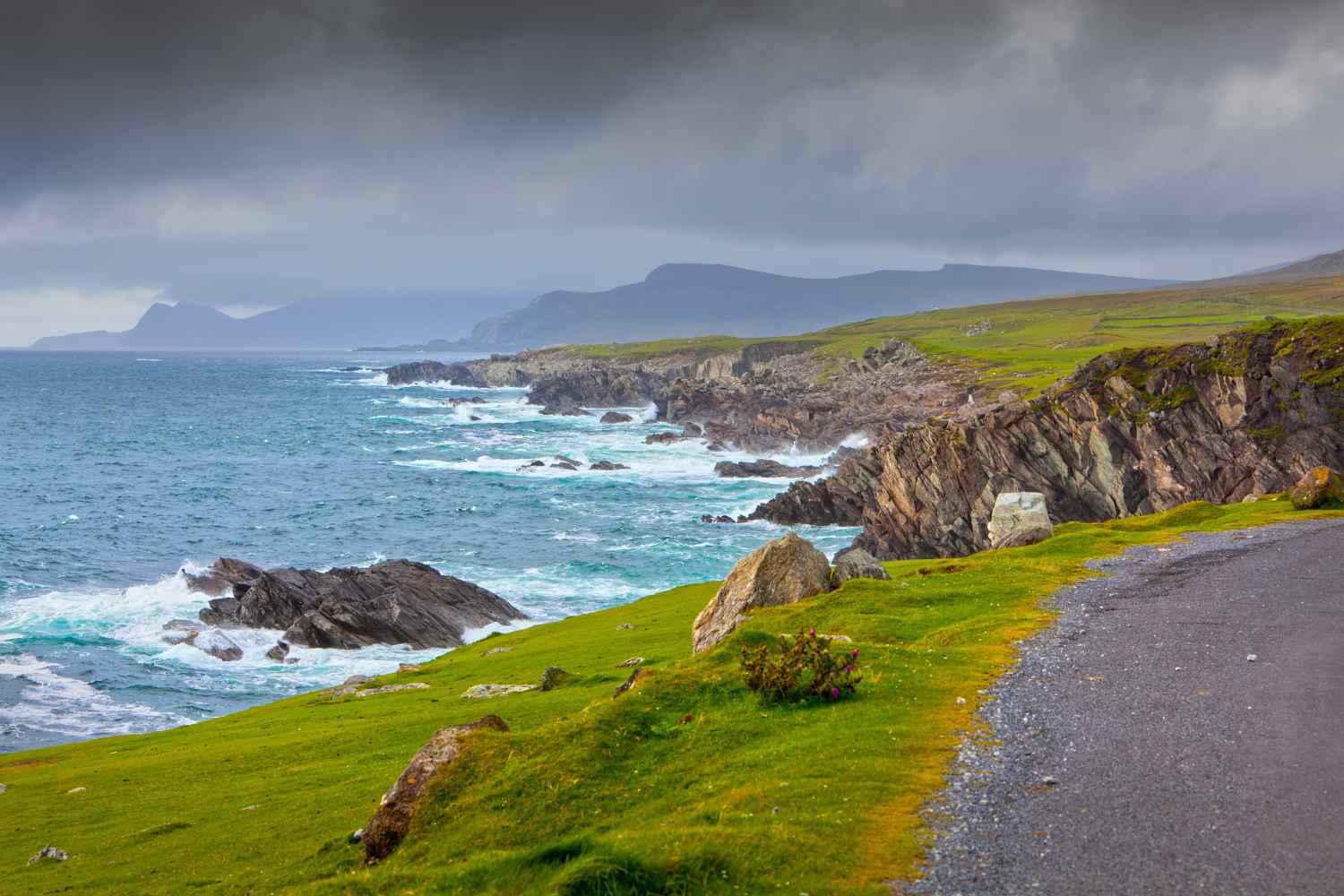
On Achill Island, in County Mayo on the west coast of Ireland, lies a beach that defies all meteorological and geological predictions. Dooagh beach, three hundred meters long and nestled between the cliffs of Keem and Keel, literally disappears during the winter months when Atlantic storms carry away tons of sand, leaving only rocks and pools of water, only to miraculously reappear in spring when sea currents bring the sand back to the coast in a process that can last as little as eight or ten days.
The story of the disappearing beach
The phenomenon has been documented since the end of the 19th century, when the inhabitants of Dooagh saw their beach disappear completely for the first time. The loss was a hard blow for the local community who used the seaweed accumulated on the shoreline as a natural fertilizer for agricultural fields. Furthermore, an embryonic tourist industry already existed at the time with hotels such as the Atlantic Hotel and Corrymore House welcoming visitors attracted by the wild beauty of the Irish coast.
The return of 1927 and the horn warning system
In 1927, after more than thirty years of absence, the sand suddenly returned. The event was greeted with such enthusiasm that the community built a pier and organized a community warning system: a resident named Patrick Callaghan was officially instructed to sound a trumpet whenever large quantities of seaweed covered the beach, so that the inhabitants could rush to collect it before the tides washed it away. That trumpet is still kept by his descendant Emmet Callaghan, a testament to how central the beach was to the economy and life of the village.
The disappearance of 1984 and thirty-three years without a beach
In 1984, a series of violent winter storms wiped out every grain of sand. For the next thirty-three years, Dooagh Bay remained a landscape of smooth rocks and pools of water. The hotels closed one after another, and for an entire generation of inhabitants the beach became just a memory passed down through photographs and stories of the elderly. Anyone under the age of forty had never seen that expanse of golden sand that their parents and grandparents talked about.
The miracle of 2017: sand returns at Easter
In April 2017, during the Easter period, something extraordinary happened. Unusually strong northerly winds blew across Ireland’s west coast in conjunction with particularly pronounced spring tides. Within a few days, hundreds of thousands of tons of sand were pushed back towards the shore, completely recreating the beach. The residents of Dooagh awoke to see a golden expanse that had not existed since 1984.
The news goes around the world
The reappearance of the beach became international news. Television crews from the United States, Great Britain, France, Germany and the Netherlands arrived on the island to document the phenomenon. Within a few weeks, the story had been read or seen on television by over a billion people around the world. The island of Achill, which has just two thousand five hundred inhabitants, suddenly found itself at the center of global media attention.
An unexpected economic boom
The impact on tourism was immediate and significant. In the months following the reappearance of the beach, the tourist flow on the island recorded an increase of between 70% and 79%. Seventy-nine jobs were created, both full and part time, an exceptional result for a local economy that had always depended mainly on nature tourism but which now possessed a unique attraction in the world.
The sand had not magically reappeared out of nowhere but simply lay offshore, in the depths of the bay, ready to be swept away again by winter storms.
The cycle repeats itself: the storms of 2018
The predictions turned out to be correct. In late 2018 and early 2019, a series of particularly severe winter storms began to gradually erode sand levels. Within a few weeks, the situation returned to its pre-2017 state. The waves hurled even larger boulders onto the coast, testifying to the power of the Atlantic when it unleashes itself against the Irish coast.
Scientific hypotheses
Scientists who have studied the phenomenon believe it is caused by an extremely rare combination of meteorological and oceanographic factors. Particularly strong and constant northerly winds blowing across a south-facing bay could push back surface water, allowing deep currents to push sandy sediments accumulated on the sea floor back up. This mechanism requires a perfect alignment of atmospheric and maritime variables that occurs with such low frequency that it makes it practically impossible to predict when the beach will reappear again.
A lesson on nature and time
The case of Dooagh beach demonstrates that nature operates according to times and logics that do not follow human desires. There are forces capable of radically shaping and reshaping the landscape in ways beyond human control. The beauty of this phenomenon lies precisely in its unpredictability, in nature’s ability to subtract and return when least expected.
A community that lives with uncertainty
The people of Achill have learned to live with this uncertainty. Their beach may or may not exist at different times, and this temporary nature makes it even more precious when it decides to manifest itself. Not everything that is beautiful must necessarily be permanent, and perhaps it is transience that gives things their deepest value.
The wait continues
Today the sand once again lies hidden in the depths of Dooagh Bay. The islanders continue their daily lives knowing that, sooner or later, perhaps in a few years or perhaps in a few decades, the winds and tides will align again in the right way. One morning they will wake up to find that their beach has returned once again, ready to amaze a new generation of visitors and prove that nature remains the most powerful and unpredictable force known to humanity.
