
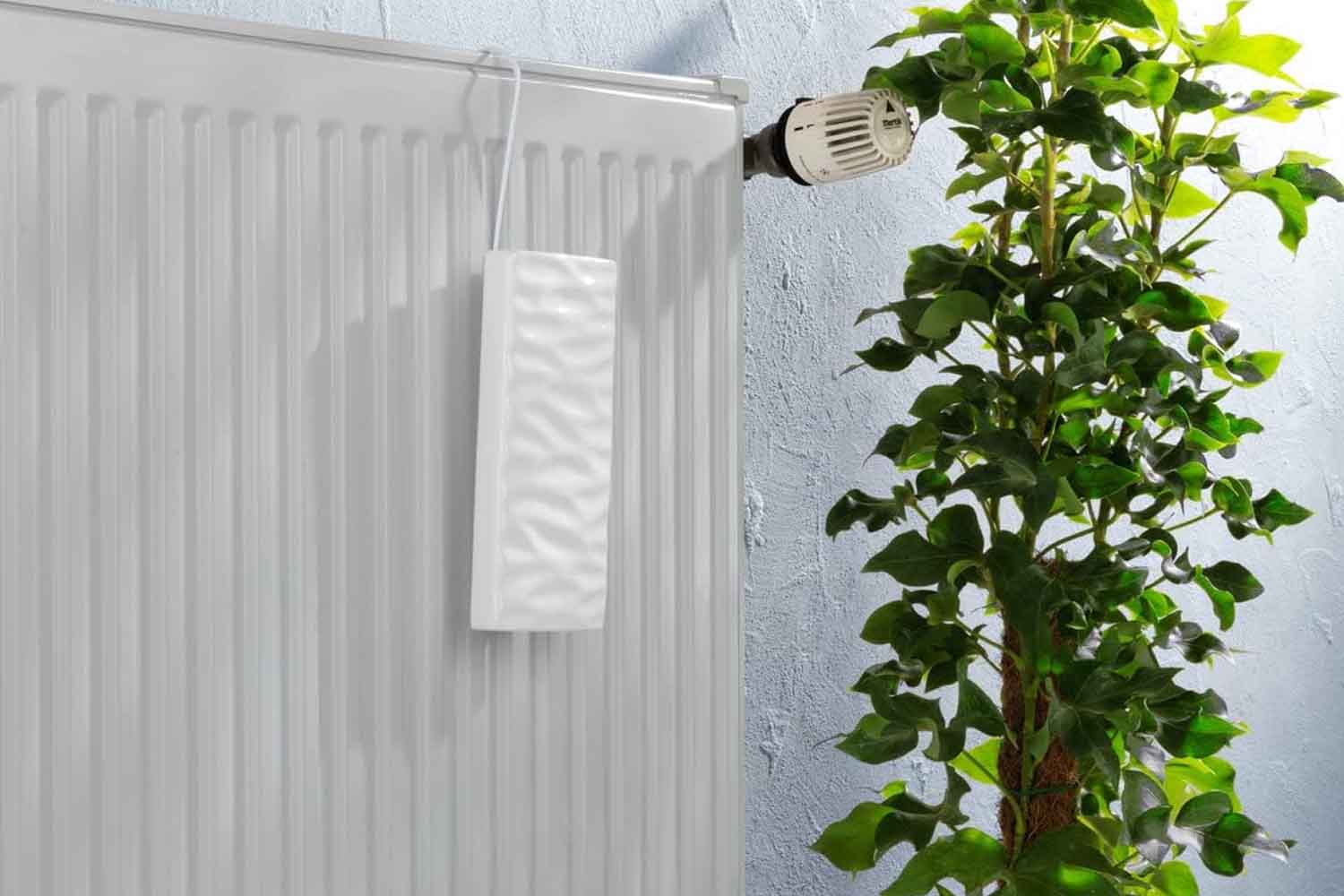
Every winter we experience the same scene: radiators on, windows closed, temperatures rising. Yet, instead of feeling warmer, we feel a subtle cold, that strange chill that does not coincide with the degrees marked on the thermostat. Together come eyes that sting, throat that tightens, skin that “tightens” even more.
The explanation is neither romantic nor mysterious: when the air becomes too dry, the body interprets the environment as colder than it really is. It is a phenomenon documented in dozens of scientific studies, including one of the most complete, that of the Danish researcher Peder Wolkoff, dedicated precisely to the relationship between humidity, air quality and health.
The bottom line is surprisingly simple: a little extra humidity changes everything. And ceramic humidifiers, so essential that they almost seem like objects from another era, instead reveal themselves to be one of the most intuitive tools for bringing air back to a more human level.
Because dry air makes you feel colder
Wolkoff reminds us of a fundamental point: there is no “humidity sensor” in our body. That sensation of scratching air, of penetrating cold despite the high temperatures, arises from a series of very concrete physical reactions. When the air is too dry, the surface of the eyes and mucous membranes lose water more quickly. It is a process that suddenly accelerates because warming, by pushing the air to become warmer, also makes it hungrier for humidity. The result is a sort of continuous, invisible evaporation.
The eyes are the first to suffer. In the absence of a minimum level of humidity, the tear film thins, breaks, leaving areas of the cornea exposed that are more sensitive to irritants. It doesn’t take long to notice it: an hour in an environment with 20% humidity is enough for a healthy subject to start having the same parameters as a patient with dry eye.
The respiratory tract reacts similarly. The nasal mucosa undergoes a small physiological collapse: it loses water while trying to humidify the air we inhale and becomes hypersaline, irritable, less protective. This condition slows mucociliary transport, our main barrier against viruses and particles. It is precisely here that the perception of cold is amplified: when the mucosa dehydrates, the evaporative effect produces a cooling which the brain interprets as a real drop in temperature.
Ceramic humidifiers, in this context, work silently. The ceramic heated by the radiator slowly releases a constant quantity of steam. It does not alter the environment, it does not create fog or condensation, but it mends the tear that heating produces. It is a precise, almost physiological compensation.
Wolkoff shows that even a minimal difference, for example going from 30% to 40% relative humidity, is enough to reduce irritation, visual fatigue and that indefinite sensation of “hard air”. And above all, it allows the body to better perceive the heat present.
A side effect you don’t imagine: fewer viruses suspended in the air
Wolkoff’s work dedicates a substantial part to the study of viruses in closed environments. This is where humidity reveals another, often ignored role: at low humidity, many respiratory viruses stay alive longer and travel better. It happens because the droplets expelled when we cough or speak immediately dehydrate and become tiny fragments capable of remaining suspended for hours.
Studies show that when humidity exceeds 40%, their infectious capacity drops dramatically. It is not a magical effect, but a physical one: the water present in the air makes the particles heavier and less stable. It is a scenario in which ceramic humidifiers do not solve the problem, but offer a valuable contribution, especially in bedrooms or winter living rooms.
More balanced air translates into less tiring breathing at night. The airways do not have to remove water from the body to humidify the passing air, and this reduces the sensation of dryness upon waking. Those who use their voice a lot, such as teachers and singers, know this effect well: the dehydrated oral cavity loses elasticity and increases fatigue. It would be enough to prevent the humidity from falling below a critical threshold to reduce the discomfort.
Ceramic humidifiers only give back to the air what heating takes away from it. Without consuming energy, without motors or filters. It is a discreet gesture, but one that perfectly follows the logic explained by scientific studies: there is no need to saturate the environment, it is necessary to prevent it from collapsing below the level that causes difficulty for the eyes, mucous membranes and perception of heat.
Wenko Humidifier with Ceramic Wave Pattern – Room humidifier with wave structure, suitable for tubular radiator, Ceramic, 9 x 19.5 x 4 cm, White
€6.99

Buy on Amazon
You might also be interested in:
