
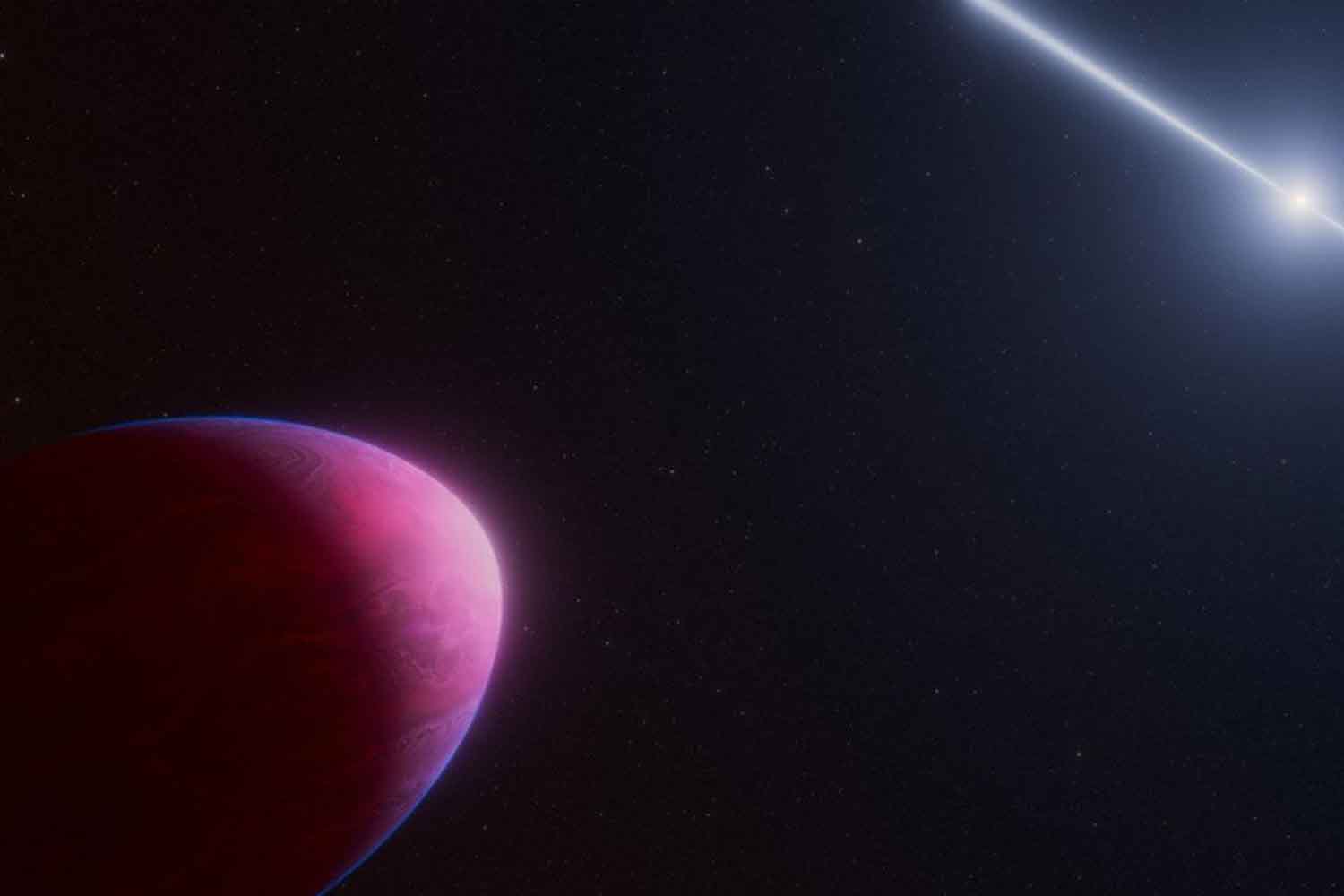
In the heart of our galaxy there is a world that seems to have come out of a science fiction story, but instead has ended up under the eyes of scientists thanks to the James Webb Space Telescope. Is called PSR J2322-2650b and it is an exoplanet that is causing discussion in the scientific community for a series of truly extraordinary characteristics: an elongated shape, similar to a lemon, an atmosphere almost devoid of oxygen and nitrogen and a chemical composition that could favor the formation of diamonds.
It’s not yet another “curious” discovery good only for an impressive title. This planet, observed with instruments capable of analyzing the light coming from very distant worlds, undermines many certainties about how celestial bodies form and evolve.
A planet deformed by extreme forces
PSR J2322-2650b does not orbit just any star. Its “sun” is a pulsar, a neutron star that rotates very rapidly and releases enormous gravitational energy. The planet circles it at an impressive distance, just one and a half million kilometers, completing an orbit in less than eight hours. Such extreme proximity subjects it to very violent tidal forces, capable of deforming and stretching it, to the point of causing it to lose its classic spherical shape.
The result is a stretched celestial body, with an irregular profile that has led many researchers to describe it, effectively, as “lemon-shaped”. A simple image, but one that gives a good idea of how far this planet is from everything we are used to imagining when we think of an extrasolar world.
An atmosphere never seen before
The James Webb observations revealed another surprising element: the atmosphere of PSR J2322-2650b is dominated by carbon and helium, while elements such as oxygen and nitrogen, fundamental to the Earth’s atmosphere, are almost completely missing. It is a very rare chemical composition, which opens up completely new scenarios.
Under extreme pressure and temperature conditions, such as those found on this planet, carbon can take on unusual shapes. Scientists hypothesize that, in the deeper layers of the atmosphere, graphite clouds may form and that the carbon, condensing, gives rise to real precipitations of diamonds. Not sparkling rain like in the movies, but real physical processes that show how capable the Universe is of creating environments radically different from ours.
Because this discovery changes the way we look at the planets
PSR J2322-2650b is important not only for its oddities, but for the questions it raises. How can a planet so close to a pulsar survive? Where does such a carbon-rich atmosphere come from? Is it the remnant of a larger planet, literally “flayed” by the star’s radiation, or the result of a formation process that is still poorly understood?
Each new observation seems to add a piece to a puzzle that, for now, remains incomplete. And that’s exactly the point: discoveries like this are a reminder that our Solar System is just one of the infinite possibilities offered by the galaxy. There are worlds that don’t resemble anything we know, and studying them means broadening our gaze, questioning models and accepting that nature, even on a cosmic scale, is much more creative than we imagine.
While we continue to search for “habitable” planets similar to Earth, the James Webb also shows us the other side of the Universe: that of extreme, inhospitable and fascinating worlds, which will never be able to welcome us but which still have a lot to teach us.
