
2025 was also marked by the effects of the climate crisis. We know, we’ve been writing about it for months and we’ll continue to do so. But there is another side of the coin that deserves space: the stories in which something worked. In the laboratories, on the coasts, inside the solar panel factories, someone has obtained measurable results. We want to remember them because they demonstrate that action, guided by science and supported by perseverance, produces concrete effects.
1 – Overtaking renewables
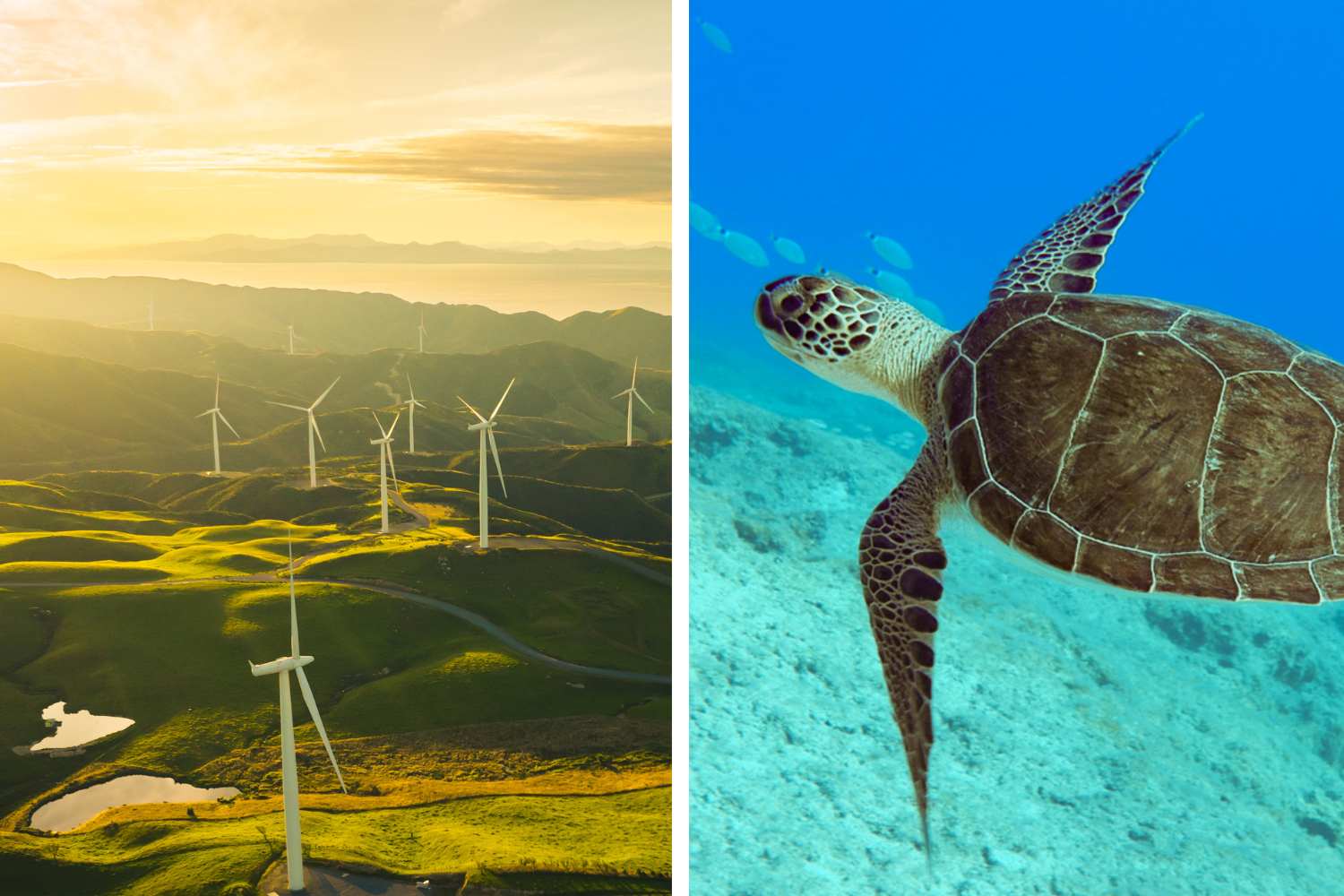
For the first time in the history of industrial humanity, renewables have displaced coal from the throne of global electricity generation. A clear, irreversible overtaking, which marks the end of an era.
China made the difference. In May it surpassed 1 terawatt of installed solar capacity. In the first six months of 2025, Beijing added 256 gigawatts of new solar plants: double the rest of the planet combined. Projections speak of 4,600 GW of new renewable capacity between 2025 and 2030, double the previous five-year period.
2 – A turtle outside the red zone
Chelonia mydas has left the red zone. The green sea turtle, after decades spent in the “endangered” category of the IUCN Red List, has risen to “least concern”. The global population has grown by 28% since the 1970s. The numbers come from Ascension Island, Brazil, Mexico, Hawaii. In some areas, populations are recovering to levels close to those before commercial exploitation thanks to the protection of nesting sites and the reduction of accidental capture in nets. The IUCN Marine Turtle Specialist Group called it an “astonishing” result.
3 – The ocean gets its treaty
In September, more than 60 countries ratified the UN Treaty on the High Seas. It will come into force in January and, for the first time, will regulate the protection of biodiversity in international waters – that 64% of the ocean which until now was no man’s land, or rather, everyone’s sea without anyone taking care of it.
The goal is to protect at least 30% of the planet’s marine and terrestrial areas. Political convergence on this issue, in an era of deep geopolitical fractures, is perhaps the most surprising news.
4 – The ozone hole is healing
The hole in the Antarctic ozone layer has reached its smallest size since 2019. The 1987 Montreal Protocol, which banned chlorofluorocarbons, continues to deliver results four decades later. It is proof that international agreements can work, if they are binding and if they are based on science.
Projections say full recovery will come by the end of the 2060s.
5 – Europe beats (its) expectations
The European Commission has admitted that the Union is “on track” to exceed its 2030 climate targets. Updated assessments of the National Climate and Energy Plans indicate a 54% reduction in emissions by 2030 – close to the binding target of 55%.
Almost half of the EU’s electricity demand in the second and third quarters was met by renewables. The transition is accelerating faster than expected, and Brussels finds itself in the unusual position of having to revise its ambitions upwards. It doesn’t happen often.
6 – Lost species return
The bearded vulture, one of Europe’s rarest birds of prey, has returned to Bulgaria after half a century of absence. It is a crucial piece in reconnecting Europe’s fragmented populations of the species.
In South Africa, researchers have found a gecko that was thought extinct for over thirty years. In Australia, the ampurta – a marsupial that seemed destined to disappear – went from “near extinct” to “least concern”, with its territory expanding by more than 48,000 square kilometers between 2015 and 2021.
They are minor stories only in appearance. Each species that returns is a food network that is reconnected, an ecosystem that recovers complexity.
7 – San Pietro resets the account with the climate
St. Peter’s Basilica is becoming a laboratory of applied ecology. The objective is ambitious: zero impact by 2026, coinciding with an important anniversary of the consecration. It means cutting 43% of energy consumption and over 60% of emissions.
The solutions are geothermal heat pumps, natural night ventilation to cool the naves without air conditioning, new LED systems. The project involves Enea, Polytechnic and University. Cardinal Mauro Gambetti calls it “transformation” towards a home that “welcomes everyone and encourages everyone to grow in humanity”.
8 – A refuge for marine giants
In Nova Scotia, the Whale Sanctuary Project has secured a 20-year lease on 83 hectares of land and water in Port Hilford Bay. It will be the first North American coastal refuge for whales and dolphins from marine zoos.
The bay offers over 40 hectares of water up to 18 meters deep, ideal for hosting up to ten cetaceans accustomed to captivity. A $15 million fundraising effort is still needed for infrastructure, but the regulatory hurdle has been overcome.
It is a paradigm shift: no longer impossible rehabilitation in the open sea, but a possible form of freedom for animals who can no longer go back. And a training center to understand what respect towards non-human intelligences really means.
9 – Full sun
Solar energy has become the cheapest source in the world. The University of Surrey has certified what the market already knew: photovoltaic costs less than wind, coal and gas. The transition is made (also) because it is convenient. In Europe, in the second and third quarters of 2025, half of the electricity demand came from renewable sources. This is the new normal, which is built kilowatt hour after kilowatt hour.
10 – Surgery on the seabed of Punta Campanella
In Punta Campanella, the “MedCoral Guardians” project of the Marevivo Foundation, in collaboration with the University of Naples, is attempting something new: the surgical restoration of the Cladocora caespitosathe cushion madrepora of the Mediterranean.
Twelve systems, 156 coral fragments positioned one by one on the seabed. Raffaella Giugni of Marevivo reminds us that corals occupy 1% of the seabed but are home to 25% of marine fauna. The project also includes the restoration of brown algae forests Cystoseira and educational workshops for over 700 students.
Here are other stories of courage and hope that marked 2025:
View this post on Instagram
