
Producing renewable energy is a fundamental step, but rethinking the fate of recycled wind turbine blades at the end of their life represents an equally crucial challenge. It is from this awareness that a project is born capable of combining sustainability, architecture and urban vision, demonstrating how even complex industrial waste can become a concrete and visible resource in our cities.
Behind this intuition is the Swedish architect Jonas Lloyd, founder of the Lloyd’s Arkitektkontor studio, who has chosen to address one of the unresolved issues of the energy transition: what happens to the blades of wind turbines when they no longer produce energy?
The answer, in this case, does not pass through the landfill but through urban architecture.
How recycled wind turbines become an urban architectural facade
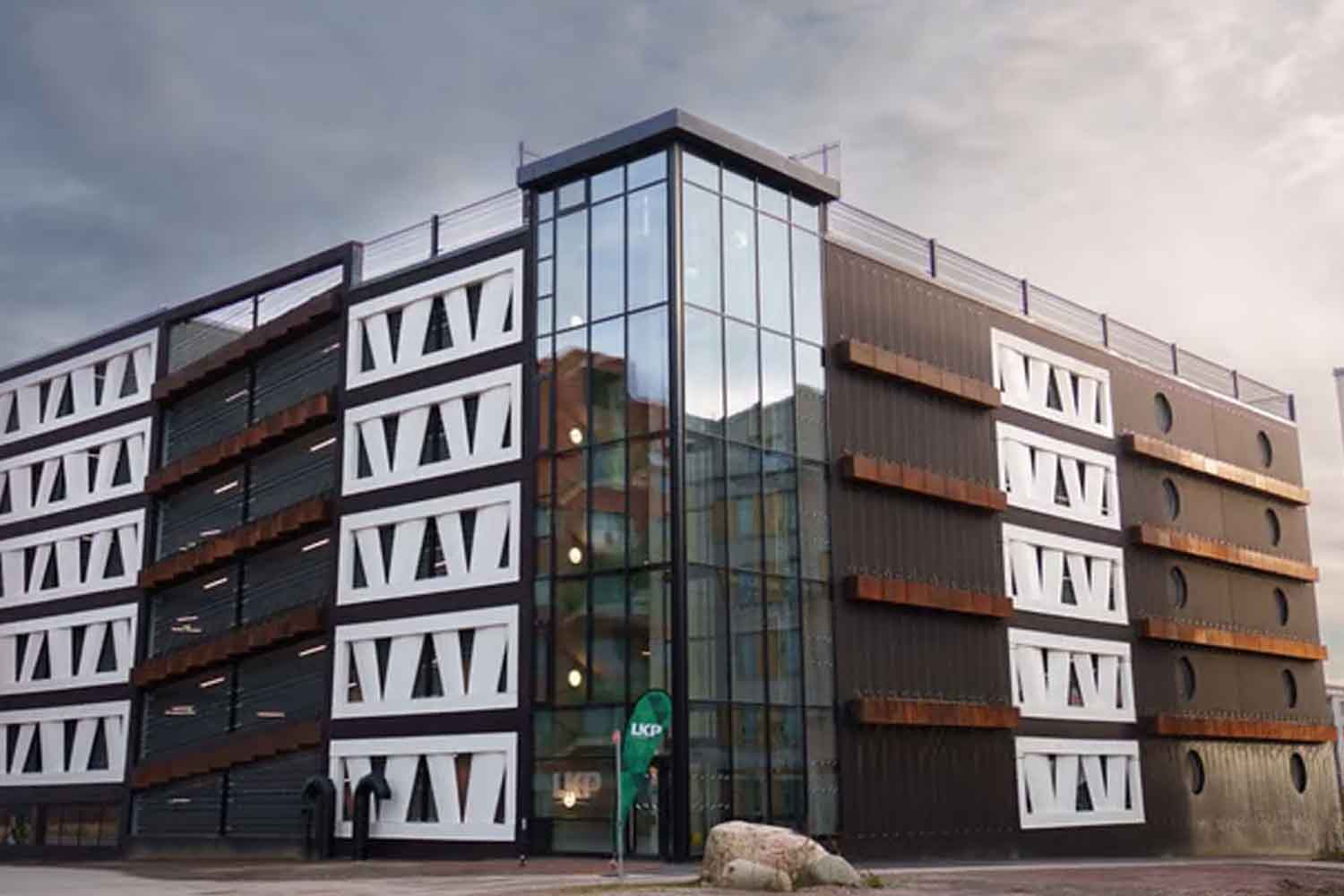
In Lund, Sweden, a recently opened multi-storey car park has transformed an environmental problem into a recognizable architectural landmark. The building, known as the Niels Bohr car park, uses 57 disused wind turbines, originally intended for disposal, to clad the entire external façade.
The blades, appropriately cut and adapted, do not perform a load-bearing structural function, but create a strong and identifying visual envelope. The result is a surprising architectural skin, capable of attracting attention and at the same time telling a story of applied circular economy. A design gesture that demonstrates how materials designed to resist wind, rain and temperature changes for decades can continue to live even outside their original context.
The problem of recycling wind turbine blades
Wind turbine blades are made of extremely resistant composite materials, such as glass fibers and resins, which make traditional recycling complex and expensive. It is a topic often overlooked in the debate on renewables, but also well documented by sector analyzes such as those by Polytechnique Insights.
The idea of reusing them directly, without destroying them or reducing them to raw material, radically changes the approach. Instead of chasing technical solutions that are difficult to scale, this project demonstrates that innovation can also arise from a change of perspective. The blades become architectural surfaces, narrative elements, visible symbols of the ecological transition, capable of communicating with those who live the city on a daily basis.
The collaboration with Vattenfall does not stop at the facades. The energy company is also experimenting with the reuse of wind turbine nacelles, the technical heart of the turbine, transforming them into tiny houses of around 20 square metres.
These micro-dwellings, fully equipped with kitchen, bathroom, advanced thermal insulation and solar panels, represent a concrete and habitable declination of the circular economy. These are not simple design exercises, but functional, autonomous and surprisingly welcoming spaces, which demonstrate how a turbine can continue to be useful even after it has produced its last kilowatt hour.
When wind turbines become benches and playgrounds
The second life of wind turbines also passes through public space. In Belgium, the startup Blade Made transforms disused turbine blades into benches, slides, playgrounds and street furniture, giving new use to a material that is difficult to dispose of. The curved surfaces, created to capture the wind, prove perfect for everyday use: resistant, durable and visually recognisable.
The idea inspired other European countries. In the Netherlands some shovels have become pedestrian bridges, while in Denmark they find a new function as bicycle shelters. It is concrete demonstration that the circular economy does not end with the shutdown of a turbine, but can continue in the form of objects that are lived in, useful and integrated into the life of cities.
Projects like these don’t just reduce the amount of industrial waste sent for disposal. They change the narrative of sustainability, making it tangible, visible and everyday. A car park, an ordinary building, becomes a silent manifesto of ecological transition, capable of making people reflect without the need for slogans.
Architecture, in this context, stops being just function or form and becomes a cultural tool, capable of improving the social acceptance of renewable energy and demonstrating that the sustainable future can also be beautiful, intelligent and perfectly integrated into the urban fabric.
You might also be interested in:
