
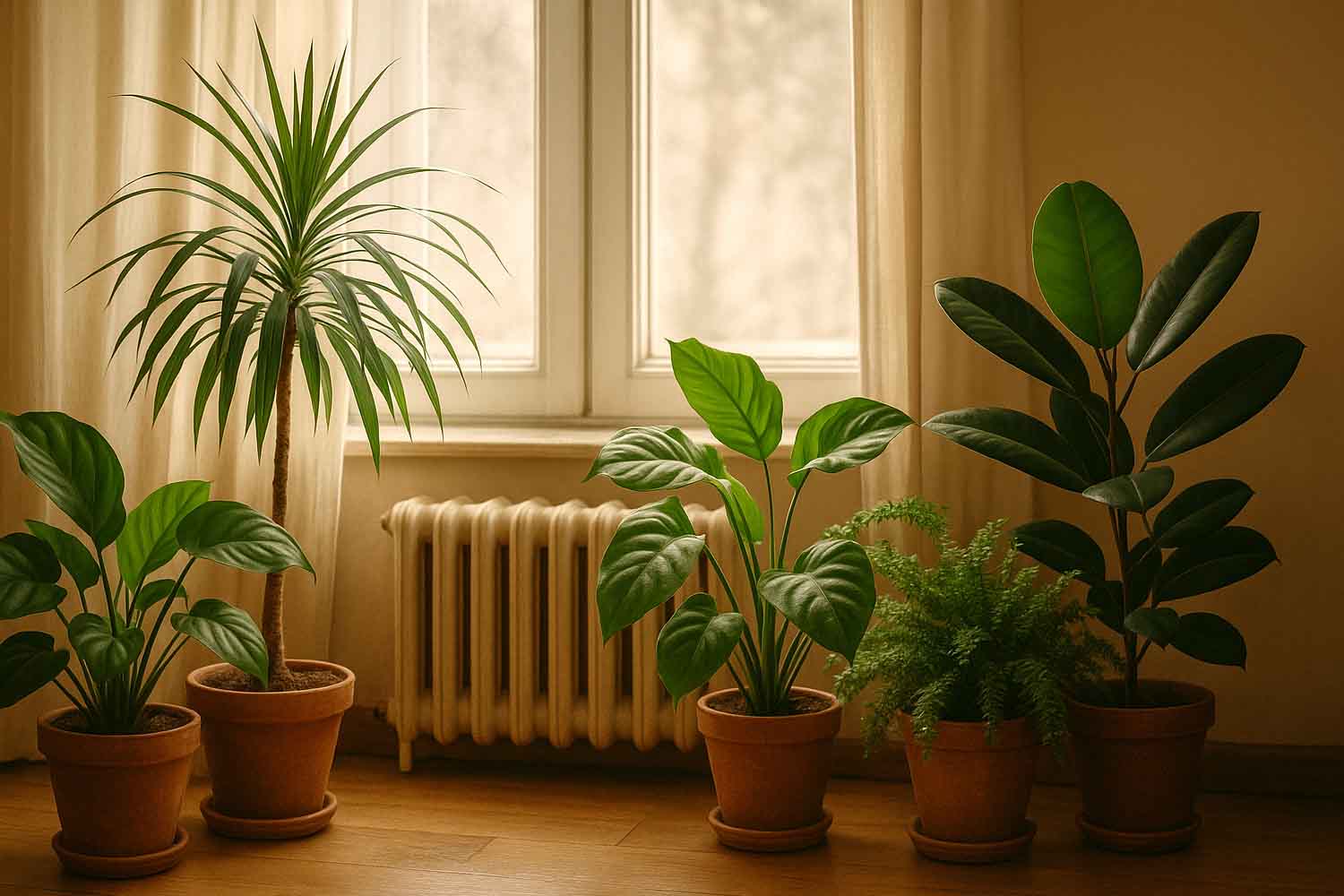
When the heating turns on, the air in the home immediately changes consistency. It becomes drier, lighter, often irritating to the skin and respiratory tract. It is a typical side effect of winter, which creates subtle but constant discomfort. In this scenario, indoor plants reveal a surprisingly useful function, because they introduce a small amount of humidity into the environment thanks to their natural way of living.
As they breathe and grow, many species release water vapor through their leaves. It’s a process you can’t see, but it’s enough to make the air less dry. Studies dealing with evapotranspiration clearly show this: even a slight increase in relative humidity can reduce throat irritation, dry skin and that “dry house” feeling that accompanies the colder months. Some research indicates that a single plant can emit between 35 grams in winter and over 50 in summer, a small but constant amount.
This change does not transform the internal climate, because neither the temperature nor the CO₂ concentration really changes. But it changes the way we experience space. The air appears less aggressive, breathing more natural, the environment more welcoming. And this physical contribution is accompanied by an equally important psychological effect: numerous studies show that the presence of greenery reduces stress, lowers emotional pressure and makes rooms calmer to live in. A few plants are enough to change the atmosphere of a place.
Species that do best in heated environments
Not all plants behave the same way. Those with large leaves or a high transpiration rate are more effective in mitigating winter dryness. Among the most suitable varieties stand out the Dracaena, the Pothos and various ferns, in particular the Boston Fern, which maintains regular evapotranspiration even in limited light conditions.
Experiments conducted in naturally ventilated offices show that these plants, when placed with a certain density, contribute to a more balanced humidity throughout the day. They do not replace a heating system or a humidifier, but add natural support that makes environments more tolerable.
What those who live in a house with plants really perceive during the winter
Those who live in heated rooms populated by plants notice small daily improvements: less irritated skin, freer breathing, a general feeling of greater liveability. The psychological discomfort linked to the closed months also tends to reduce, because the presence of greenery offers a form of calm that contrasts the dryness of heated environments.
In research conducted in work spaces, this effect is even more evident. People judge the environment to be healthier, more pleasant to be in and, in some cases, more “fresh”, even when the real parameters do not change. It’s a perception that can even influence the way you regulate the air conditioning, allowing you to better tolerate slight variations in internal temperature.
In short, indoor greenery is not a miracle remedy, but a daily ally. It doesn’t upset the environment, but makes it more hospitable. Especially in winter, when the heating dries out everything it finds.
Sometimes a plant next to the window is enough to change the quality of our breathing.
You might also be interested in:
