
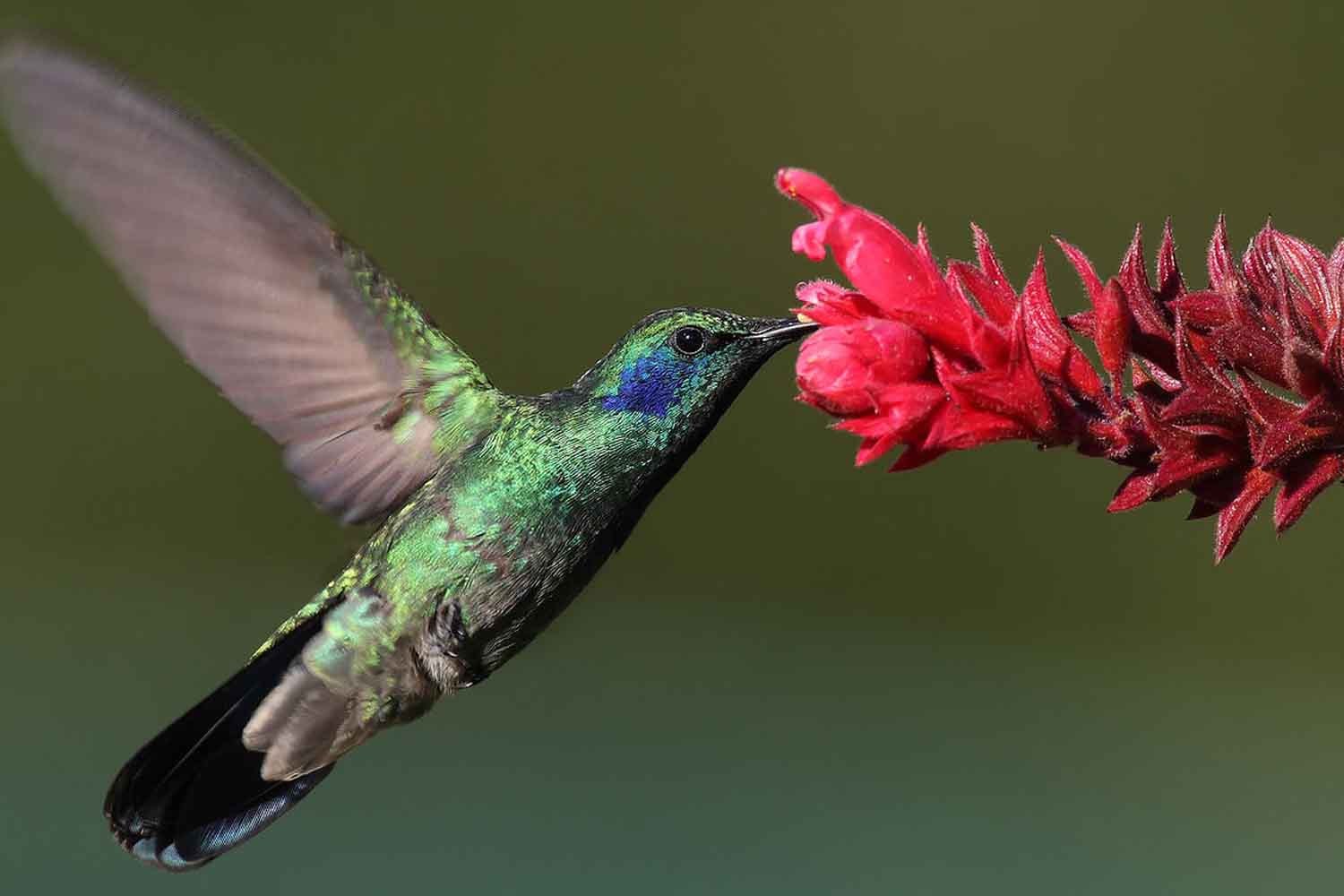
There is a scene that many know well: a feeder hanging from the balcony, a sugary liquid that shines in the sun and a hummingbird that arrives like an arrow, stops for a few moments and then disappears. A simple, almost affectionate gesture, which involves millions of people in the United States every year. Yet this very daily habit is contributing to something much bigger: the human-influenced evolution of hummingbirds, here and now.
The question is as banal as it is powerful: what happens when wild animals find a constant, easy and always available source of food? Do they simply continue their usual lives or, over time, does that comfort begin to leave a deeper mark?
A group of researchers from the University of California, Berkeley decided to get to the bottom of this question, choosing a species that symbolizes coexistence with man: the Anna’s hummingbird, scientific name Calypte anna. A hummingbird that, instead of disappearing under the pressure of urbanization, seems to have found a way to thrive right alongside us.
A hummingbird that grows where cities grow
Anyone who has visited the west coast of North America has almost certainly seen it. Small, very fast, with green and bronze reflections, Anna’s hummingbird is now a regular presence in gardens, parks and residential neighborhoods. While many species struggle to survive the loss of habitat, this hummingbird has done the opposite: it has expanded its range and increased the number of individuals.
According to researchers, this is no coincidence. This bird moves where humans move, exploits the resources we create, and adapts with surprising speed. A behavior that makes it similar to other “commensal” species, capable of living in close contact with us without being domesticated.
The beak, a matter of life and death
For a hummingbird, energy is everything. His metabolism runs at very high rates and every mistake can be costly. For this reason the beak is not just an aesthetic feature, but a fundamental tool that decides how effectively the animal is able to feed itself and compete with others.
Over the past hundred years, Anna’s hummingbird has faced two major human-related changes. On the one hand, the spread of non-native ornamental plants, such as eucalyptus, capable of producing nectar even when local species do not flower. On the other, the invention and spread of feeders, which transform courtyards and balconies into real energy stations that are always open.
Added to all this is another element: the expansion towards colder areas, where survival requires a delicate balance between nourishment and heat dispersion.
Diet, cold and small daily compromises
The hummingbird doesn’t live only on sugar. Insects and spiders provide much-needed protein, while on colder nights these birds can enter a state of torpor, lowering their metabolism to conserve energy. But having an easy food source during the day can make a huge difference, especially in winter, when flowers are scarce.
And it is precisely in this context that feeders become something more than a simple aid: they become a constant pressure on the evolution of the species.
To understand what was really happening, researchers pieced together clues from different worlds. They measured hundreds of specimens preserved in museums, collected from the end of the 19th century to the early 2000s, analyzing the shape of the beak in detail and not just in length.
They then reconstructed the spread of feeders and ornamental plants through old newspapers, advertisements and articles that told how these novelties spread in the communities. Finally, they compared everything with data from large ornithological censuses, such as the Audubon Christmas Bird Count, which has been monitoring the presence of birds in the area for decades.
Shape-changing feeders and beaks
When all this data is put together, the picture becomes clear. Where feeders and eucalyptus increase, hummingbirds also increase. But not only that. The beak of Anna’s hummingbird has really changed over time. It has become longer, more tapered, with a slimmer shape at the top. Not a random growth, but a precise transformation, consistent with a new way of eating.
Males, in particular, show a more pronounced upper tip, a characteristic that could help in battles around feeders, where competition is intense and often aggressive.
Contrary to popular belief, hummingbirds do not drink “through” their beaks. They use a special tongue that moves back and forth at an impressive speed. In natural flowers this means small sips from many different corollas. At the manger, however, the situation changes: there is only one rich and concentrated source, to be exploited as much as possible before being chased away. In this context, even a small change in beak shape can make the difference between eating more or being driven away.
Cold, latitude and temperature control
The study also shows another interesting detail. In colder areas, beaks tend to be slightly smaller. The reason is simple: the beak disperses heat. Reducing its size helps retain it. Not only nutrition, therefore, but also thermoregulation. A subtle balance, shaped by the environment and, indirectly, by our choices.
Researchers are cautious and speak of convergence of evidence, not absolute certainties. But the message is strong: man can drive rapid evolutionary changes even without wanting to. It doesn’t take millions of years. All it takes is decades, a few generations and a profoundly changed environment.
The study, published on Global Change Biologyreminds us that the human impact on nature does not only come from the destruction of habitats. Sometimes it manifests itself through daily, seemingly harmless gestures, such as filling a manger. Anna’s hummingbird, with its shape-changing beak and its success near our homes, is living proof that evolution is not a distant tale. It’s happening now, often right under our balcony.
You might also be interested in:
