
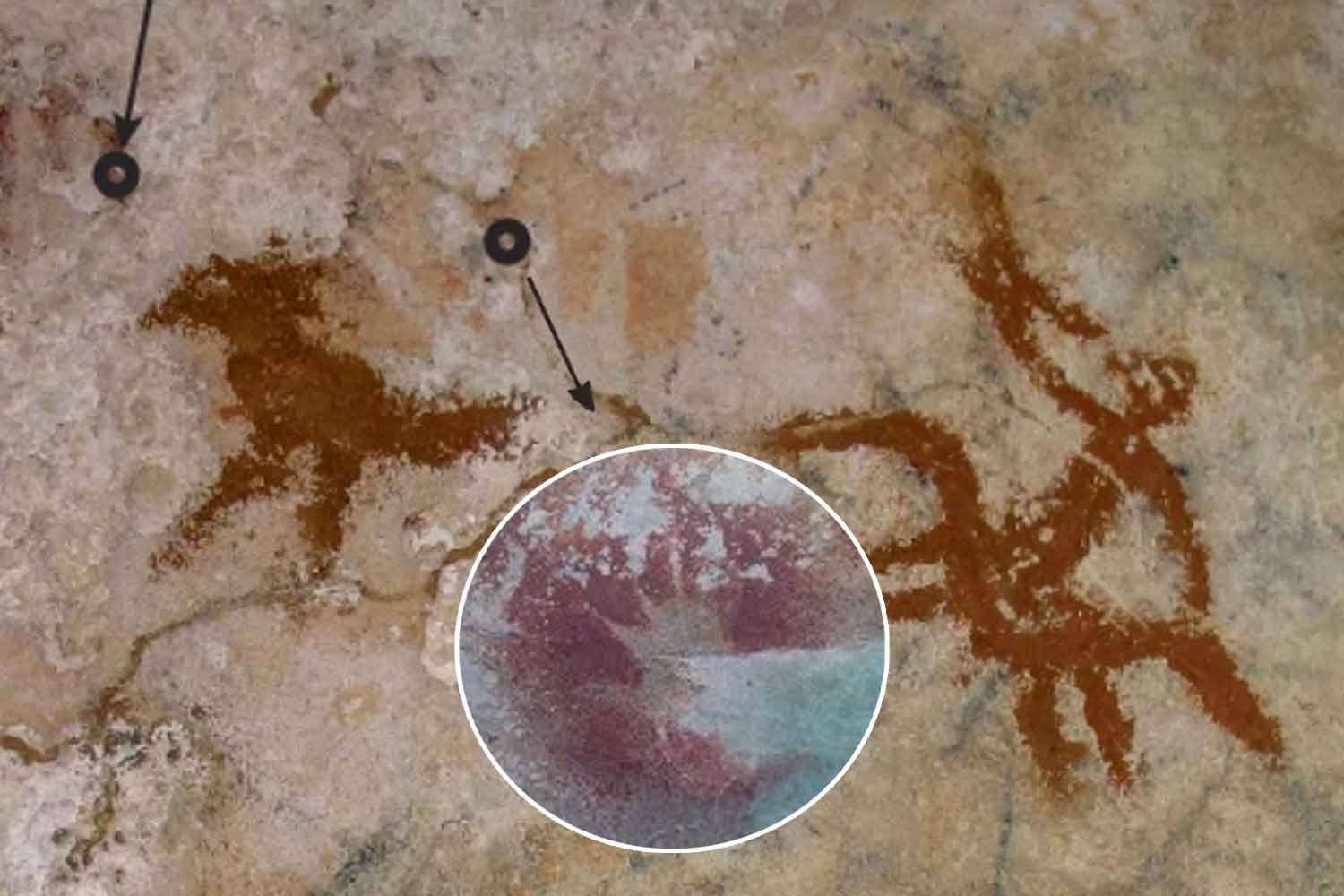
There oldest rock painting ever discovered dates back to 67,800 years ago and was found in a modern-day cave Indonesiaon the island of Sulawesi. It does not depict animals or hunting scenes, but something even more direct and universal: the outline of a human hand. A simple, almost intimate gesture that crosses time and reaches us.
The discovery took place in the Liang Metanduno cave, a place already known to archaeologists for the presence of very ancient artistic evidence. The dating of the pigments was carried out with great precision thanks to an international team led by Maxime Aubertfrom Griffith University in Australia. The results were published in the scientific journal Natureconfirming the exceptional importance of the find.
Not a simple footprint
At a superficial glance it might seem like a normal handprint, but scholars explain that it is one stencilsmade by blowing the pigment around the hand resting on the rock. The peculiarity lies in the fact that the design was subsequently modified, thinning the fingers to create the impression of a claw hand.
This detail opens up fascinating scenarios. According to the researchers, the painting could represent a very ancient idea of connection between humans and animals, a theme already present in other rock works found in Sulawesi. In fact, in some caves on the island, hybrid figures appear, half human and half animal, which suggest a surprisingly complex symbolic imagery for such a remote era.
Sulawesi, a living archive of the world’s oldest prehistoric art
This discovery doesn’t come out of nowhere. Precisely in Sulawesi, in the Leang Tedongnge cave, rock paintings dating back to around 45,000 years ago were identified in 2017, until then considered the oldest ever found. Now that record is surpassed by more than 20,000 years, definitively shifting the center of prehistoric art from Europe to Southeast Asia.
The analyzes conducted on all the paintings of the Liang Metanduno cave show that this place was frequented for artistic activities for a very long period, at least 35,000 yearsuntil about 20,000 years ago. A fact that tells of the presence of a continuous, deep-rooted and incredibly long-lived artistic culture.
A discovery that also speaks of migration and climate change
In addition to the cultural value, the oldest rock painting offers precious clues about the movements of the first human populations. During the ice age, when sea levels were much lower than today, Sulawesi would have represented one of the key passages for migrations south and east.
It is likely that the people who made these paintings were part of the populations that, over thousands of years, would have reached Australia crossing the so-called Sahul, the ancient supercontinent that united Australia, Tasmania and New Guinea. In this sense, that hand imprinted in the rock is not just an artistic sign, but a silent trace of humanity’s journey.
