
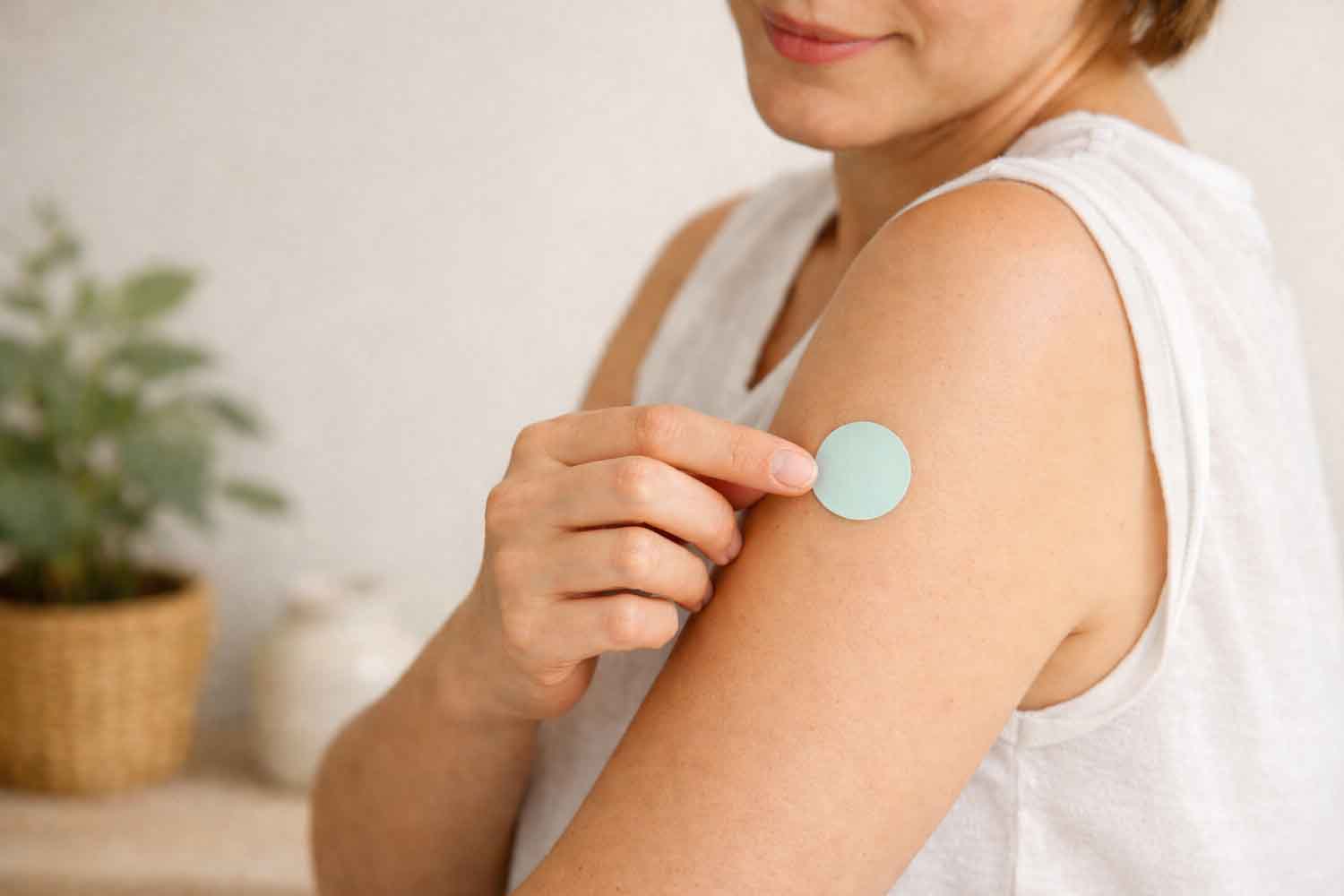
A small patch on the skin is enough and, at least on paper, tiredness, stress, insomnia, pimples and drops in concentration should ease. Health patches have discreetly entered the daily habits of many people, especially online, where they are described as practical and immediate solutions to the inconveniences of modern life. Colorful, visible, often combined with a reassuring aesthetic, they seem to say a very simple thing: you can feel better without effort.
And this is perhaps where their success begins.
“Easy” health and wellness patches: why they fascinate us so much
In the panorama of contemporary wellness, patches occupy a particular space. They are not drugs, they are not real medical devices, but not even simple cosmetics. They are placed in that gray area of ”alternative” well-being that promises a lot without asking almost nothing in return. There’s no need to change your lifestyle, there’s no need to really stop: just apply a sticker and continue.
Their language is direct, reassuring, often emotional. They talk about energy, balance, calm, concentration. Broad concepts, difficult to measure, but immediately recognisable. In a historical period in which we often feel tired, overloaded and little listened to, the idea of silent, discreet and always-at-hand help becomes extremely attractive.
The images circulating online also contribute to strengthening this imagery. When a celebrity is photographed with an “anti-stress” patch on their arm or wrist, the effect is immediate. It also happened recently and the case was analyzed by an in-depth study by Fielding Graduate University, which highlighted a key point: media visibility increases trust in the product, but says nothing about its real effectiveness. The fact that a famous person wears a patch is not scientific proof, but acts on a psychological level, normalizing and making that gesture desirable.
What science says about absorption through the skin
The central promise of health patches is that of transdermal delivery: the substances contained in the patch should pass through the skin and into the body. In medicine this mechanism has existed for a long time, but it only works under very specific conditions. Nicotine patches or hormonal patches are the result of years of research, clinical studies and rigorous regulations. The molecules used are specifically chosen so that they can overcome the skin barrier, which is extremely selective.
In the case of wellness patches, the situation changes. Vitamins, plant extracts, adaptogens and minerals do not have the same chemical characteristics as drugs designed for skin absorption. Various scientific studies, including those also cited by National Geographic, underline how the skin is much more effective in blocking the entry of substances than in letting them pass. This makes it unlikely that many of the claimed ingredients will actually make it into the bloodstream in significant quantities.
Some comparative studies have also shown that vitamin patches do not guarantee the same levels of nutrients obtainable with oral supplementation. The interesting fact, however, is that many people still report a feeling of benefit.
The role of the placebo effect and visible health
This is where an often underestimated aspect comes into play. Feeling better isn’t always tied to a measurable change in the body. The placebo effect is a real, documented response and should not be confused with the idea that “it’s all fake”. If a person feels more calm or focused after applying a patch, that feeling really exists, even if it’s not related to absorption of the claimed ingredient.
Fielding’s analysis explains it clearly: the gesture of taking care of oneself, especially when it is visible and conscious, can influence the emotional state. The patches thus become a sort of physical reminder. They are there, on your skin, to remind you that you are doing something to feel better. In this sense, they function more as psychological tools than physiological solutions.
Then there is another element not to be ignored. These patches are visible. And in the world of social media, what you see matters. Wearing them communicates attention to one’s well-being, investment in oneself, belonging to a certain idea of health. It is a form of performative well-being, which passes through the body but also speaks to others.
Between marketing and real need
The problem is not so much the existence of the patches, but the way in which they are described. When a product is presented as a simple answer to complex problems, the risk is to shift attention away from the real causes. Chronic stress, persistent tiredness, difficulty concentrating often have deep roots, linked to the rhythms of life, work, relationships and sleep.
In this context, health patches intercept an authentic need, but translate it into a quick, individual and paid solution. They’re not necessarily useless, but they’re not the answer they promise to be either. Science, at the moment, calls for caution: there is a lack of independent and solid clinical studies demonstrating its biological effectiveness.
Perhaps the point is not to ask whether or not they work in an absolute sense, but to understand what we are really looking for when we apply them. More energy? More control? A visible sign that we are trying to take care of ourselves in a world that leaves little room for care?
You might also be interested in:
