
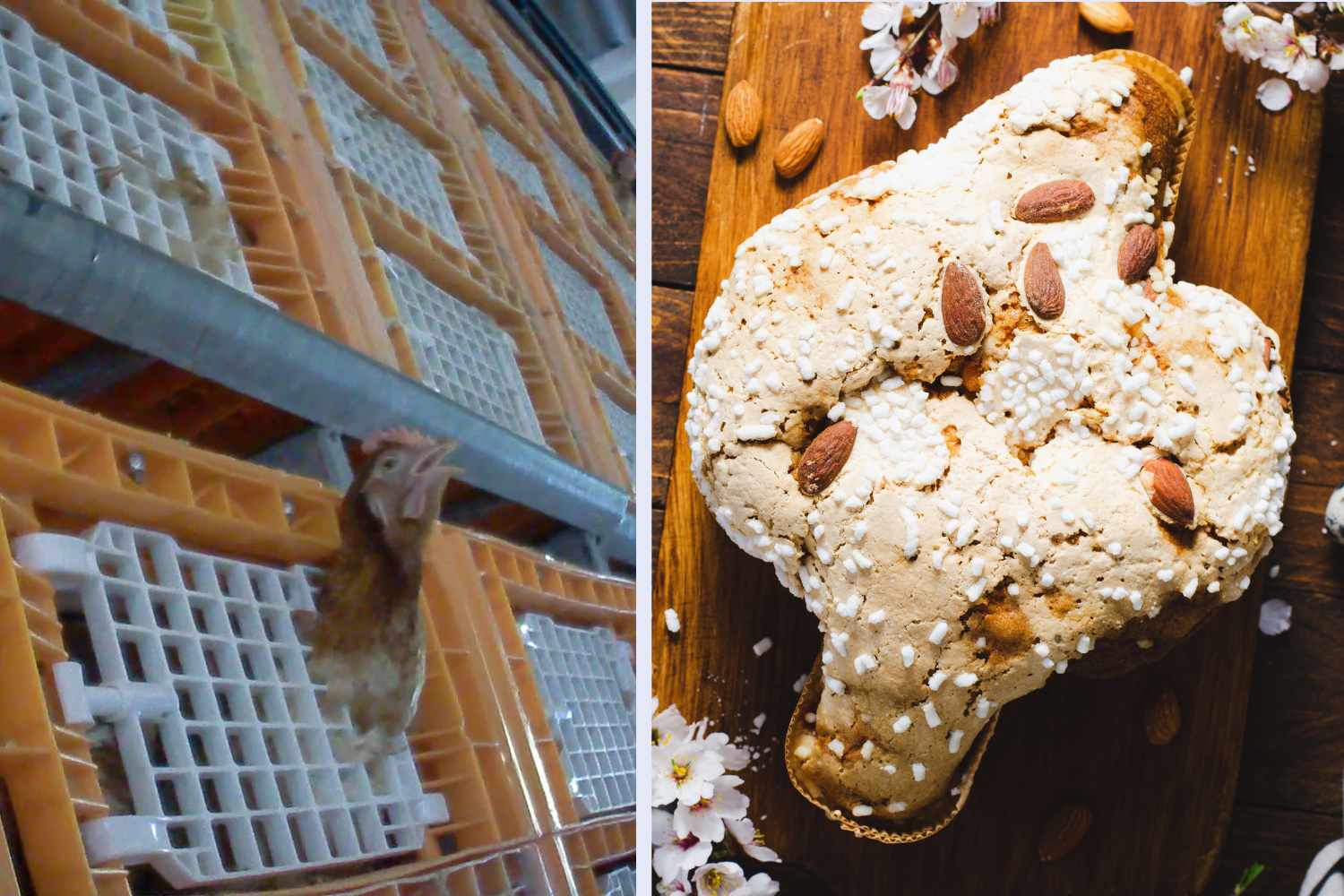
Easter is upon us and, like every year, the supermarket aisles are filled with doves, chocolate eggs and traditional sweets. We buy them almost out of habit, attracted by the packaging, the price or the familiar brand. But behind every Easter dove there is a production chain that is worth knowing and there is a question that few people ask: where do the eggs used to prepare it come from?
The answer is given to È Animali, which has just published a new report in which it analyzes the corporate policies of the main dove producers regarding the use of eggs from caged farms. The result is a two-speed picture: there are those who have already made the right choice, and those who are still late.
Millions of chickens still in cages
In Italy, every year, over 17 million hens spend their entire productive lives confined to cages. Even in the so-called “enriched cages” – the modern and theoretically more humane version – each animal has space barely larger than an A4 sheet of paper. Not enough to scratch around, take dust baths, spread their wings or simply escape constant contact with other animals. Completely natural behaviors for a hen, but impossible in these conditions.
However, Europe is moving: Austria and Luxembourg have already banned enriched cages, Germany has planned a complete elimination by 2026-2029, France has blocked the construction of new caged farms since 2018. Italy, however, is still at a standstill, despite over 90% of Italians saying they are in favor of the ban, according to the latest Eurobarometer on animal welfare.
Virtuous brands
The good news is that the majority of companies analyzed have already made the transition, some for years. Vergani is the most virtuous of all: it achieved the goal already in 2021 and today all the eggs in its confectionery products, including doves, come exclusively from free-range hens.
Along the same lines are Balocco and Galup, who have both formalized public policies and declare that they have already completely eliminated caged eggs from their entire production, including Easter doves. Tre Marie Ricorrenze has also made a public commitment in this sense, extended to the entire Galbusera Group of which it is part, and today all its products respect this standard.
Paluani also undertakes to use eggs from free-range hens, albeit with some gray areas: the ingredient lists available online do not report this specification, making it difficult for the consumer to verify the actual application of the declared policy.
Finally, waiting for confirmation is Maina, who has published a formal commitment to eliminate eggs from caged hens by this Easter 2026 — an imminent goal. Currently 75% of the eggs used in its branded production already come from free-range hens, and the company has also made the additional commitment to eliminate combined farming systems from its supply.
Brands that still use cage-free eggs
The sore points concern Bauli and Melegatti, the only two companies on the panel to have not yet made a public commitment for the entire range of branded products. Both claim to use free-range eggs for their croissants, but this is a practice not formalized in a real company policy and therefore potentially subject to future changes without any obligation of transparency towards consumers.
The Bauli case is the one that weighs the most: the group alone holds about a third of the market shares of Easter doves in Italy, yet it has not yet made any public commitment to eliminate cage eggs from its entire production. A choice that, if made, would have an immediate and large-scale impact.
Companies like Bauli can make a big difference – declared Simone Montuschi, president ofessere animali – It would not just be about improving breeding conditions, but about meeting the demands of consumers who want to see a cage-free transition in Italy too.
In Melegatti, however, which is part of the multinational Valeo Foods group, not only does it lack a corporate brand policy, but the group it belongs to has not adopted any policy that excludes the use of eggs from caged hens for its brands. A double void that makes Melegatti’s position the most distant from the standards that the sector is trying to set itself.
HERE you can read the complete report.
What can we do
In addition to purchasing choices – favoring brands that have already adopted cage-free policies – there is also a way to push on the legislative front. essereanimali has launched a popular initiative bill to ban cage breeding in Italy for all species, filed at the Supreme Court of Cassation on 12 March together with The Good Lobby and civil society personalities such as the Olympic athlete Riccardo Bugari and the cartoonist Zuzu.
The goal is to collect at least 50,000 signatures by September to formally bring the issue to Parliament. Signing costs a minute but it could change the chickens’ lives.
