
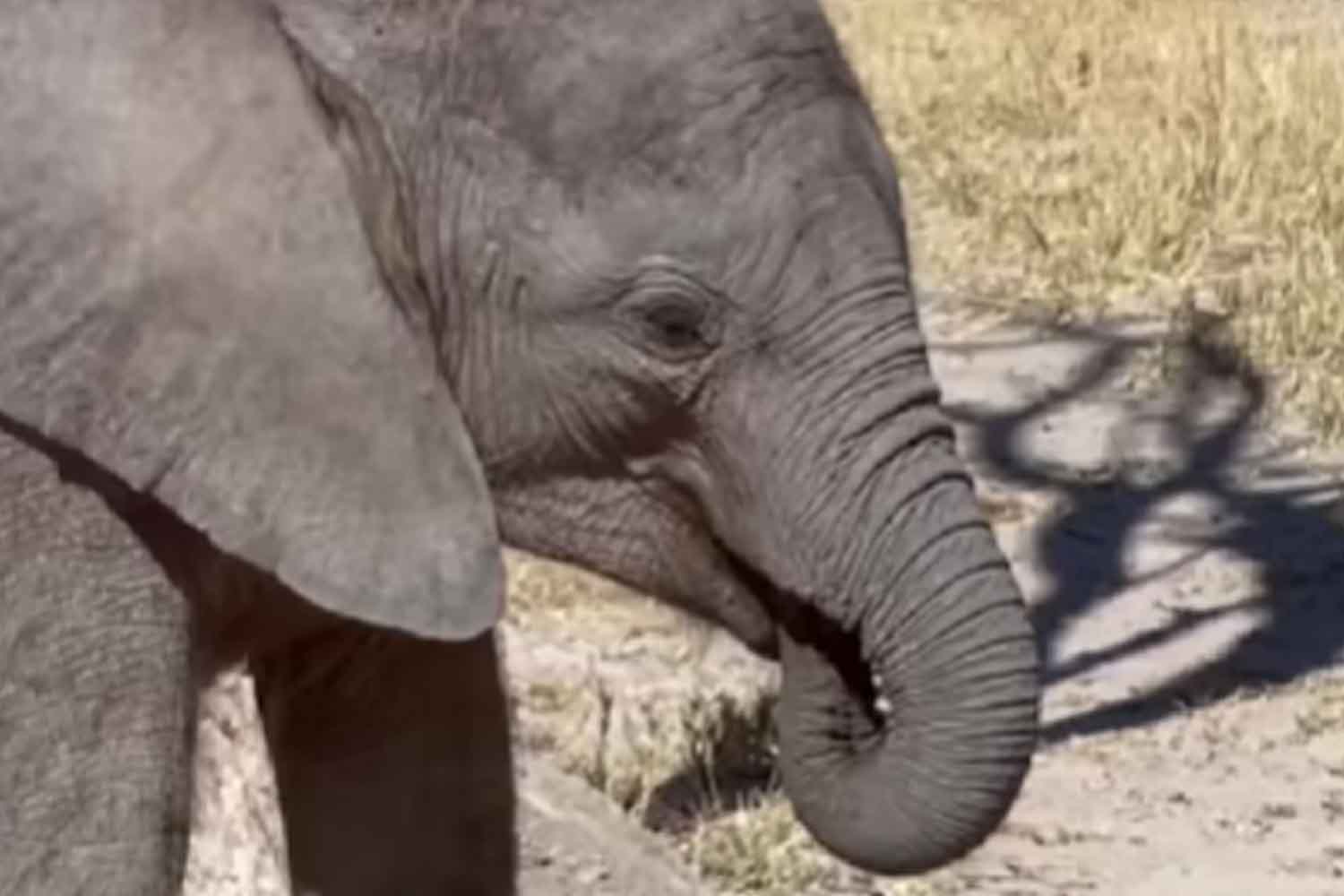
A baby elephant stays close to its mother, stops for a moment and raises its trunk to its mouth. From the outside it just looks like a sweet scene. Instead, within that gesture there is already a lot of his growth. Scholars who observe the behavior of elephants call it trunk-sucking and describe it as a frequent behavior especially in young ones, linked to the search for comfort and reassurance. ElephantVoices records it as just that: a way to calm down, often observed when the puppy appears uncertain or in need of security.
The first major coordination exercise
The trunk, for a baby elephant, is an entire world. It is used to touch, smell, grasp, explore. The San Diego Zoo reminds us that it is an extraordinarily complex structure, with tens of thousands of muscle bundles and no bones or cartilage. Precisely for this reason it requires time, practice, continuous attempts. In the first months the puppies are clumsy and spend their days practicing, until the control of their movements becomes more precise.
Within this apprenticeship, sucking the trunk has a very concrete meaning. It helps to regain a feeling of stability and, at the same time, allows the little one to become familiar with an instrument that he does not yet know how to control well at the beginning. In fact, the San Diego Zoo explains that cubs spend a lot of time learning to control their trunk, while ElephantVoices links trunk-sucking to situations of hesitation and the need for comfort.
The interesting point lies here: that gesture which to us only seems funny accompanies a specific phase of growth. The puppy calms down and, at the same time, experiences his own body. The two things walk together.
Even in children, sucking helps reassure them
This is why the comparison with human newborns holds up well, as long as it stays on the right ground. The American Academy of Pediatrics explains that babies are born with a strong sucking reflex and that thumb or finger sucking can have a calming effect. It is a very common form of self-consolation in the first months of life.
In elephants something similar happens on the functional level. The gesture changes, because the body changes, but the direction remains recognizable: seek relief, reduce agitation, find familiarity through a repeated movement. This is why the image is so striking. An enormous animal, destined to grow to impressive dimensions, goes through its childhood with a small and quiet gesture, very close to that of our children.
Over time this habit tends to diminish. As the puppy grows, body control increases, the relationship with the trunk changes and that need occurs less often. The San Diego Zoo observes that the cubs gradually become more adept at using their trunks and that by the time they are two or three years old they no longer need their mother’s milk. Growth also comes from here: from an initial clumsiness that settles down, day after day, without haste.
You might also be interested in:
