
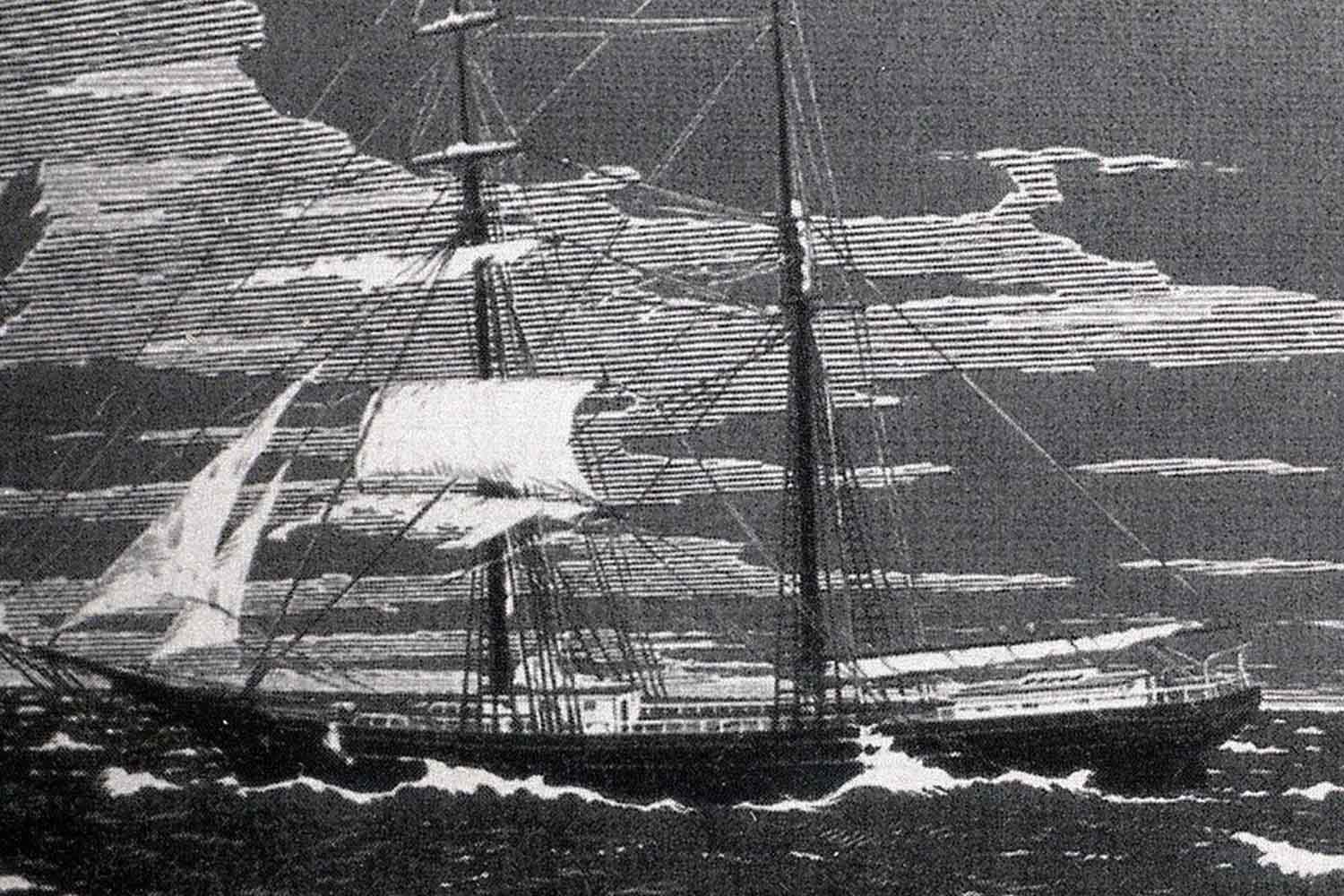
Great sea stories endure when the crime scene seems written by someone with a ferocious taste for absence. The Mary Celeste has always belonged to that category. They found her in December 1872, in the middle of the Atlantic, about 400 miles from the Azores, more or less 640 kilometers from the coast, as she proceeded without a guide towards the Strait of Gibraltar. A silence reigns on board that makes it uncomfortable to even talk about it now.
The American brig, commanded by Benjamin Briggs, still floats well. The sails bear the signs of the journey, the hull remains healthy, the hold retains almost all the cargo. The onboard objects are there. The shelter is there. The captain, his family and every member of the crew, however, have vanished. A completely salvageable ship is towed to Gibraltar by British sailors, and from that moment the case sticks to the collective imagination as do certain stories that refuse to age.
For decades, imagination has taken up all available space. Pirates, mutinies, lightning diseases, sea creatures, dark forces. The repertoire was vast, even too vast. The charm of the Mary Celeste was right there: a ship that seemed suddenly abandoned, without visible struggle, without looting, without bodies. The kind of puzzle that throws anyone who tries to think like a sailor astray. Because a crew leaves a still navigable vessel only when staying on board becomes more frightening than the open sea.
A lethal mixture in the tight hold to defend against the waves
The most solid explanation today looks down. Look inside the hold. The Mary Celeste, which was originally called Amazonwas traveling from New York to Genoa with a precious and very delicate cargo: high-grade ethanol for industrial use. In all, 1,700 wooden barrels packed into the belly of the ship. In Europe that load was used to strengthen the wines, and they awaited it impatiently.
The trouble is that the Atlantic, in winter, gives no respite. The sea was pounding hard. The crew kept the hatches tightly closed to prevent water from spilling inside. A sensible, almost obligatory choice. Except that down there, in that darkness saturated with wood and steam, an invisible danger was accumulating.
Subsequent investigation of the recovered wreckage found nine completely empty barrels. The wood, porous by nature, had allowed an enormous quantity of alcohol to seep through. We are talking about approximately 300 gallons, over 1,100 liters of ethanol, evaporated in the closed space of the hold. During the crossing the ship had passed from the freezing cold of New York to the milder waters towards Portugal. The temperature below deck had risen above 13 degrees Celsius, the flash point of ethanol. At that point the air was filled with combustible gas. All it took was a trigger.
Here the case changes face. And it also changes tone. Because the idea of a classic fire, with blackened wood and a burning smell, clashes with what the rescuers saw on the Mary Celeste: no charred walls, no visible signs of combustion. A detail that has kept the most picturesque theories alive for years. Except that not all fires leave the same signature.
Anyone who has seen a cake or a pan flambé knows that the flame of alcohol can dance quickly, blue, almost clean. It feeds on the steam, runs to the surface, consumes the gas and leaves what is below intact. Transported to naval scale, this chemistry becomes far less elegant and far more terrifying.
In 2006 the chemist Andrea Sella, of University College London, tried to put order into the paradox. He built a replica of the Mary Celeste’s cargo hold and simulated cargo losses using paper cubes instead of barrels and butane instead of ethanol. Then came the spark. A huge fireball went off. The detail that matters comes immediately afterwards: the paper cubes remained intact. No serious burns, no soot, no widespread blackening.
The dynamics resembled a pressure wave explosion more than a traditional fire. A dramatic blaze in front, relatively cold air immediately behind. The gas burns in a fraction of a second, the solid material is saved. In that picture, the hatches can blow, the deck can shake, the crew can convince themselves that they are one step away from catastrophe. And this is precisely the key. That blaze, for those who suffer it in the darkness of a hold, does not resemble a laboratory chemical curiosity. It looks like the end.
A very rapid flame
Sella said it clearly: of all the hypotheses advanced over time, this remains the most convincing because it holds the facts together without forcing them. Explain why the ship was still in good condition. It explains the absence of heavy traces of burning. It explains above all the sudden escape. For a crew of 1872, already tested by rough seas, a blue flash, a wave of heat and hatches that open on their own are enough and more than enough to trigger panic.
The most interesting aspect comes a few years later, when other chemists decide to push the test even closer to the material reality of the Mary Celeste. Jack Rowbotham and Frank Mair, at the University of Manchester, work on the theory for a television documentary and choose to do something very simple on paper, quite complicated in reality: use wood and ethanol, i.e. materials that are more faithful to the real ones.
The model is 1:18 scale. This time it’s not enough to create a flammable cloud. We also need to reconstruct the climatic transition that the sailors actually experienced. First the researchers spray cold ethanol in the small hold, replicating the cold temperatures of the departure from New York, then they cause an electric spark. Nothing happens. The cold keeps the vapors too sparse, too poor to catch fire.
At that point they ideally move the ship towards the warmer climate of the Azores area. They heat the ethanol in a water bath and heat the wooden model with gas stoves. They spray the alcohol again. The spark finally finds a rich and unstable cloud. The explosion arrives immediately, violently. The hatch, supported without rigid fixings, flies to the other side of the room. The wooden bridge warps. Yet the technicians found no traces of combustion or carbonization on the wood of the model. Zero. Ethanol flames can reach around 2,000 degrees Celsius, only here duration matters more than temperature: the blast is very short, ferocious, and then it’s gone.
It is a scene that puts Mary Celeste back into a human dimension. Much more human than pirates and ghosts. No one on board had a degree in chemistry, and you didn’t have to be superstitious to be overcome by terror. In a dark ship filled with alcoholic fumes, a blue glow and a wave of heat can seem like a prelude to an explosion capable of opening the hull.
The decisive spark will probably remain nameless. Two barrels moved by the roll that rub against each other. A sailor opening a hatch to let the hold breathe while still keeping his pipe lit. A minimal contact, a wrong gesture at the wrong second. The chemistry here doesn’t deliver perfect cinematic detail. Deliver something better: a plausible chain of events.
The captain, in all likelihood, sees or hears enough to think that remaining on board is equivalent to braving the next blow. He orders everyone to get into the lifeboat. The most logical idea, at that moment, is to wait outside for the danger to pass, remaining towed by the ship. Then all it takes is a cable that breaks, a sudden gust, a sea that changes mood. The brig continues. The boat disappears. The Mary Celeste remains alone, and it is precisely that solitude that builds the legend.
The modern proof that has brought order to a tenacious legend
There is also a beautiful, almost tender detail amidst such a story. The chemists who worked on this hypothesis want to transform their model into a tool for schools, a dissemination activity capable of explaining how fuel mixtures work and, at the same time, how scientific reasoning proceeds when facing a historical enigma. The interest, they essentially say, lives in the path even before the solution: putting yourself in the head of those who were there, in another century, with other fears, other tools, another way of reading the world.
And perhaps this is precisely the point that makes Mary Celeste still so alive. The Ghost Ship sheds some fog, sure. He gains something much more fascinating: an explanation that manages to keep the thrill and the facts together. No invisible hand on the rudder, no sea monster, no neatly packaged curse. Just wood, ethanol, temperature, pressure, panic. For more than one hundred and fifty years people have searched for the ghost in the ocean. The ghost, in all likelihood, was waiting in the hold.
You might also be interested in:
