
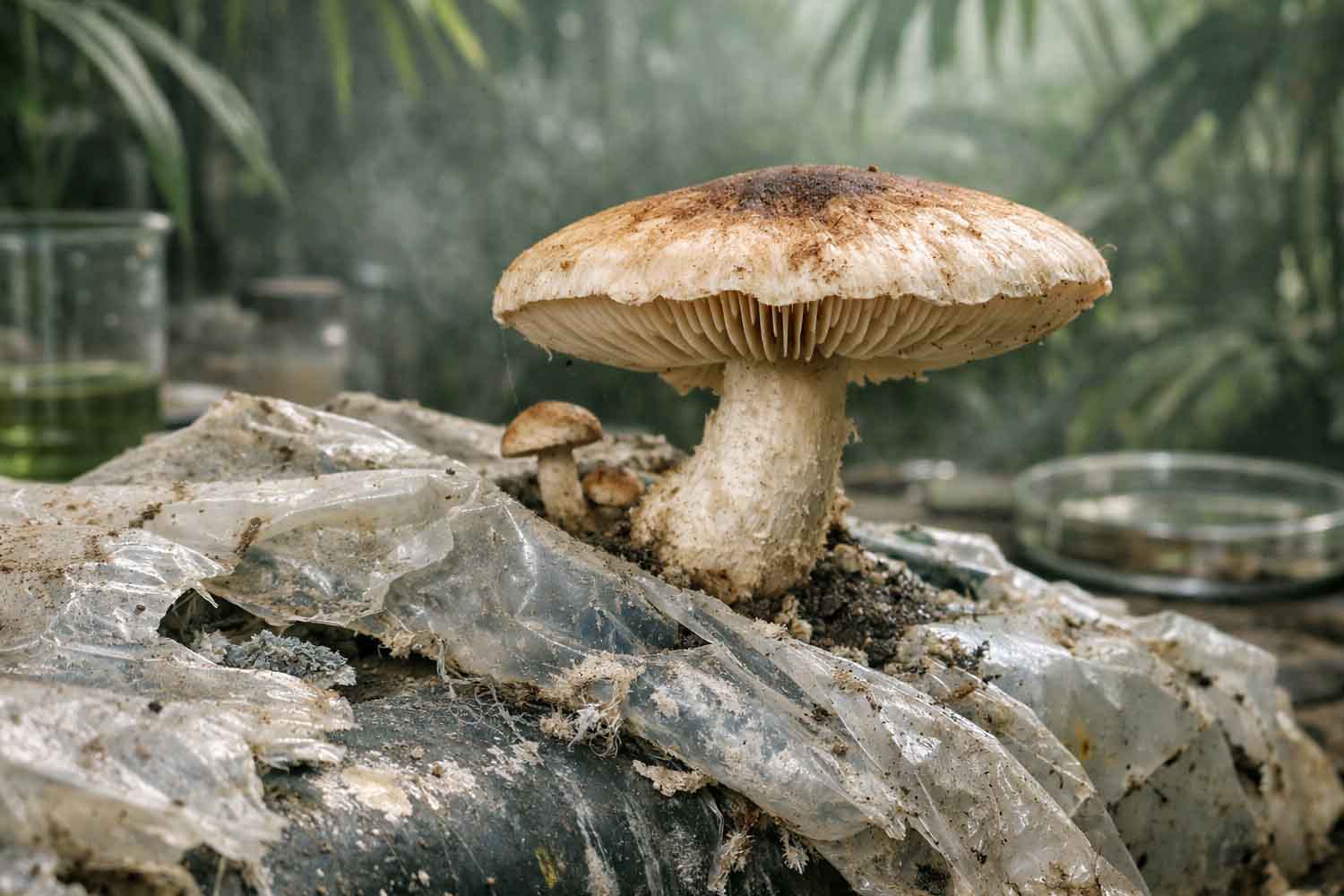
Plastic continues to grow as a mass that expands every year. The numbers help to understand the scale of the problem: global production has exceeded 400 million tons per year, and the most cited estimates indicate that only around 9% of the plastic produced on a historical scale has actually entered a recycling cycle. The rest accumulates in landfills, is dispersed in natural environments, fragments into increasingly smaller particles and remains there for a long time, in water, soil, the food chain.
Within this scenario, plastic-eating fungi have attracted attention for years because they touch on a precise point: using living organisms and their enzymes to attack polymers that today weigh like a permanent legacy. The line of research exists, it is serious, it has already produced highly cited studies. The decisive step is all here: we are talking about laboratories, controlled tests, biological mechanisms rigorously observed. There is also talk of a perspective that remains open, still in search of scale, speed and continuity.
From the Ecuadorian Amazon forest to a study that has become central
The best-known story begins in 2008, when a group of Yale students participated in a research expedition to the Ecuadorian Amazon. During that work they collected endophytic fungi, microorganisms that live in plant tissues without destroying them. Among the isolates studied later, one immediately attracted attention: Pestalotiopsis microspora.
In 2011, a study published in Applied and Environmental Microbiology showed that two isolates of this species were able to grow on polyurethane as the sole carbon source, both in the presence of oxygen and in anaerobic conditions. The same work added a very important detail: the molecular characterization of the observed activity suggested the involvement of a serine hydrolase, an enzyme capable of intervening on the bonds of the polymer.
That detail about anaerobic conditions weighs heavily, because the inside of a landfill tends to become oxygen-poor over time. There the material remains compressed, humid, stratified, crossed by biological processes which also lead to the formation of landfill gas. Seeing an active fungus on polyurethane in an environment of this type opened a concrete gap in the scientific imagination: biodegradation, in that context, stops seeming like just a plate exercise and begins to dialogue with real places where plastic really accumulates.
The strong point of this research lies precisely in its specificity. Many polymer degradation strategies rely on physical or chemical pretreatments, such as oxidation, heat or surface alterations that make the material more vulnerable. Here, however, a biological capacity comes into play that acts in milder conditions and brings with it a question that is now stable in the literature: how far can this type of degradation really go outside the laboratory?
Other fungi, other enzymes, the same horizon
Pestalotiopsis microspora remains the symbolic name, but the field has expanded. In 2017 a work on Environmental Pollution described the case of Aspergillus tubingensis, isolated from a waste disposal site in Islamabad, Pakistan, capable of degrading polyester polyurethane under experimental conditions on agar. The study documented evident changes to the surface of the material, signs that strengthened the idea of fungal biodegradation of polyurethanes as a concrete line of research.
From here we enter a broader territory, that of mycoremediation, that is, the use of mushrooms to treat environmental contaminants. The most cited protagonists are often white-rot fungi, white rot fungi known for their enzymatic apparatus: laccases, peroxidases and other biochemical tools that allow the attack of very resistant organic molecules. Applications and studies on synthetic dyes, pesticides, hydrocarbons, persistent aromatic compounds and various industrial pollutants appear in the literature.
The chapter on heavy metals also often enters into the same discussion, with a useful distinction to keep in mind. In this case the fungi work above all through adsorption, immobilization, sequestration or transformation, rather than through a “digestion” of the contaminant in the common sense of the term. It is another face of the same biological intelligence: on the one hand degradation of complex organic substances, on the other physico-chemical interaction with toxic elements present in soil and water.
Because plastic-eating mushrooms remain a strong promise
The fascination of these studies is immediately clear. The idea that an organism already present in nature can attack such stubborn synthetic materials has something profoundly concrete, almost artisanal. Yet the distance between a result obtained in cultivation and a solution capable of holding up on an industrial scale remains wide. The most recent reviews insist on the same issues: slow kinetics, incomplete conversion of polymers, very strong variability between species, materials and environmental conditions, plus the decisive problem of scalability.
This means that plastic-eating mushrooms today must be read for what they really are: a promising biological frontier, already solid on an experimental level, still looking for infrastructures, processes, times and costs compatible with the real world. Science has already shown that some fungi can attack polyurethane and other polymers. Now we need the hardest step, the one that leads from papers to plants, from culture media to real waste, from intuitions to systems. For now they work in silence, inside a plate, while outside the plastic continues to arrive in tons.
You might also be interested in:
