

The Daphne laurel or laureola is an aesthetically very fascinating evergreen shrub, it has shiny dark green lanceolate leaves, and is no more than one meter tall.
Its cultivation, in the garden or in pots, is simple and does not require particular attention. Let’s find out what its main characteristics are and how to take care of it.
Daphne laurel: characteristics
This shrub is native to Europe, but is also found in Algeria, Morocco and the Azores; this species grows in mostly rocky areas, in thickets and also along mountain prairies, up to 2,000 meters above sea level. It reaches a height of 1 meter, and has a very branched habit. The branches are alternate and their bark is light brown as they age.
Its lanceolate leaves have a sharp or rounded tip, plus a petiole. They are dark green in the upper part, and lighter in the lower part, and closely resemble those of trees and shrubs of the genus Laurus (laurel).
This plant flowers in spring, more precisely between February and April, and has fruits measuring approximately 10×8 millimetres; these are fleshy and contain an ovoid-shaped seed inside them. The flowers are characteristic of an intense yellow-greenish colour, glabrous, and lightly scented, whose length ranges from 7 to 14 mm.
Daphne Laurel: how to take care of it
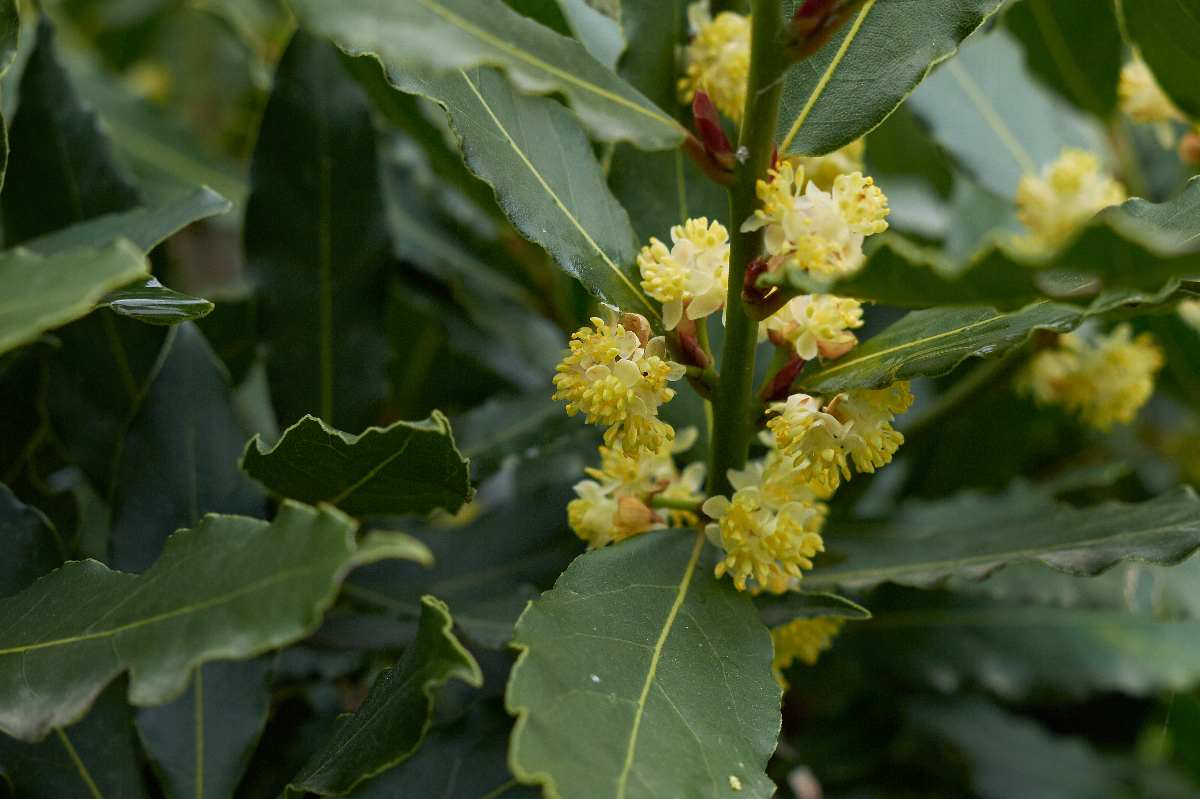
Laureola is a plant that grows well in gardens, but it is also interesting to grow it in pots when it cannot be planted in open ground. Since it does not grow fast and very tall, it is possible to control it very well; furthermore, its root system is not invasive.
Position
Daphne laurel is a bush that should be kept in the shade, as direct sun could burn its leaves. Like any other plant, it needs light to be able to photosynthesize, but this must not be direct so to make it grow and stay healthy we recommend keeping it in a shaded area, yes, but bright.
Soil or substrate
In the garden it grows in acidic, neutral and slightly alkaline soils, with a pH between 5.5 and 8. Almost any type of substrate can be used in pots, such as universal or mulch, or even coconut fibre, etc… We advise you to choose a container that has holes so that unabsorbed water can escape.
Irrigation
Laureola is not a drought-tolerant shrub, however, it does not like frequent watering either. Usually, with watering once a week during the winter, and about two or three a week the rest of the year it can hold up well.
The important thing is to avoid wetting the leaves, as they could burn.
In addition to watering it from time to time, it is important that it is fertilized regularly, especially during its growing season. When temperatures are between 15 and 35ºC, it will need a little extra “food” to allow it to develop. For this reason we recommend fertilizing it with liquid fertilizer if it is in a pot, and granular or powder fertilizers if grown in the garden.
Sowing or transplanting time
The transplant must be carried out in early or mid-spring, once winter is behind us. Furthermore, remember that if it is grown in a pot this must be changed to a larger one every three years or so, so that your laurel plant can grow and develop optimally.
How to prune it
Daphne laureola does not require extensive pruning: it is sufficient to intervene after flowering, between April and May, to remove dry, damaged or crossing branches, so as to maintain an orderly shape and encourage growth. It is important not to over-cut, as the plant does not react well to drastic pruning. Again, remember to always wear gloves before touching it, as the sap can be irritating to the skin.
Diseases and parasites
Despite being a fairly resistant plant, Daphne laureola can be affected by some phytosanitary problems. Among the most common parasites we find aphids and scale insects, which tend to colonize leaves and young shoots: signs such as sticky leaves, deformations or small spots are often the first indicators of an infestation. In terms of fungal diseases, powdery mildew can manifest itself with a whitish film on the leaves, while water stagnation favors root rot, recognizable by the general wilting of the plant despite regular watering. To prevent these problems it is sufficient to ensure good drainage of the soil and not excessively water.
The plant is poisonous and toxic
Before deciding to grow Daphne laureola in the garden or in pots, it is essential to know that it is a very toxic plant for humans and pets. All its parts – leaves, fruits, bark and sap – contain poisonous substances such as dafnine and mezertein, which can cause skin irritation upon simple contact and much more serious symptoms if ingested, including nausea, vomiting and breathing difficulties. It is therefore advisable to always handle it with gloves and keep it away from children and pets.
You might be interested in:
