
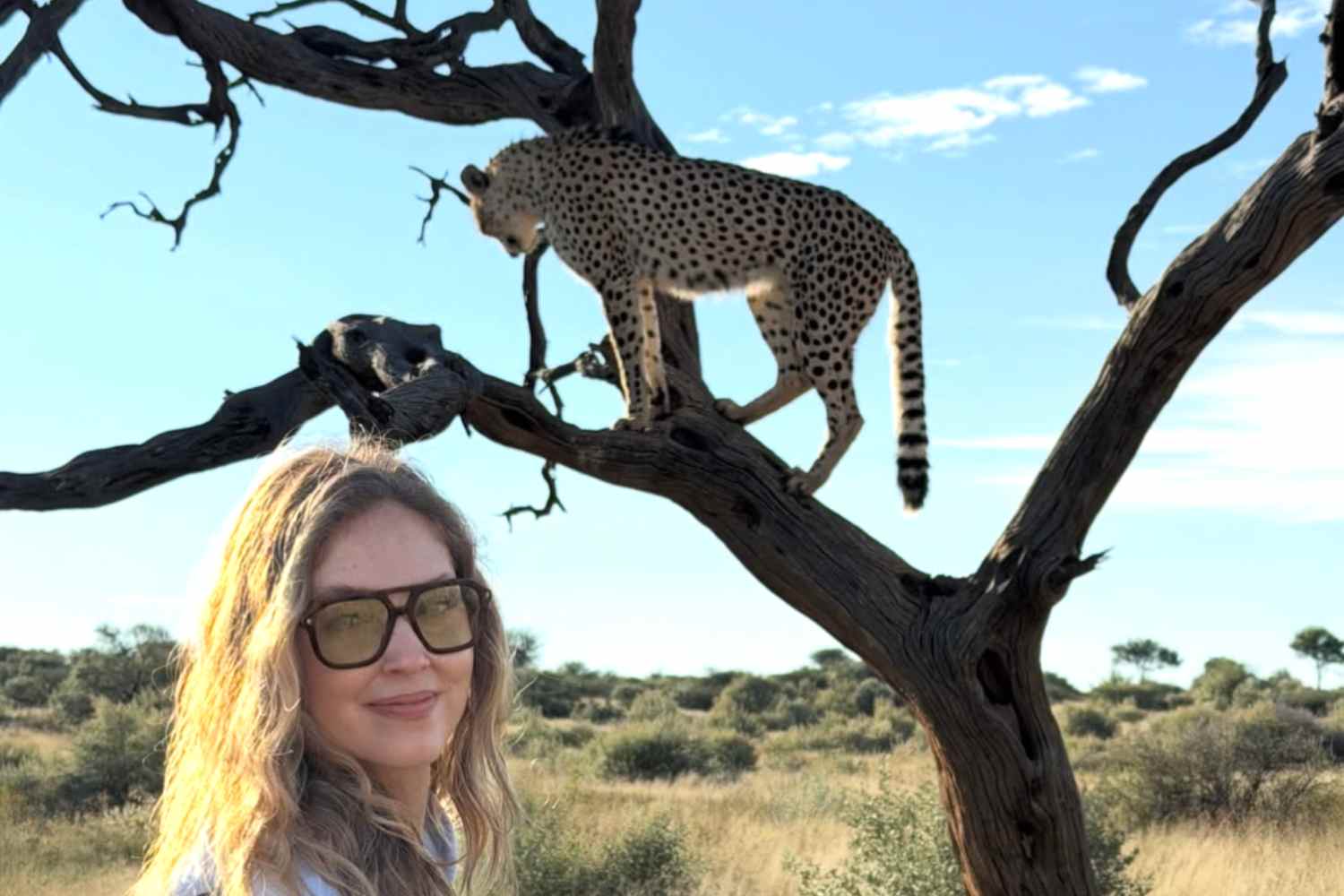
A spectacular journey, but for whom?
Namibia is one of the most extraordinary places on the planet, a territory where the savannah opens up into endless landscapes, where silence belongs to giraffes and rhinos long before it belongs to tourists, where wildlife follows ancestral rhythms that human presence should respect with humility and discretion. Chiara Ferragni chose this corner of Africa for her latest trip, invited Everseen Africa, organizers of luxury design safaris in Africa, documenting everything with the usual abundance of content for her millions of followers.
The images have made the rounds on social media, celebrated as a hymn to wild nature, yet behind these photographs lies a question that is worth asking clearly: who is really at the center of this story, the animals or the influencer?
View this post on Instagram
The rules of the safari and their meaning
In all the large national parks of southern Africa, from Botswana to Namibia to South Africa, there is a fundamental and mandatory rule: visitors must remain inside the vehicle during the safari. This rule is both a safety measure for tourists and a guarantee of respect for wild animals, who perceive the shape of the vehicle as something neutral and familiar.
The human figure standing on the ground, however, immediately becomes a disturbing variable in their ecosystem. Physical interaction with wild animals is to be avoided in all contexts: wildlife requires distance, the prohibition on feeding it is absolute and the search for a close relationship represents a conceptual error even before a behavioral one.
Yet the photographs circulating on the profiles of VIPs on safari often tell a completely different story: studied poses in the middle of the savannah, animals used as scenography, neighborhoods artfully constructed for an image with thousands of likes.
View this post on Instagram
Nature becomes scenography
The problem with Ferragni’s journey is the spectacularization of the animals. Wild animals that get used to the close human presence, that approach tourist facilities or that tolerate contact with visitors, are animals whose natural behavior is already compromised, even when everything appears idyllic in the frame of a social story.
The safari industry and its distortions
The anthropocentric vision leads many tourists to convince themselves that animals are there to be admired and photographed. When this doesn’t happen easily, highly invasive attitudes towards the natural world come into play.
Safari tourism has built a billion-dollar industry around this logic which, in its more commercial and less conscious version, transforms reserves into theme parks where wildlife becomes an attraction and the guide is rewarded based on the quantity and proximity of sightings.
Many international tourists link the tip to the guide’s ability to show as many animals as possible and as close as possible. This leads to disturbing animals during delicate moments such as mating, hunting or caring for their young. The result is a vicious cycle in which animal welfare is systematically sacrificed to obtain spectacular content.
The role of influencers
The influencer phenomenon amplifies this dynamic on an unprecedented scale. When a person with tens of millions of followers posts a photograph next to a rhino, they normalize that experience as desirable and replicable.
This creates a tourist demand that the most unscrupulous structures will try to satisfy, often with increasingly less respectful practices. An authentic ethical safari is something very different: it is an immersive experience where sightings are possible but not guaranteed, and above all they are not the main objective.
It means accepting the distance, even when it is great. It means understanding that silence and observation are worth more than any selfie. It means recognizing that the savannah belongs to its inhabitants and that the tourist is just a guest.
Talking about Namibia without betraying it
Namibia deserves to be visited, loved and talked about. But it deserves a story that puts its authenticity at the center: fragile ecosystems, complex balances, a fauna that has the right to exist independently of the human gaze.
When the safari becomes a photo session and wild animals become the backdrop for content to be monetized, something essential is lost. And that loss affects everyone, even those who observe those infinite landscapes with wonder from afar.
