
A well can save a season and ruin a balance built over centuries. In the arid lands of southern Angola, small water infrastructures created to respond to drought have provided immediate relief to under-pressure pastoral communities, yet have also fostered sedentarisation, dependence on fixed sources, loss of mobility and greater fragility in the long term. In some areas of the province of Namibe, between 15% and 43% of the infrastructures surveyed were out of use due to depletion of aquifers or faults in the pumping systems; for those who had already reduced transhumance, that failure became a trap rather than a technical accident.
From such a concrete scene comes an uncomfortable question for the way we are used to talking about water. For decades we have treated it as a quantity to be measured, moved, accumulated, distributed. Cubic metres, pipelines, reservoirs, concessions, efficiency, network losses. All necessary things, of course. Ancestral sociohydrology adds friction: water lives within social relationships, memories, practices, landscapes, community rules, moral economies. Removing it from that fabric and reducing it to a “resource” can work on paper, much less on the ground.
The water out of the Excel sheet
The global crisis makes this discussion much less theoretical than it seems. In 2022, 2.2 billion people lived without safely managed drinking water, 3.5 billion without safe sanitation, and approximately half of the world’s population experienced severe water scarcity for at least part of the year. Agriculture absorbs 72% of global freshwater withdrawals, a figure that alone is enough to explain why every decision on water affects food, health, landscape, inequalities and power.
The proposal of ancestral sociohydrology starts from a precise criticism: modern hydrology has constructed the water cycle within a scientific tradition born in Europe, linked to the idea of regularity, balance, prediction and control. This approach has allowed enormous progress, but has also brought with it a colonial and technocratic legacy: looking at territories, especially those arid or outside of temperate European climates, as “defective” places, to be corrected with works, regulations and infrastructures. Local knowledge, in this scheme, often ends up treated as useful folklore to consult, while the real decision remains in the hands of technicians, governments and financiers.
Sociohydrology, born to study the interactions between human societies and the water cycle, had already tried to broaden the field. The problem identified now concerns its philosophical basis: even when it inserts communities, institutions and behaviors into the models, it risks transforming them into external variables, data to be pigeonholed, measurable elements that react to the water system. Ancestral sociohydrology calls for a more radical step: recognizing that some communities know water through practices, mutual obligations, collective memory, rituals, forms of local governance, and caring relationships with the landscape.
Knowledge that walks
“Ancestral” must be handled well here. It does not indicate a museum of immobile practices, rooted in a picturesque past. It indicates knowledge rooted in places, transmitted between generations and continuously adapted to needs, crises, opportunities and changes. A community that changes a water harvesting technique after a long drought is already innovating. It does so without separating the work from the landscape, the landscape from social life, social life from the rules that keep people together.
The examples cited cross very different worlds and must be kept distinct. In some African cultures, the Ubuntu principle links individual existence to social and ecological interdependence. In many First Nations communities in Canada, kinship ecology views humans, animals, waters, ancestors, and territories as kin bound by mutual obligations. In Andean cosmologies, water can be thought of as a vital current that flows through people, animals, plants, mountains, and cycles of life and death. These references are not interchangeable, because all knowledge arises from a territory, from a political history and from its own cultural protocols.
The most interesting part comes when this knowledge becomes infrastructure. In Tunisia, jessours are small systems of dams and terraces built in the beds of ephemeral watercourses: they slow down flows, retain sediments, favor agricultural niches and local biodiversity. In Zapotec Mexico, 26 communities affected by long periods of drought have self-organized to recharge aquifers with low-tech, economical and regenerative interventions, supported by community rules and reciprocity. Water, in that framework, serves the community, future generations and the river itself.
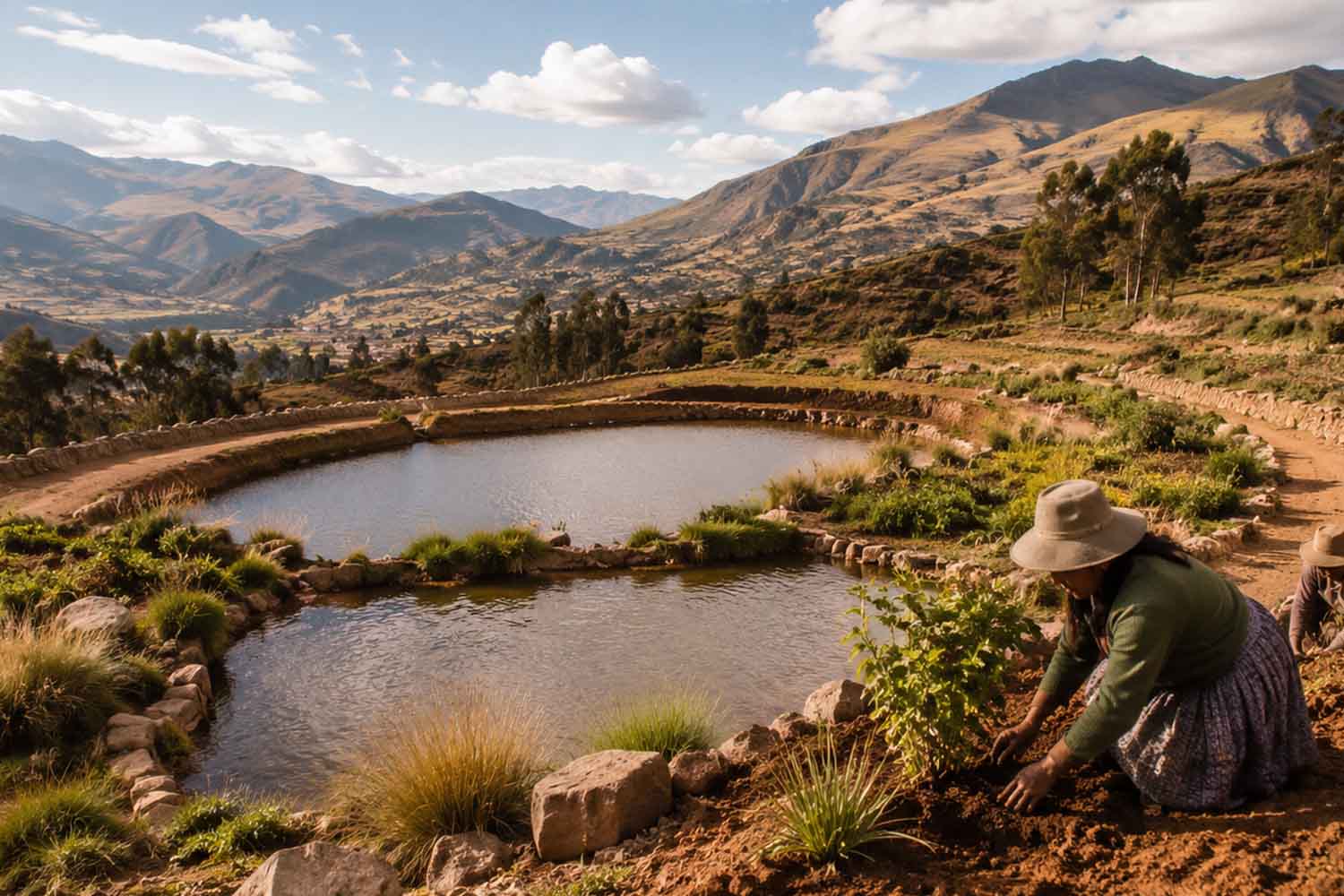
In Andean cosmologies, water can be thought of as a vital current that flows through people, animals, plants, mountains, and cycles of life and death. In Peru this vision has also taken the form of very concrete work: in the Quechua community of Quispillacta, in the Ayacucho region, the Machaca sisters, agricultural engineers and farmers, have brought yaku waqachay, the “care of water”, back to the center. They collect rain, use local plants and elements, create lagoons, help aquifers recharge and treat water as a presence to accompany, not as a material to be squeezed. The result, today, is also measured in numbers: dozens of lagoons, more than one and a half million cubic meters stored, a technique that has even entered public programs to address the water crisis in the Andes. Yet, the decisive part remains less photographable: the community that sings, thanks, works together and remembers that the water, before ending up in a plant, belongs to a pact.
The same principle returns in an almost peasant formula, planting rainwater: not taking the rain when it has already run away, but stopping it first, letting it enter the soil, giving it time to become humidity, groundwater, roots. In India, especially in the arid areas of Rajasthan, i johad they work exactly like this: small basins or earthen embankments that collect rainwater, slow down runoff and help recharge the aquifers. They are poor works only in appearance, because they bring together technique, landscape and community. In Zapotec Mexico, 26 communities affected by long periods of drought have self-organized to recharge aquifers with low-tech, economical and regenerative interventions, supported by community rules and reciprocity. Water, in that framework, serves the community, future generations and the river itself.
This also changes the way we look at solutions. A dam, a well or a pipeline can be useful, in some cases indispensable. The problem arises when the infrastructure arrives as a single answer, the same everywhere, separated from grazing habits, from transhumance routes, from traditional authorities, from the real distribution of power. In pastoral lands, increasing the water available at a fixed point can reduce mobility, concentrate people and animals, consume pastures, and create dependence on depletable aquifers. A solution designed to increase resilience can end up consuming it.
Two eyes to look at the same river
Ancestral sociohydrology proposes a more demanding pluralism than simple “participation”. Inviting a community to a decision-making table and then translating everything into categories already decided elsewhere changes little. The step required is more uncomfortable: letting situated knowledge modify the questions of science, the models, the indicators, the very way of defining what a water system is. The formula invoked is that of two-eyed seeing, “seeing with two eyes”: one eye formed by Western science, the other by knowledge rooted in the places. The same problem observed from different perspectives, without overwhelming one over the other.
In this framework, culture, memory, taboos, ritual calendars, mutual obligations and oral maps cease to be “soft factors”. They can become real elements of models, because they influence the use of water, the maintenance of systems, the distribution of benefits, the ability to withstand a drought or a flood. The research proposes to combine hydrological models, participatory mapping, oral histories and local narratives to better capture the feedback between communities and water.
The discussion also reaches the law. In various Western and non-Western countries, the idea of recognizing legal personality or rights to natural entities has already taken different forms: rivers, forests, mountains, territories considered subjects to be protected and not just assets to be administered. In 2021, in Canada, the Mutuhekau Shipu River, also known as the Magpie River, received legal personality recognition promoted by the Innu Council of Ekuanitshit and a regional municipality; in Colombia, the recognition of the rights of the Amazon has opened a front even broader in scale and complexity.
For Italy, all this also speaks to everyday life much closer: cemented rivers, exploited aquifers, dry basins, thirsty agriculture, fragile maintenance, conflicts between civil, industrial and ecological uses. Ancestral sociohydrology does not offer a ready-made recipe to paste on the Po, the Arno or an Apennine stream.
Offers a less arrogant posture. Before deciding where to put more water, he asks who uses it, who loses it, who governs it, who pays the price, which memory of the territory is listened to and which is treated as background noise. Water runs away quickly when the soil is hard, bare, compacted, abandoned. It remains where it finds roots, well-placed stones, hands that repair, communities that observe. Before looking further and further for it, perhaps it is better to start again from here: from the exact point where it falls.
You might also be interested in:
