
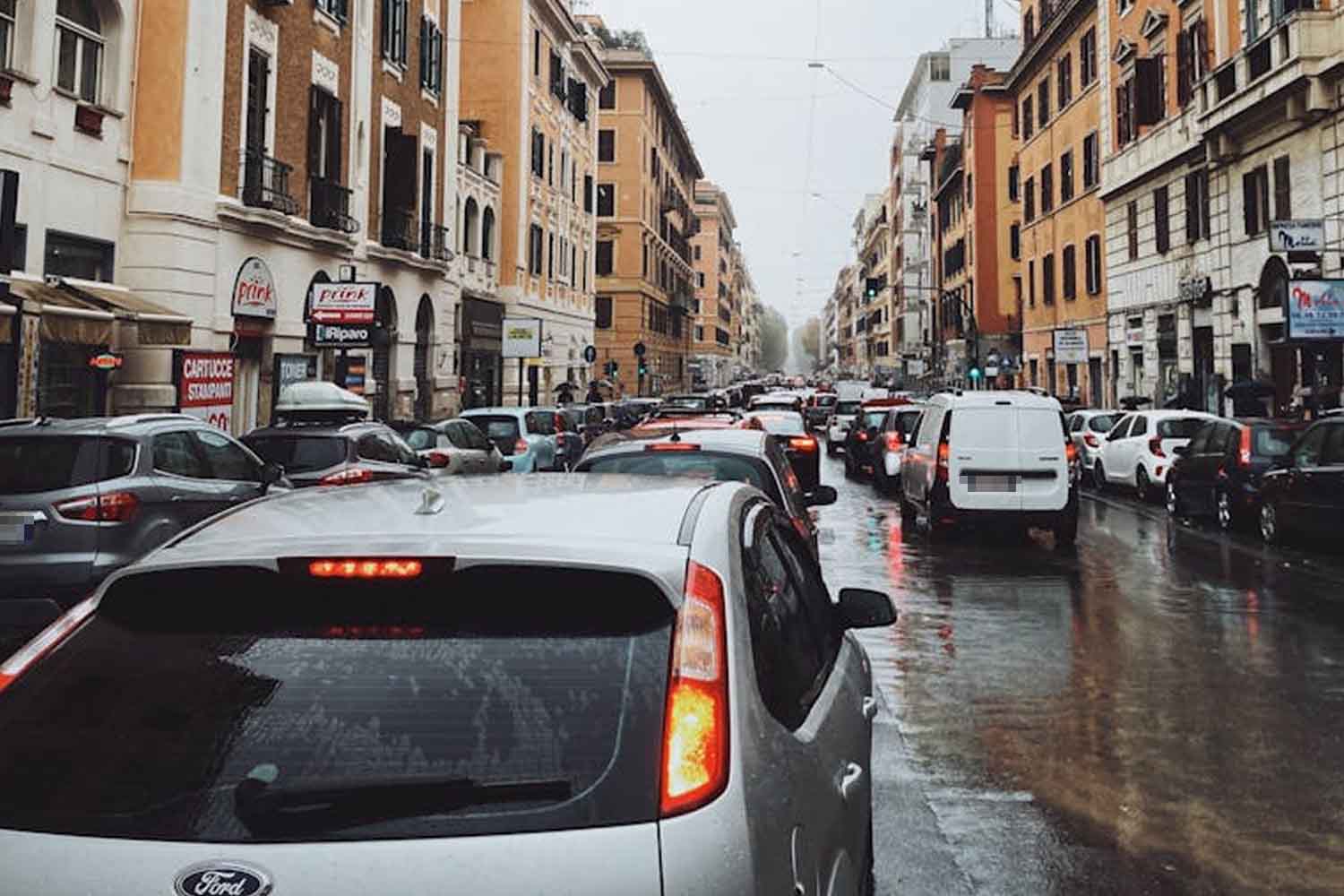
It is enough to go down to your house on any given morning to understand that the relationship between Italians and the car has something very physical about it. Pavements gnawed away, second rows with the four arrows lit as if they were a spiritual permit, garages transformed into storage areas, parking spaces searched for with the same patience with which one searches for a decent apartment to rent. Then the numbers arrive and the feeling becomes statistics: Italy is the European country with the highest motorization rate. In 2024, the cars registered with the PRA, the Public Automobile Registry, will exceed 700 for every 1,000 residents. The European Union average stops at 578, while France, Germany and Spain remain in a range between 550 and 600.
Put like this, it seems like a simple picture: we have more cars than others. Except that the matter becomes more complicated as soon as you look under the hood of the data. Because those over 700 cars for every 1,000 residents tell the story of the cars registered, owned and formally present in the system. They tell the story of a country that has built its idea of autonomy around four wheels for decades. They talk about families with multiple cars, areas where public transport is difficult, entrenched habits, small towns where without a car even buying bread becomes an expedition. But not all those cars are actually consuming asphalt every day.
The number changes on the street
Then comes the data that shifts everything. If we consider only the vehicles that are estimated to have actually been in circulation, the Italian rate drops to 564 vehicles per 1,000 inhabitants, a figure referring to 2021. At that point the record is reduced: Italy returns in line with the European average. The difference is enormous: on one side there is the car registered in the register, on the other the one that actually moves.
As soon as you move from the record to the street, the record loses a bit of shine. A car can stay there for a thousand reasons: it’s old, it’s only used on Sundays, it belongs to a family member who doesn’t drive much, it’s needed “for safety”, or no one wants to deal with procedures, costs and scrapping. The data doesn’t say why every single car stays put. But they show the crack well: in Italy we have many registered cars, many fewer actually moving. Part of the vehicle fleet is more in garages, courtyards and car parks under the house than in daily traffic.
Even from an environmental point of view it changes a lot. A stationary car takes up space, a moving car produces traffic, emissions, noise and fuel consumption. They are different problems. The fleet of cars that fill garages, courtyards and sidewalks is one thing; another is the one that enters traffic every day, queues at traffic lights and weighs on the air of cities.
A long story
The car, in Italy, quickly became more than a means of transport. It is clear from the Istat data: during the economic boom, between 1961 and 1971, the cars registered with the PRA went from less than 50 to over 200 per 1,000 inhabitants. In ten years the material landscape of the country changes, trips, weekends, the way of going to work, the very idea of freedom within a family changes. In 1991 we were already at 500 cars for every 1,000 residents. In 2024 we will exceed 700.
Roads are also built around that growth. At the end of the 1950s the network of state and provincial roads doubled in just over a decade. Between 1956 and 1964, the years of the Autostrada del Sole, the motorway network tripled and reached over 1,600 kilometres. Today it exceeds 7,500 kilometers. The car enters the head even before it enters the garage. If the country gets longer, it can be reached and crossed, it is done more and more often with a steering wheel in front.
That long history, however, still weighs heavily. In many Italian territories, the car remains the only realistic way to go to work, accompany a child, pay a visit, reach a station. Where trains, buses and local connections struggle, talking about giving up the car sounds easy only from afar. Elsewhere, however, the car remains out of habit, laziness, convenience, fear of being discovered. Putting them together is convenient for controversy, much less for real life. Otherwise we end up in the usual theater: some defend the car as if it were a natural right, some describe it as a private fault. In between, daily life.
The rest of the mobility runs, the car stays
Meanwhile, other ways of moving have changed a lot. The Italian railway, which started from a fragmented network at Unification, today moves over 55 billion passenger-km, compared to 7 billion in 1924. On the Rome-Milan route, in 1926, there were three direct connections per day and they took between 13 and 14 hours; in 2025 there will be around 130 connections and those without intermediate stops cover the route in less than three hours. High speed now has a substantial impact on overall rail mobility, with an estimated contribution of around 40% of total passenger-km.
Even the plane has changed scale: passengers leaving or arriving at Italian airports have gone from 800 thousand in 1954 to over 218 million in 2024. The country has moved more and more, in different ways, with increasingly faster infrastructures. Yet, the car remains there, as a central object of everyday life. Sometimes indispensable, sometimes convenient, sometimes just inherited from an old model that continues to park in front of the door.
Between these two numbers there is a practical question, less noisy than horns and more useful than many controversies: how many cars are really needed, and how many remain there because we have built everything as if they were necessarily needed? Meanwhile, the result can be seen every evening, when you go around the same neighborhood looking for a place. The European record, at that point, has a very precise sound: arrow, brake, reverse. And another car stopped outside the house.
You might also be interested in:
