
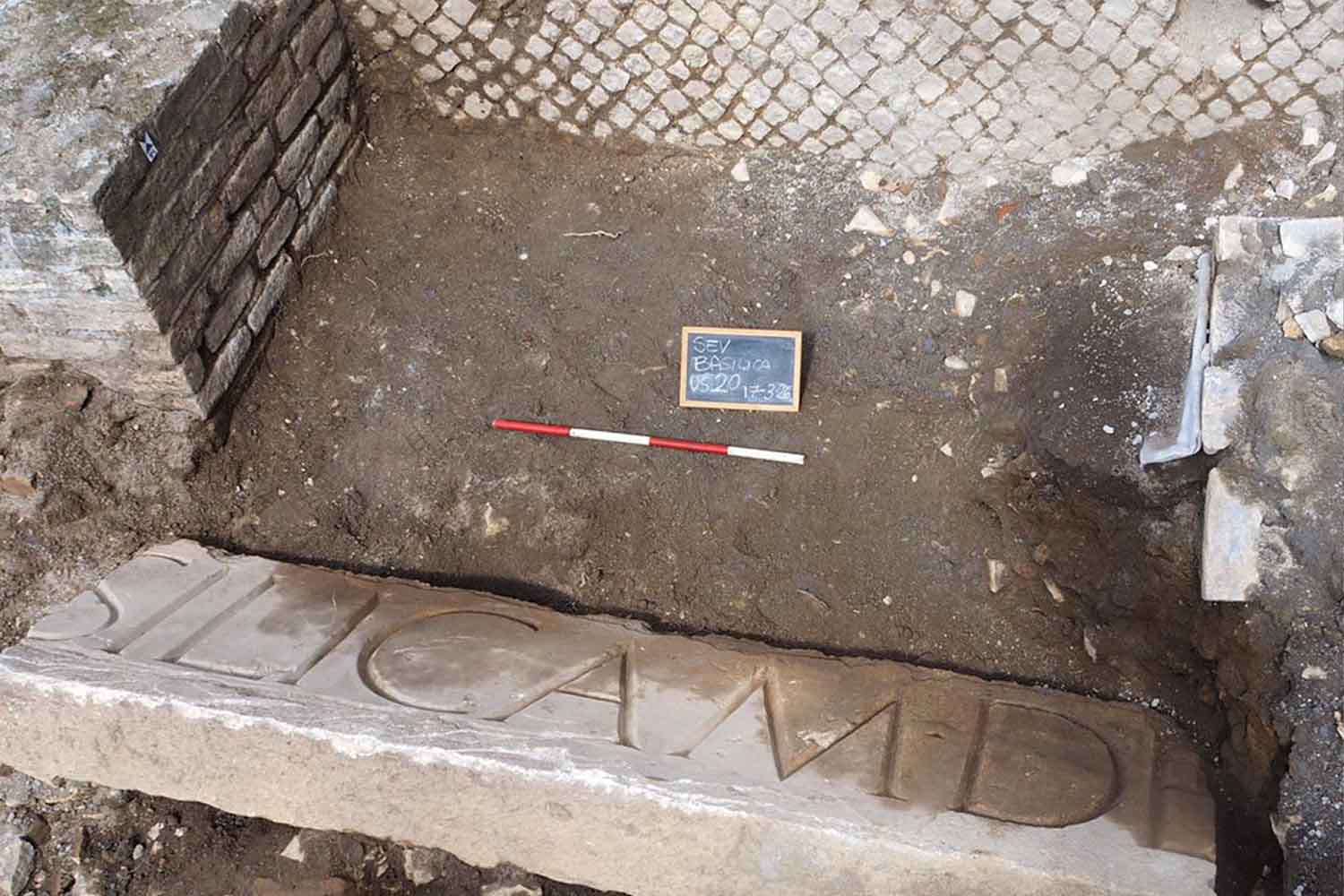
In the compacted ground behind the temple, where a half-certainty had remained for years, a word has re-emerged. A few letters, engraved on a plastered travertine architrave block, large enough to change the way you look at one of the most important spaces of the Sanctuary of Hercules Victor in Tivoli: (BA)SILICAM DE(—). A portion, sure. A fragment. However, in archaeology, sometimes a well-written fragment is enough to put an entire building back in order.
The discovery comes from new archaeological investigations launched by‘Institute Villa Adriana and Villa d’Estewith funding from the Ministry of Culture – General Directorate of Museums, together with the Department of Antiquity Sciences of the Sapienza University of Rome. The place is one of those that already hold stone, power and landscape together: the Sanctuary of Hercules Victor, one of the most impressive monumental complexes in Roman Italy, clinging to the history of Tivoli with a strength that crosses the centuries without asking permission.
The inscription is dated to the age of Augustus, between the end of the 1st century BC and the beginning of the 1st century AD. Its importance lies precisely in its dryness. Those letters allow us to confidently identify the building identified over thirty years ago behind the temple: it was one basilicaa large covered public environment, intended for different functions, including administrative and judicial activities. A space of service and representation, where civil life went undercover, among columns, decorations, expectations, decisions.
The word that changes excavation
The building was discovered in 1992, behind the temple, against the back wall of the triple portico, that is, that large porticoed space organized on three sides around an open central area. At the time, its monumental façade, marked by nine entrances, had been brought to light. The dimensions, over 800 square meters, and the architectural structure had already suggested the presence of a large central hall surrounded by a covered corridor.
The final blow of confirmation was missing. Now it comes from a fallen block, buried, surviving collapses, reuses, earthquakes, silences. The basilica of the Sanctuary of Hercules Victor thus takes on a full, more solid, less hypothetical name. And with it the interpretation of the entire complex also changes, because that space returns to being a living part of the monumental machine of the sanctuary, with a precise public function and a recognizable institutional weight.
The archaeological data also crosses a famous passage from Suetoniusthe ancient author, biographer-antiquarian most inclined to anecdotes imperial than to dry news. In the De vita Caesarumin the life of Augustus, the historian says that the emperor mainly frequented maritime retreats, the islands of Campania and some cities near Rome, including Lanuvium, Praeneste and Tivoli. Precisely in Tivoli, writes Suetonius, Augustus often administered justice in the porticoes of the temple of Hercules: “ubi etiam in porticibus Herculis templi persaepe ius dixit”. In our own words, the emperor also used these spaces as a concrete place of authority, far from the center of Rome and yet still fully within his system of power. Now that step finds material support. Not a theatrical rehearsal of the emperor sitting there deciding cases, of course. A stone, a few letters, and the story at least begins to have a floor under its feet.
Three meters below the steps
The discovery comes from a particularly preserved excavation context. Approximately three meters below the current floor, extensive levels of collapse emerged, in all likelihood linked to an earthquake that occurred in late antiquity. Layers that had remained sealed for centuries, like a room quickly closed and then forgotten, have yielded a very rich set of materials: ceramics, architectural elements in terracotta, inscriptions on marble slabs, metal objects, sculptural reliefs and numerous fragments of painted plaster.
Among the most significant objects there is also a bronze ring with engraved inscriptionsa small and tenacious detail, one of those finds that shift the gaze from the monumentality of architecture to the more minute scale of hands, bodies and daily uses.
The paintings preserved on the collapsed walls belong to the second and third Pompeian styles. This indicates that the building was richly decorated already in the early imperial age. No bare space, therefore. The basilica had to present itself as a representative environment, built to communicate prestige, order and authority. The painted walls, which ended up on the ground with the collapse, still retain the memory of that care.
From the layers also came stamps imprinted on the bricks with the names of the producers C. Naevius Asc(lepiades?) And P. Decumiusactive between the late republican age and the beginning of the imperial age. They are productive traces, almost industrial signatures ante litteram, useful for placing materials, construction sites and construction times. Alongside these elements there are various fragments of Campana slabsarchitectural decorations in terracotta, with the scene of the contest for the tripod of Delphi between Apollo and Heracles. The most immediate comparison refers to specimens from the so-called House of Augustus on the Palatine, a detail that further tightens the relationship between Tivoli and the figurative culture of the Augustan age.
The sanctuary after the collapse
The layers following the collapse tell of another life of the site, later, perhaps less brilliant, yet still active. Ceramics dating to between the 5th and 6th centuries AD have emerged, including African chiarata, oil lamps and transport amphorae. Materials that talk about presences, exchanges, circulation of goods. The sanctuary, after its monumental season, continued to be crossed, used, transformed.
These data strengthen the hypothesis of a reuse of the area for defensive purposes during the Greek-Gothic wars of the 6th century AD, fought between the Byzantines and Ostrogoths. Those names today seem distant, almost scholastic, but instead there are very harsh years, disputed cities, divided territories, improvised or re-adapted fortifications. Even a large Roman sanctuary could become something else, lose its original function and still remain useful, because ancient stones, when history changes tone, are often enlisted again.
The Sanctuary of Hercules Victor thus shows a long stratification: the new inscription holds together the Augustan moment, the literary memory and the archaeological data. The excavations will continue in the coming months. They will be able to clarify other aspects of the structure, the decorations, the ways in which the sanctuary was frequented during its long history. For now, that plastered travertine block remains, with a broken and very heavy word. Basilica. Three meters below today’s steps, Tivoli found a room just waiting to be called by its name.
