
The air that you pay for as if it were cream
There is a deception that works precisely because the product seems abundant. Over-dispensed ice cream, the one served with the enormous, swollen, almost sculptural scoop, is one of the most emblematic cases of how visual perception can surpass the rational judgment of the consumer. Part of what you pay is air. It’s not a metaphor: it’s chemistry, and it even has a technical name.
That parameter is called overrunan English term that indicates the percentage of air incorporated into the ice cream during processing. The formula is simple: the ratio between the weight of the mixture before freezing and the weight of the finished ice cream, expressed as a percentage, is measured. A 30 percent overrun means that every hundred grams of finished ice cream contains approximately thirty grams of air. No flavor, no nutritional value, no substance: just volume. And volume, in the world of ice cream, translates directly into price.
Artisan versus industrial
For quality artisanal ice cream, the typical overrun ranges between 20 and 45 percent, depending on the preparation method and recipe. It means that the mixture processed in the batch freezer incorporates a limited amount of air, sufficient to give creaminess and lightness to the product without distorting its structure. The artisan ice cream maker focuses on a balanced mixture that maintains authentic flavor and concentration of noble ingredients.
Industrial ice cream tells a different story. In that case the overrun can exceed one hundred percent, which means that at least half of the final volume is compressed air. The industry uses this technique for a specific economic reason: increasing the volume of the product with the same raw materials reduces the cost per unit and allows higher margins. The result is an ice cream that appears abundant, which apparently melts more slowly thanks to the aerated structure, but which is poorer in taste and less dense in consistency. The more air is incorporated, the more the concentration of fats, sugars and natural flavors is diluted, with a direct effect on the quality perceived on the palate.
Because too much air is counterproductive
Excessive overrun is not just a matter of dilution. When the air quota exceeds certain limits, the ice cream becomes frothy, almost spongy. The perception of freshness decreases, the creaminess gives way to a light texture that is more reminiscent of an industrial mousse than a real ice cream. The valuable ingredients, those that determine the authentic aromatic profile of a pistachio or a ripe strawberry, are submerged by a structure that favors volume over intensity.
The paradox is that this type of ice cream, at least visually, looks better. The ball is bigger, more imposing, more inviting. The average consumer tends to associate size with generosity and, by extension, quality. It is exactly on this mechanism that the commercial success of the low-density product is based: not on substance, but on appearance.
The collapsing ball: the first sign not to ignore
Learning to recognize a puffy ice cream is simpler than it seems, as long as you know what to look for at the counter. The most immediate signal is the stability of the shape. A high-density ice cream, produced with raw materials in adequate concentrations and with limited overrun, maintains its contours even at room temperature for a few minutes. It melts progressively and compactly, without sudden sagging.
Ice cream rich in air behaves differently. As soon as it is removed from the well and placed on the cup, it begins to lose consistency in a few seconds: the upper edge of the ball collapses on itself, like a foam that loses its structure. Observing the balls already served to previous customers, if you have a moment of time at the counter, provides concrete information on the quality of the product without having to ask anything.
Closed wells and color as quality indicators
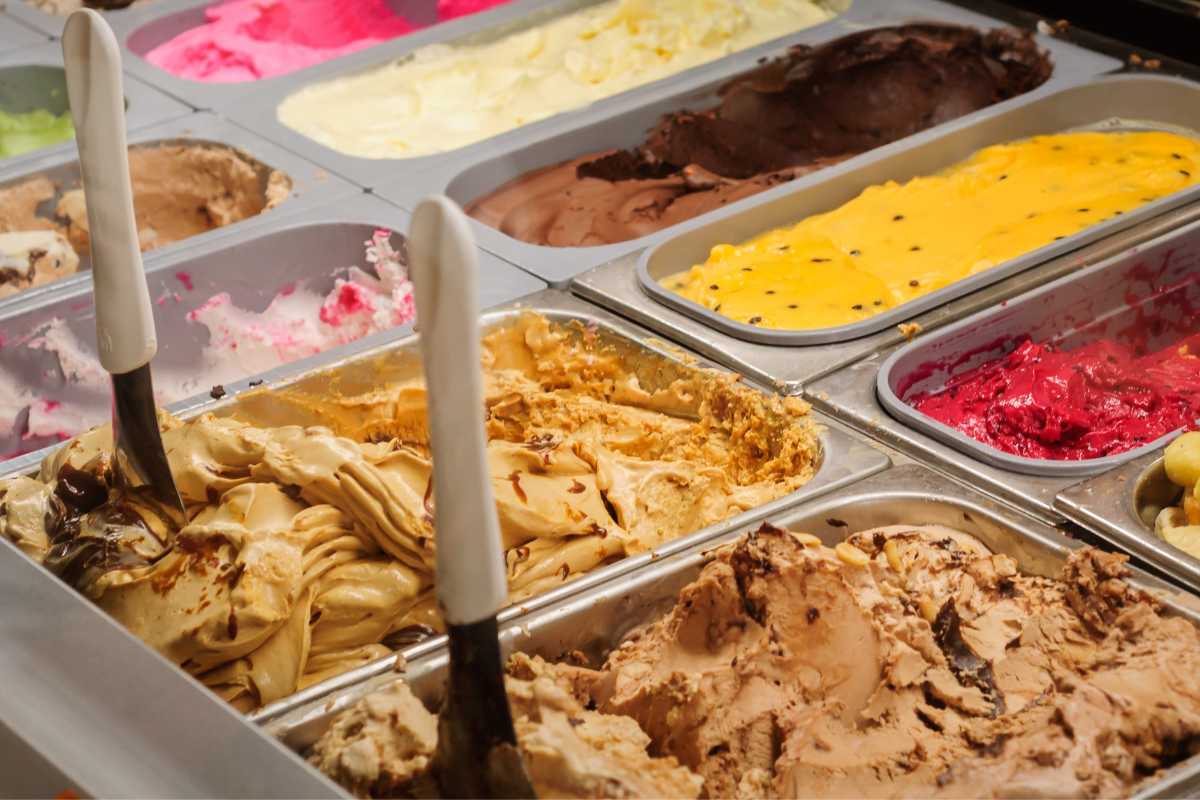
Covered wells, those hidden under metal or glass lids, are almost always a positive sign. Ice cream shops that display product in tall, puffy mounds decorated with artificial fruit and dollops of cream are often compensating for low density with visual spectacularity. Quality ice cream does not need to be displayed: it tends to be below the level of the edge of the well, with a smooth or slightly wavy surface, free from spectacular excesses.
Color also offers useful indications. Authentic pistachio has a green-grey, dull, almost dusty color, far from the bright green that is obtained with food colorings on artificially flavored industrial bases. The natural strawberry turns towards pinkish-orange, not towards the bright red of candy. Quality chocolate tends towards an intense dark brown, not the light brown that results from the heavy use of condensed milk and thickeners. None of these details is an absolute guarantee, but together they build a picture that the attentive consumer can learn to read with some reliability.
What the label says (and what is silent)
For packaged ice creams the issue shifts to the label, where the margin of opacity is even greater. The ingredients are listed in decreasing order of weight: if sugar, glucose syrup or water appears in first place instead of milk, eggs or fruit, the message is unmistakable. But the most relevant data, the overrun, does not appear anywhere.
European legislation does not provide for the obligation to declare the percentage of air incorporated into the ice cream, although this directly affects the value of the product. Producers can therefore inflate volumes without any obligation of transparency towards the buyer. It is a gap that has persisted for decades in the regulatory framework of the sector, and which effectively leaves the consumer without an immediate comparison tool between products that are very different in terms of density and concentration of raw materials.
How to protect yourself: the right questions to ask
In the absence of a regulatory obligation, consumer defense involves active curiosity. Ask the ice cream maker the origin of the main ingredients, find out if the bases are artisanal or purchased ready-made, ask if the pistachio is of certified origin: it is all legitimate information that a serious professional willingly provides. Anyone who responds evasively or with an embarrassed smile is, in most cases, already saying something important.
The quality ice cream market exists and is thriving. But navigating it requires awareness, because the difference between an excellent product and a mediocre one is almost never visible at first glance. In fact, the opposite is often true: the puffiest, most colorful and most spectacular ice cream is, statistically, the one that deserves the least trust.
