
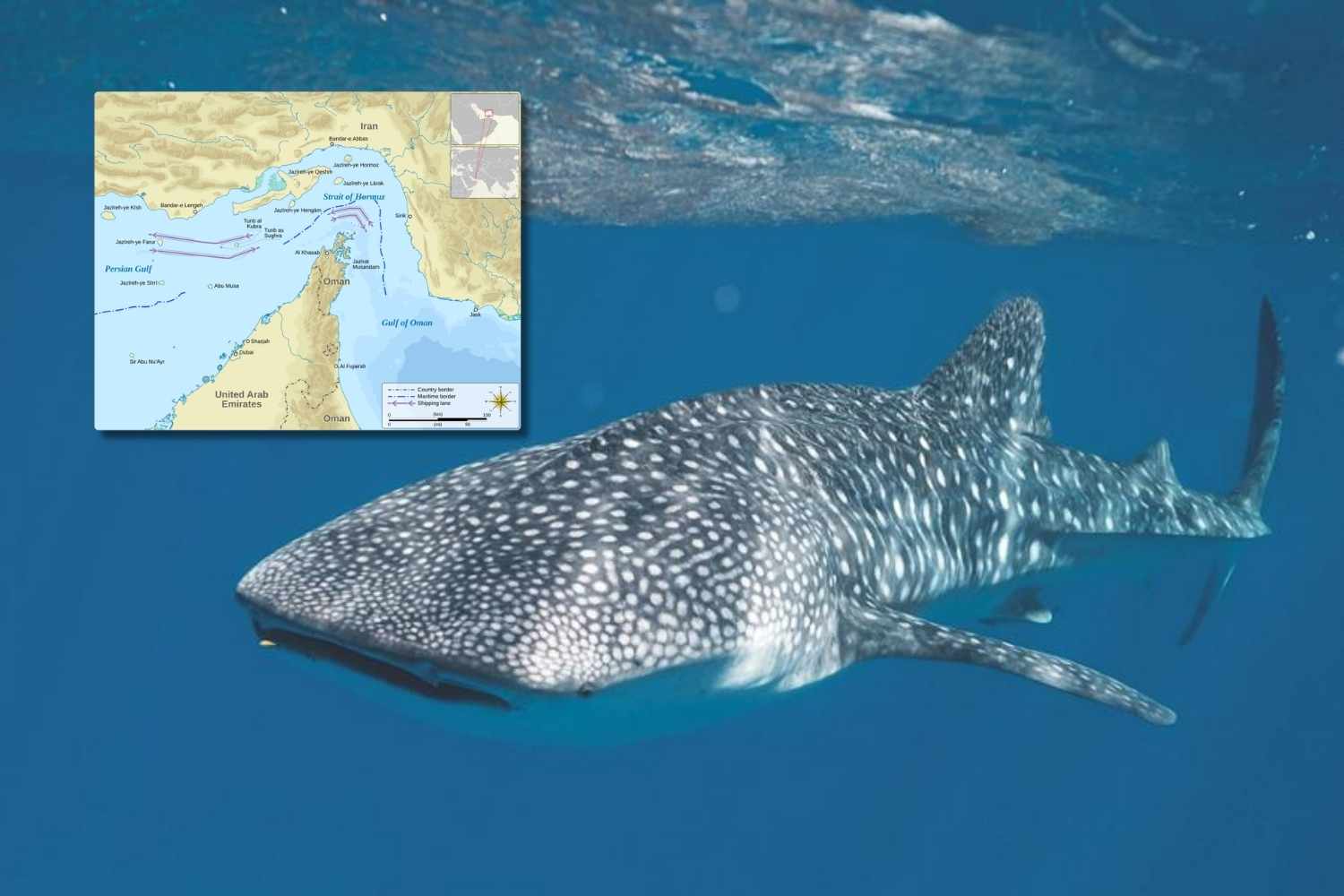
In the heart of the Persian Gulf, the Strait of Hormuz represents one of the most delicate points on the planet: a strip of water a few kilometers long that separates and unites Iran, Oman and the United Arab Emirates, through which a crucial share of the world’s oil transits.
But beneath the surface, this same corridor is also an ecosystem of extraordinary complexity, where species such as the whale shark, dugongs and rare Arabian humpbacks coexist, all linked to an extremely fragile environmental balance. The waters, already naturally warm and salty, have become over the years an involuntary biological laboratory, but also a silent front of ecological crisis.
The whale shark and the routes of survival
Among the most emblematic presences stands out the whale shark, which uses the Gulf as a seasonal feeding area: it concentrates in the Persian Gulf in summer and moves towards the Gulf of Oman in the colder months. However, this migratory balance is increasingly unstable.
The growth of shipping traffic, combined with military tensions in the region, has intensified the risk of collisions and exposure to noise and chemical pollution. Oil tankers and military ships transform the strait into a network of continuous noise that interferes with the life cycles of marine species.
When noise becomes a biological threat
One of the least visible but most devastating impacts is that of underwater noise pollution. Cetaceans, such as Arabian humpback whales, depend on sound to orient themselves, communicate and feed. In such a small space, the noise of military engines and sonars overlaps with biological frequencies, creating a sort of “sonic blindness”. The consequences are serious: disorientation, reduced diving and long periods of forced fasting. For a population already reduced to a few dozen individuals, it means a direct risk of collapse.
Invisible mines, explosions and shock waves
Military activities in the strait introduce an additional level of danger. Naval mines and underwater explosions generate pressure waves capable of damaging the internal organs and hearing systems of fish and marine mammals. Even when non-lethal, these disruptions cause chronic stress and forced displacement. In such a restricted environment, each migration becomes a high energetic cost, which reduces the species’ ability to survive.
An ecosystem that cannot regenerate
The Persian Gulf is a slowly changing basin: its waters take years to completely renew. This means that any oil or fuel spills can persist for a long time, amplifying the effects of each accident. A possible spill into the strait would have knock-on consequences: sea turtles, dolphins, birds and corals would be affected simultaneously. Posidonia oceanica, fundamental for dugongs, would risk disappearing due to turbidity and reduced light.
Dugongs and corals: hidden vulnerability
Dugongs depend entirely on submerged grasslands. When the seabed is disturbed by ship traffic or pollution, these plants disappear, interrupting the food chain. Without them, even the species that depend on them progressively collapse. At the same time, the corals of the Gulf – among the most resistant in the world – are exposed to increasingly intense thermal, chemical and physical stress.
View this post on Instagram
A natural laboratory under geopolitical pressure
The Strait of Hormuz is today a paradox: one of the most strategic energy corridors on the planet and, at the same time, a biological sanctuary that is silently losing its resilience. The overlap between commercial traffic, military tensions and ecological fragility creates an unstable balance, where every geopolitical crisis also becomes an environmental crisis. But unfortunately no one cares.
You might also be interested in:
