
The quality of life in Italy is no longer a single concept, but a sum of different conditions that change radically based on age and province. The sixth edition of the survey of Sun 24 Hours introduces a deeper reading of well-being, based on 60 territorial indicators (20 for each age group: children, young people and the elderly), updated and certified by official sources.
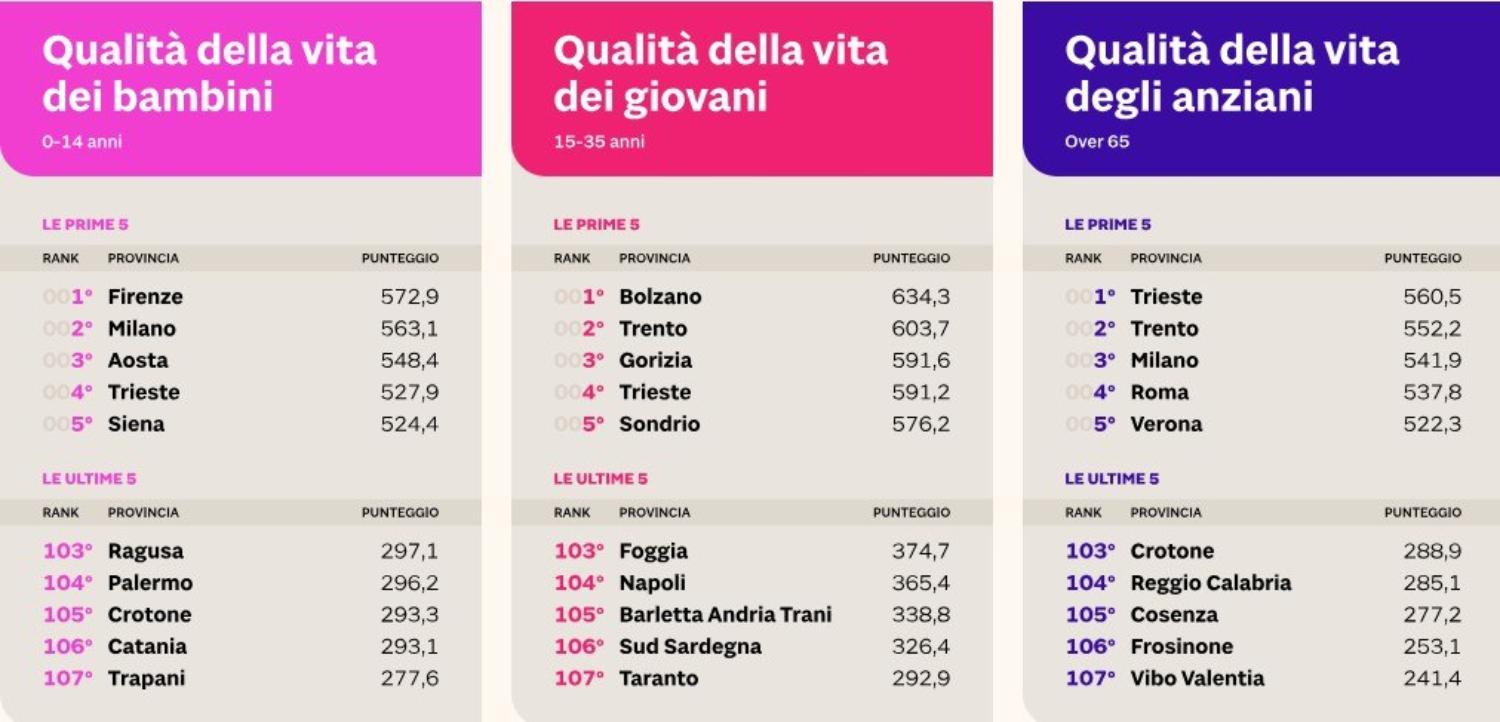
The report photographs a multi-speed country, where child well-being, opportunities for young people and services for the elderly follow very different territorial logics. Three symbolic places emerge at the top of the rankings: Florence for children, Bolzano for young people and Trieste for the elderly population. Among the most significant innovations are two key elements: the presence of supportive social relationships and the possibility of accessing local services within a 15-minute walk, such as pharmacies, shops and recreational spaces.
A changing Italy: fewer children, more elderly people
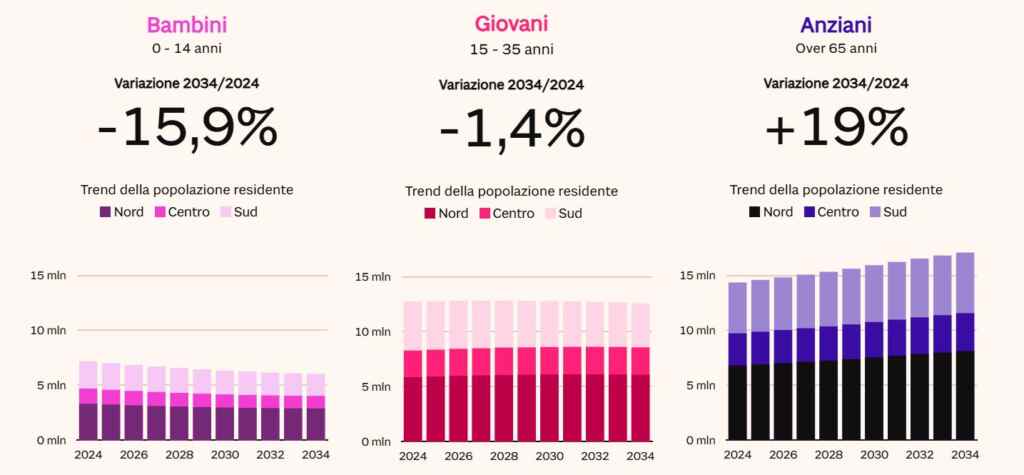
The demographic data outline a critical scenario. According to ISTAT estimates for 2024-2034, the population between 0 and 14 years will decrease between -12% and -19%, while that between 15 and 35 years will only grow in the Centre-North and will decrease by up to -10% in the South. The elderly, on the other hand, will increase by +19%, marking a strong generational imbalance. The country is therefore faced with a progressive “dejuvenation”: fewer young people, more elderly people and growing pressure on the social and health systems.
Children: Florence leads, South in difficulty
In the ranking dedicated to children, Florence stands out as a leader, thanks to educational services, access to pediatric healthcare and a social network. The best also include Milan (advanced health and education services), Trieste, Cagliari and Genoa.
The South, on the other hand, shows more fragility: Trapani closes the ranking. Among the national data, the average fertility of 1.14 children per woman stands out, while in Cagliari it drops to 0.75 children per woman, despite a high presence of paediatricians. Milan stands out for advanced services such as well-equipped schools and widespread healthcare, but loses positions for the average living space of families, equal to 56.6 square metres.
Young people: work and autonomy are the central issue
For young people the main gap concerns work. In Taranto, unemployment under 35 reaches 44%, one of the highest figures in the country, while Bologna confirms itself as a university center with 1 in 2 young people graduated. Bolzano leads the general ranking of young people thanks to employment, services and urban quality, followed by Trento and Gorizia, while other cities show a more fragile balance between training and job placement.
At the bottom of the ranking are many southern provinces, with strong difficulties in employment and education. The Eumetra-Foundation Fair survey adds an interesting fact: 4 out of 5 young people are satisfied with their lives, but only 42% are satisfied with their mental health and just 27% with their work. The most heartfelt issue is not income, but personal balance.
Elderly: Trieste dominates, Milan and Rome solid
Among the over 65s, the leadership is from Trieste, which excels in home care and social participation. Immediately behind is Trento, strong in care services and civil involvement. Milan, on the other hand, records the highest average pension benefits in the country, equal to 26,300 euros per year, while cities such as Bari, Naples and Palermo stand out for the presence of local services dedicated to the elderly. The North-East dominates the ranking overall thanks to health services, home care and social participation. At the rear is Vibo Valentia, symbol of the still marked territorial divide.
A country between imbalances and social transformations
The survey highlights an Italy undergoing profound changes: the number of people living alone is increasing (+7.9%), the consumption of antidepressants is growing (+3.3%) and scholastic skills are worsening, with 44% of students experiencing numerical difficulties and 39.9% in language skills. The average age of mothers rises to 32.7 years, while marriages fall to 2.8 per thousand inhabitants.
North leading, South trailing: a structural divide
The final picture confirms an unfortunately consolidated trend: the North dominates almost all the rankings. The top 20 positions of young people are entirely Northern, while 18 of the last 20 belong to the South. Among the most balanced territories emerge Trieste, Trento and Aosta, capable of maintaining good results over several generations.
A compass for the future of the territories
The 2026 index is not just a ranking, but a snapshot of the country’s fragilities. Services, work, education and social relationships become decisive factors in understanding where people live best and why. An Italy that changes quickly, but still unequally.
You might also be interested in:
