
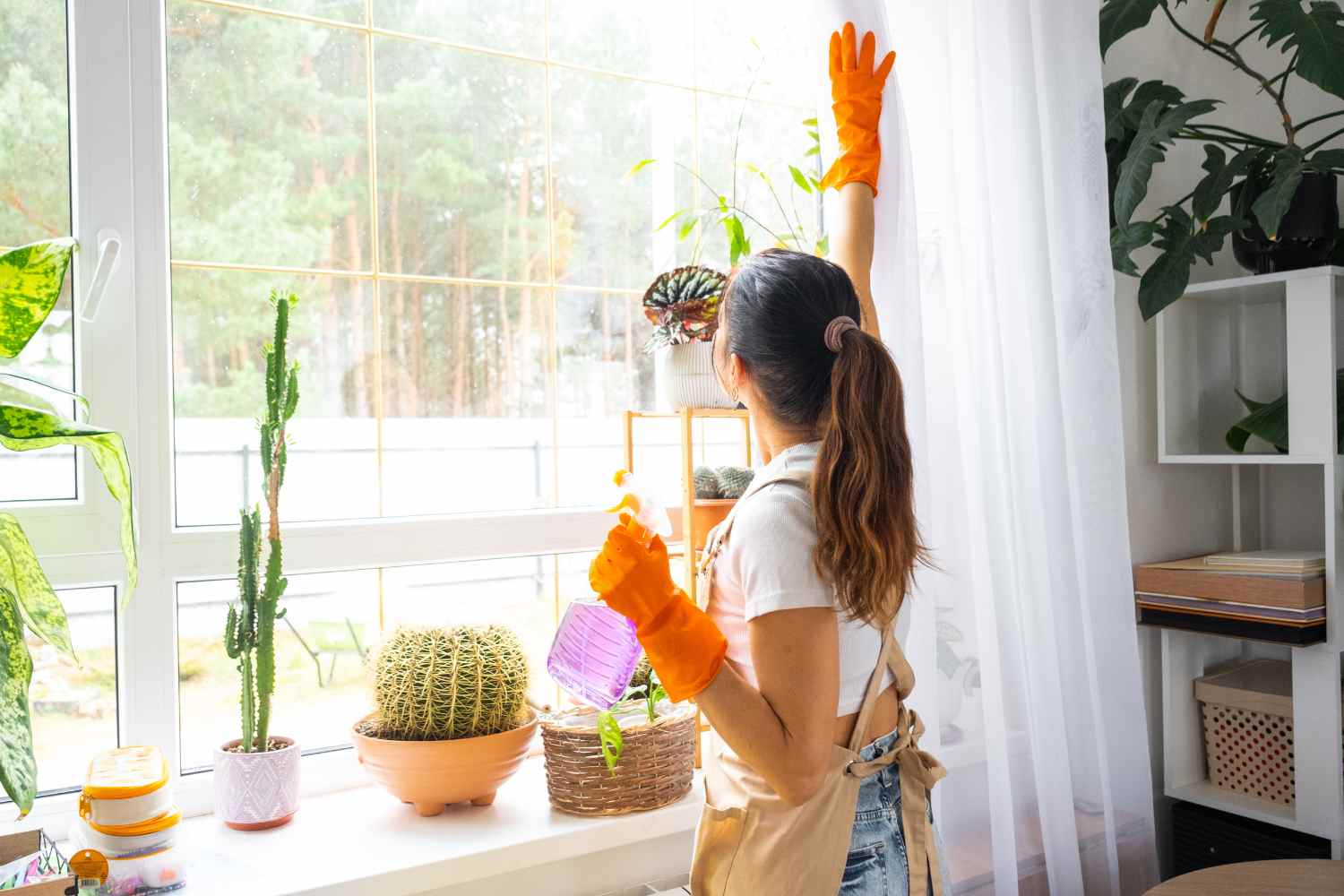
Spring cleaning was not born as a simple domestic need or as a seasonal change ritual. The underlying idea is much more stratified: it is a gesture that combines hygiene, symbolism and calendar, and which has its roots in civilizations that are distant from each other but surprisingly aligned on a precise point – the need to “start again” when nature renews itself.
Between March and April, with the lengthening of the days and the increase in light, closed environments during the winter begin to be experienced differently again. But even before being a practical question, this moment has historically been interpreted as a threshold: the end of one cycle and the beginning of another. Cleaning the house, therefore, meant putting order back also on a symbolic level, eliminating what belongs to the past.
It is from this overlap between material necessity and cultural meaning that the expression “spring cleaning” was born, which has now entered common language but was originally full of a much deeper value.
The religious root: Jewish Passover and the removal of the “chametz”
One of the oldest references to this practice is found in Jewish tradition, particularly in the preparation for Passoverthe Jewish Passover. This holiday falls in spring, after the first full moon following the equinox, and commemorates the liberation of the Israelites from slavery in Egypt.
Before the celebration begins, families must remove all traces of chametzor leavened foods. This is not a superficial cleaning: every corner is checked, every residue removed. The gesture has both a historical and symbolic meaning. According to the biblical story, the escape from Egypt was so sudden that it did not even allow the bread to rise. Eating unleavened bread and ridding the house of yeast therefore becomes a way to relive that founding event.
This practice, repeated for centuries, has contributed to consolidating the idea of a deep cleaning linked to spring. It is not just an act of domestic order, but a form of cultural memory that is expressed through concrete gestures.
Persian Nowruz: “shaking the house” to start again
Another fundamental tradition comes from the Persian world with the Nowruzthe New Year celebrated exactly at the time of the spring equinox. Here cleanliness takes on an even more explicit form as a rite of passage.
The practice is known as “house shaking” (khaneh tekani), an expression that conveys the idea well: it is not just a matter of tidying up, but of intervening radically on the domestic environment. Carpets and curtains are washed, broken objects are fixed, clothes and fabrics are changed or renewed, unnecessary accumulations are eliminated.
This process has a very clear symbolic value: leaving behind what is old, stagnant or deteriorated to welcome a new beginning. In this sense, Nowruz is not simply a celebration, but a moment of realignment between domestic space, time and identity.
It is interesting to note how this practice anticipates by centuries concepts that are very widespread today, such as decluttering or domestic sustainability. The idea of repairing instead of replacing, of ventilating instead of accumulating, is already present in these traditions.
Chinese Lunar New Year: Wiping away bad luck
Even in China there is a very similar custom, linked to the Lunar New Year, which falls between the end of January and February, just before the arrival of spring. In this context, cleaning is called “sweeping away the dust”.
The meaning goes beyond simple hygiene: the dust symbolically represents bad luck and negative energies accumulated during the year. Cleaning the house therefore means getting rid of it, creating a favorable space for good luck.
However, there is a precise rule: cleaning must be completed before the celebrations begin. Once the new year begins, sweeping or cleaning would be counterproductive, because it would also be equivalent to eliminating the luck that has just arrived.
This detail reveals a central aspect of these traditions: the relationship between daily gesture and symbolic system. Even a simple action like passing the broom can take on different meanings depending on the moment it is performed.
A common thread: purification, time and space
Despite cultural and geographic differences, these traditions share a similar structure. Cleaning always takes place at a time of transition – equinoxes, New Years, religious holidays – and has the aim of preparing the space for a new phase.
The home, in this context, is not just a physical place but an extension of the person and the community. Cleaning it up means intervening on a broader system, which includes memory, identity and expectations for the future.
This explains why spring cleaning has survived over time, even when its original meaning has faded. The idea of “making space” continues to be intuitively powerful, even in completely secularized contexts.
What remains today
Today, spring cleaning is often perceived as a practical habit, linked to seasonal tidying up or the need to air out rooms after the winter. However, some traces of the original meaning remain.
The desire to eliminate the superfluous, to reorganize spaces, to change the arrangement of objects is not only functional. It responds to a deeper need for renewal, which continues to emerge cyclically.
It is no coincidence that many contemporary practices – from minimalism to decluttering – unconsciously take up the same pattern: getting rid of the past to build a lighter and more manageable present.
Spring cleaning therefore represents an interesting example of cultural convergence. Different peoples, in distant times and contexts, have developed similar practices to respond to the same need: to mark the transition from one phase to another through a concrete gesture.
This universality suggests that the need for renewal is not only cultural, but also deeply human. The home becomes the place where this need manifests itself visibly, transforming a daily action into a collective ritual.
And perhaps this is precisely why, even today, the idea of “spring cleaning” continues to work: not because it is necessary, but because it speaks to something deeper than a simple domestic habit.
