
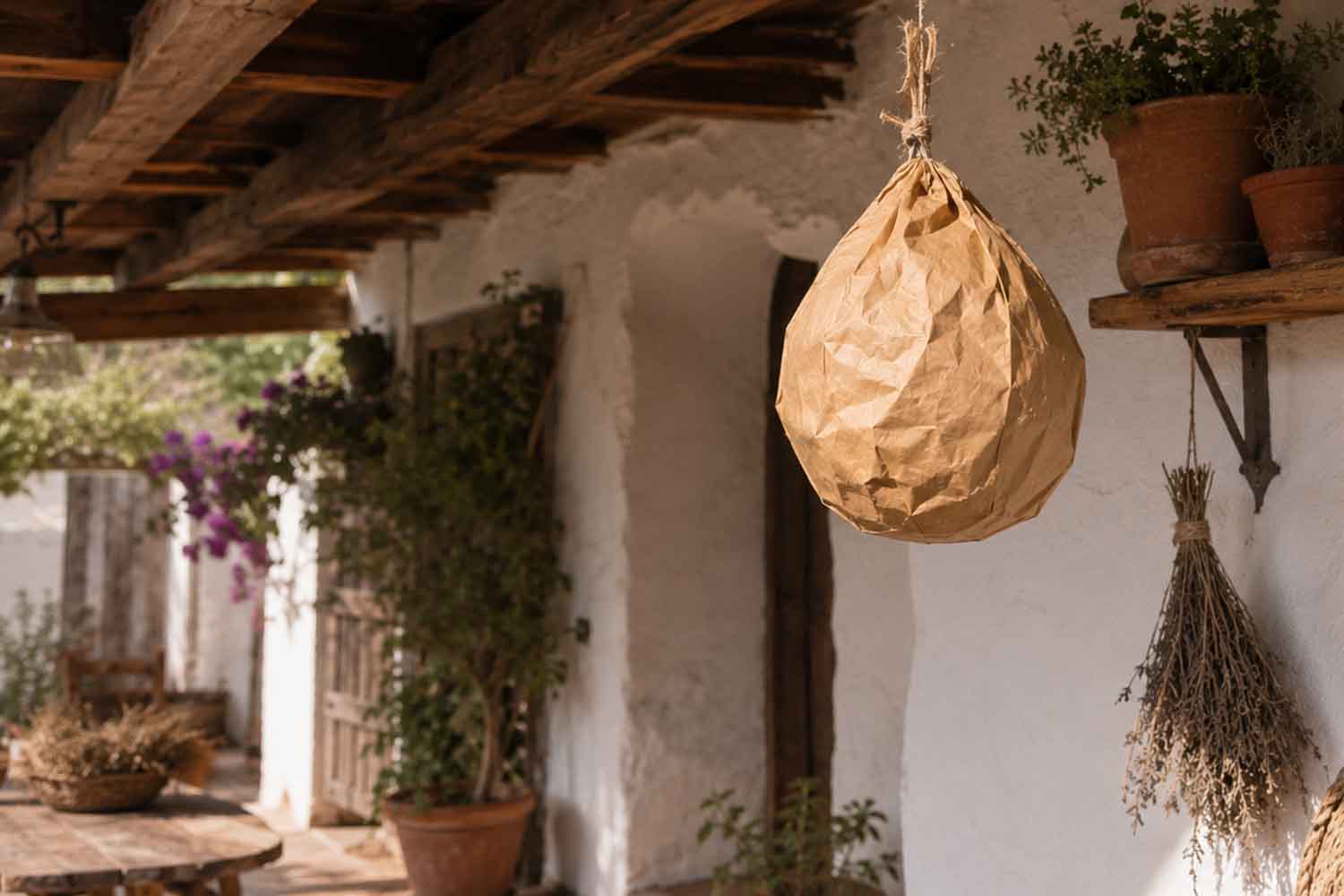
A paper bag hanging from a branch seems like one of those garage solutions, born between a clothespin, a rope found at the bottom of the drawer and the slightly stubborn hope that nature lets itself be fooled with little. Yet, every spring, when the bees, wasps, hornets return and the garden begins to do its job as a small noisy ecosystem again, even these minimal ideas begin to spin. The trick is simple: take a kraft paper bag, inflate or crumple it, close it so that it vaguely resembles a nest and hang it in a clearly visible place, under a canopy, near a tree, in a sheltered area. The goal would be to make an Asian hornet founding queen believe that space is already occupied.
The story works well because it has its own immediate logic. In spring, a queen looks for a suitable place to found the colony. If from afar it intercepts a shape similar to an already inhabited nest, it may avoid it and move elsewhere. Everything clean, everything cheap, no insecticides sprayed at random, no generic traps capable of causing damage even to beneficial insects. The problem lies in the verb: could. Solid evidence on the effectiveness of fake nests remains weak, and some entomologists urge caution because several wasps can nest even at close range or reuse existing structures. So yes, the fake nest can be described as a low-impact preventative attempt, not as a safe remedy. The difference seems small. In the garden, however, it changes a lot.
The hanging bag
The interesting part here is the measurement. A bag of paper costs almost nothing, leaves no residue, does not kill bees, bumblebees, butterflies and other pollinators who already fare badly enough without our creative help. It can be prepared in a few minutes: kraft paper, a bit of string, a rounded and irregular shape, a position well exposed to view. Better under a roof overhang, among the branches of a tree, near a porch or in an area where suspicious movements have been seen in previous years. It must seem like an already installed presence, not a sad bag forgotten after shopping.
The calendar weighs more than the object. The false nest makes sense at the beginning of the season, when the queens come out of the winter and are looking for a place to build their first nest. In France we often talk about the period between March and June for the foundation of the first nests; in the source text the reference was mainly to April and May, that is, the window in which many gardeners begin to pay attention to the first insistent flights. Once the colony is started, that bag becomes rustic decor. Maybe even nice, but without much use.
It must be said clearly: the Asian hornet, Vespa velutina, is not just any wasp that ended up by chance near the basil pot. It is an invasive alien species, native to South-East Asia, which arrived in Europe in 2004 and in Italy reported since 2012 in Liguria, with a localized presence especially in some areas of the North and a spread kept under observation. It preys on bees and other insects, affects beekeeping and puts pressure on ecosystems. ISPRA describes it as a hornet with a blackish-brown livery, with a yellow-orange frontal part of the head, legs with yellow ends and an abdomen marked by a thin, lighter band and a clearly visible yellow-orange area.
Better early than late
The real nest, when it exists, must be taken seriously. That of the Asian hornet can become large, subspherical, often built into trees, buildings, hedges and in some cases even closer to the ground. ISPRA indicates diameters between 50 and 80 centimeters and frequent placement above ten meters in height. This detail matters because many people only imagine danger when they see something close at hand. Instead, sometimes, the problem lies overhead, hidden among the leaves, until the colony’s activity becomes evident.
For this reason, the paper bag, if you really want to try it, should be part of a much more concrete strategy: observe the garden, check sheds, sheds, hedges, low branches and sheltered areas, avoid do-it-yourself in front of an active nest, report suspicious sightings. The Stop Velutina network indicates three central actions: reporting the presence of the insect or the nest, eliminating the nests through competent channels and using anti-wasp traps at the right times, especially in spring to intercept the founding queens or between late summer and early autumn for new queens.
In Italy there is also a national management plan for the Asian yellow-legged hornet, approved by MASE in 2022; some Regions, such as Tuscany, have activated specific plans with monitoring in apiaries, collection of reports, staff training and destruction or neutralization of nests by trained teams. Tuscany, for example, recalls that the species arrived in the regional territory from Liguria and has spread since 2017 in the north of the region up to the province of Florence. Here the issue stops being a garden trick and becomes public management, beekeeping, biodiversity, money, personnel, intervention times.
The trick and the limit
The temptation for a simple remedy is understandable. Anyone who has a vegetable garden, a balcony full of flowers, two hives nearby or just a table in the garden where they can eat without feeling under siege wants something very normal: to prevent the problem before it becomes big. In this sense the fake nest has an advantage: it pushes us to look first, to act first, not to wait for August with a now structured colony and thousands of insects on the move.
Then comes the limit, the least comfortable one. The Asian hornet cannot be fought with a single gesture. France, where the species was accidentally introduced in 2004, has now recognized that eradication with current means is no longer realistic and aims to limit impacts with coordinated actions, research, targeted destruction of nests and protection of apiaries. It is a weighty sentence, because it says something simple and rather unpleasant: when an invasive species stabilizes, the lost time is paid for for years.
Hanging a paper bag, then, can only make sense if it stays in place: a small, preventative, harmless visual deterrent, to be tried soon and without illusions. Alongside this, there must be open eyes, rapid reporting, respect for pollinators and zero heroism in front of an already formed nest.
You might also be interested in:
