
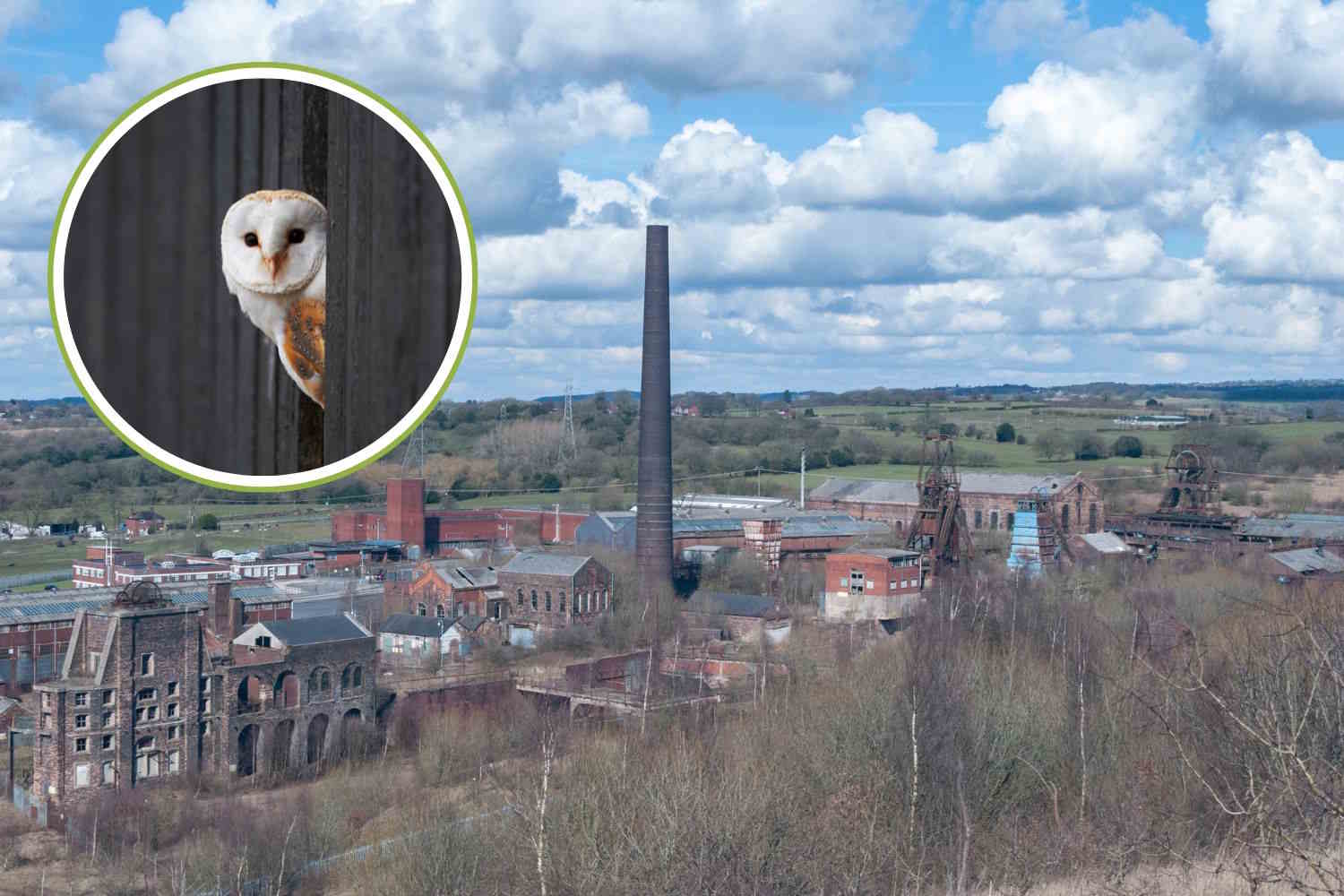
At first glance they just seem like old iron, bricks marked by time, rusty towers left standing due to stubbornness. Chatterley Whitfield, in Staffordshire, England, belongs to that category of places that industry leaves behind when it stops digging: huge, difficult to manage, full of memory, too expensive to recover quickly and too important to be erased with a bulldozer.
Then you look better. Roses, wild flowers and strawberries grown on the old piles of coal slag appear among the remains of the mine. Inside the tall buildings, those that once served to bring men underground, today barn owls and short-eared owls move. The wheels of the mining castles, those large structures used to lower the miners underground, still act as a frame. Only now, instead of coal, a white shadow passes.
The Chatterley Whitfield mine produced coal until 1976. After the formal closure of the mine, it reopened two years later as a museum, attracting tens of thousands of visitors for years. In 1993 that chapter also closed. Since then the site has remained there, suspended between protection, abandonment and recovery projects. A huge piece of industrial archaeology, with listed buildings, towers, workshops, still recognizable structures and a fragility that grows every winter.
The mine returned to its den
Documenting this transformation was Andrew Mason, photographer and son of John Mason, one of the miners who worked at Chatterley Whitfield in the 1960s. His return to that place has something concrete and almost domestic: a son who returns to his father’s work space and finds, among cracked walls and worn beams, a life that in the meantime he has learned to slip into everywhere.
With permission from Stoke-on-Trent City Council, which is responsible for the property, Mason set up a camouflage shed inside the former mining complex to observe the animals without disturbing them. From there he photographed barn owls and short-eared owls among the disused buildings, at the highest points of the mine, where the structures become perfect perches for checking the terrain and identifying prey.
The scene works precisely because it holds together two worlds that seemed destined to ignore each other. On the one hand, the iron, the rust, the towers, the old technical buildings. On the other, the silent flight of a nocturnal bird of prey, the grasses grown without permission, the patience of a nature that arrives without inaugurations, without signs, without ribbon to cut.
One of the strongest images shows a single barn owl streaking through the air in front of the mining castles, with the tarnished towers in the background. The white of the animal, almost unreal, passes in front of a car that has been stopped for decades. It seems like a photograph constructed on purpose, but instead it’s just the somewhat brutal precision of the places when they stop obeying the function for which they were designed.
Flowers on the waste
The word “rewilding”, in cases like this, always risks seeming tidier than reality. Here renaturalization has the least elegant and most convincing aspect of things that grow wherever they happen: wild strawberries on coal residues, flowers among ruins, birds of prey inside buildings that no one had designed for them. Mason said he saw precisely this alienating detail, small strawberries growing on old slag heaps. A kind of botanical note written on industrial history.
The site, moreover, offers shelters, heights, cavities, quiet areas and open spaces around. For a barn owl, an abandoned tall building can become an ideal observation point. For a short-eared owl, open environments and grassy areas can provide hunting opportunities. For foxes and badgers, who according to local observations frequent the area, the disused structures and little disturbed land become corridors, possible dens, passages.
Mason hopes to soon set up camera traps to record even these more elusive animals. It would be another way to read the mine without easy nostalgia. Not as a romantic ruin, not as a post-industrial postcard setting, but as a contested space between human memory and animal return.
Chatterley Whitfield, before becoming this great carcass inhabited by birds of prey, had been the largest mine in the area and one of the most important in the country. In 1937 it was the first in the UK to exceed one million tons of salable coal in a single year. An enormous record, built on the arms of thousands of men, on tough shifts, on entire families linked to life underground.
This is why the presence of owls does not erase anything. Indeed, it makes everything more visible. The towers remain towers. The mining castles remain signs of work, effort and risk. Except that today, among those structures, a form of life passes by that does not ask permission from industrial memory. He crosses it.
Living and fragile heritage
Chatterley Whitfield is also an open problem. The buildings are protected, the site appears in the registers of historic heritage at risk, and its conditions require complex interventions. Conserving such a large mine means dealing with safety, costs, constraints, degradation and regeneration projects. In the meantime, however, the fauna is already using it. Without waiting for the perfect plan.
This is the most interesting part of the story: nature here does not return to an “empty” place. Return to a very full place. Full of work, mourning, local pride, failed tourism, promises of recovery, bureaucracy, sagging bricks, rusting iron. Green comes into all this and complicates it. It makes it less firm.
In a country like England, where industrial heritage is often part of the collective identity, an abandoned mine is not just a ruin. It is a material memory. Chatterley Whitfield talks about coal, industrial growth, the decline of a sector, the economic transformation of entire communities. Seeing a barn owl fly in front of those structures adds a further level: it shows what happens when a place ceases to belong only to its original function.
The abandoned mine thus becomes a kind of open archive. The walls preserve the history of human work, the animals rewrite it with their daily presence. There is no need to choose between one thing and another. We just need to prevent degradation from destroying everything before someone finds a decent balance between protection, safety and wildlife. Because in certain photographs nature seems to win. In fact he works slowly, occupies gaps, tries, loses, returns. A barn owl passes between two rusty towers and for a second the site seems to breathe again. Then the silence remains, the real one.
You might also be interested in:
