

Chocolate-filled biscuits, soft snacks, cereal bars, packaged croissants. They are the snacks that fill children’s backpacks throughout Europe and are often perceived as “harmless” or even suitable for childhood.
Yet a new analysis carried out by the French magazine 60 Millions de Consumers out of 82 products intended for children, it dispels this perception: 91% of the snacks analyzed are ultra-processed.
A fact which, as often happens in these tests, may seem like a “hot water discovery” for those who closely follow the topic of industrial food, but which remains fundamental for a simple reason: not all European consumers are really aware of what ultra-processed means and, in the meantime, these products continue to occupy a stable place in everyday food life, especially for the little ones.
The analysis was conducted in collaboration with Yuka — the well-known app that, by scanning the barcode of products, helps consumers decipher their real composition. From this source, the compositions of products belonging to 10 categories of children’s snacks were extracted, studying for each one the content of sugars, fats and saturated fatty acids, as well as the number of ultra-transformation markers present, such as emulsifiers, colorings and artificial flavourings.
Products marked with the “red flag” are those that contain problematic additives and/or the highest levels of sugar and fat, with more than four indicators of ultra-processing. The scores assigned by Yuka’s algorithm were not taken into consideration.
Ultra-processed foods: what it really means
When we talk about ultra-processed foods we are referring to industrial products that do not simply “transform” a raw material, but break it down and recompose it through a long chain of processes, until obtaining a final food that would hardly have a domestic equivalent. In these products, in fact, the ingredients are no longer simply flour, milk or cocoa, but combinations of derived substances, such as syrups, refined fats, isolated proteins, flavorings and additives which serve to modify taste, consistency and shelf life.
The result is a food that can be very pleasant on the palate and stable over time, but which progressively distances itself from the structure and simplicity of “basic” foods.
As French experts point out, there are several studies that highlight how a diet rich in ultra-processed foods is associated with an increased risk of obesity, metabolic and cardiovascular diseases. And children in Europe consume more of them than adults: around 46% of daily calories come from these products.
One of the most critical aspects highlighted by the test concerns the combination of very high sugar content, long list of industrial ingredients and strong “child-friendly” marketing (characters, colorful packaging, historic brands). It is precisely this mix that makes snacks so attractive for the little ones and so problematic from a nutritional point of view.
The most obvious critical issues emerge in the categories of chocolate snacks, filled biscuits and cereal bars intended for children. The highest levels of industrial transformation are concentrated in these products.
It is not uncommon to find products with sugars above 40g per 100g, refined oils as main ingredients and a long list of additives, flavorings and syrups. In many cases, these are foods built more on the basis of their commercial and sensorial function than their nutritional one.
Kinder and Ferrero, among the sugariest products
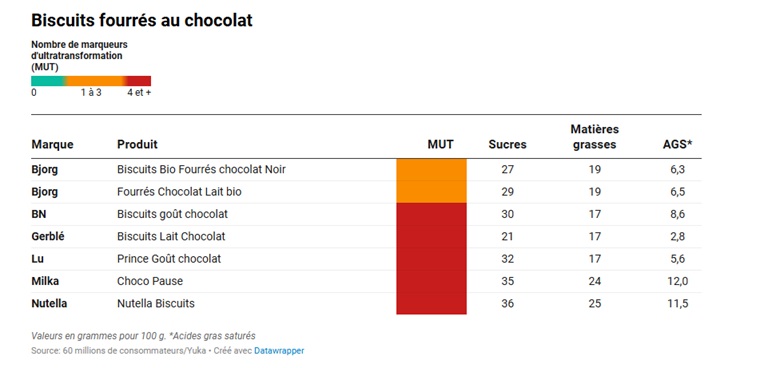
Among the most popular brands in Italian supermarkets, the Ferrero group stands out, with some products included in the analysis. The picture that emerges is rather coherent and concerns above all the high sugar content and the strong presence of ingredients typical of ultra-processed foods.
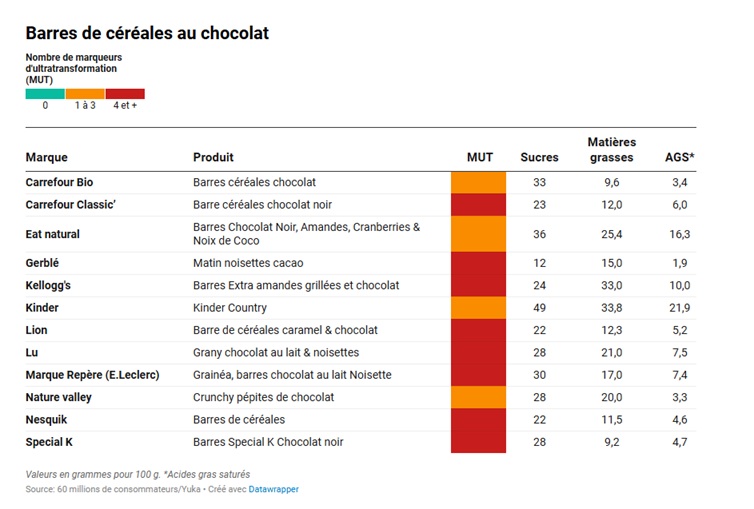
In detail, Kinder Délice is among the sugariest products in the category, with approximately 43 g of sugar per 100 g and a nutritional profile typical of ultra-processed snacks. Kinder Country also shows similar critical issues, with a high share of sugars and fats and the presence of various ultra-processing markers. To complete the picture, Nutella Biscotti are among the worst in the filled biscuit category, with significant levels of sugars and saturated fats, as well as the presence of palm oil.
In general, the test suggests that many Kinder products are formulated to be extremely pleasant to the taste, but not very satiating: a characteristic that can encourage repeated consumption and make the snack less effective as a moment of energy balance between meals.
@60 Millions de Consumers
@60 Millions de Consumers
Milka, LU and Kellogg’s
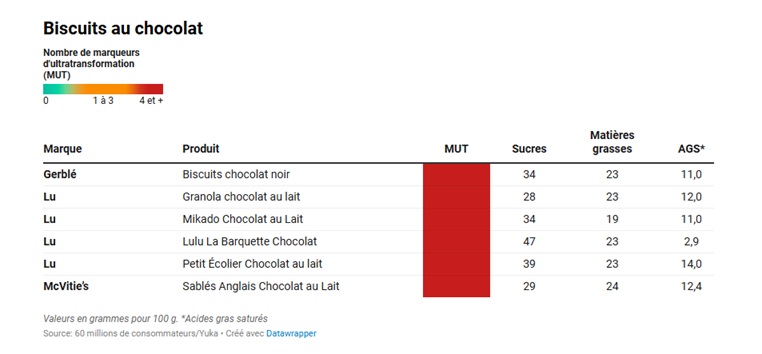
Alongside Kinder, critical issues also emerge for other brands that are very present in the European and Italian markets. Milka Choco Pause stands out for its high sugar and saturated fat content, while several LU products, such as Petit Écolier and other chocolate snacks, have long lists of ingredients and a significant presence of additives.
A separate chapter concerns cereal bars, such as Kellogg’s, often perceived as a “light” choice or suitable for a snack. Instead, analysis shows that many of these bars feature sugar or glucose syrup among the first ingredients and a very small amount of real fruit, often less than 5%. The “fruity” or “grainy” flavor is frequently achieved through added flavors rather than through significant natural ingredients.
Only some versions, in particular organic ones or with more essential ingredient lists, stand out for a slightly simpler composition, without transforming this category into a truly nutritionally balanced choice.
Overall, despite differences from product to product, many of these snacks share a basic characteristic: more than foods in the strict sense, they are industrial formulations built to maximize taste, shelf life and palatability.
@60 Millions de Consumers
@60 Millions de Consumers
The “least worse”
Although the general picture is strongly oriented towards ultra-processed products, the study identifies some relatively more balanced categories.
Croissants and milk bread are on average less sugary and less complex in terms of ingredients than other snacks. Some versions, particularly those with simplified recipes or organic versions, show shorter ingredient lists and a composition closer to that of a traditional baked product.
Even simple dry biscuits represent a more nuanced category: some products come a little closer to an essential domestic recipe, although they are often characterized by a non-negligible content of saturated fats, which still requires moderate consumption.
Among the products that are relatively “saved”, the study highlights some references from large-scale retail trade, in particular from the Carrefour Bio line, which in the categories of cereal bars and simple biscuits are among the least complex options from a formulation point of view. In these cases, in fact, the ingredient lists are generally shorter and with less use of syrups and additives than many industrial snacks intended for children, even if they are still ultra-processed products.
Even some brioches and baked products from the same brand, especially in the simpler versions or without excess added sugar, show a slightly more balanced profile than the average of the snacks analyzed.
What to choose for children’s snacks
If we really have to buy something packaged, we must always keep in mind that fewer ingredients and fewer industrial transformations correspond, in most cases, to better nutritional quality. Likewise, a reduction in sugars contributes to greater satiety, while less use of marketing and aggressive packaging reduces the risk of excessive consumption.
In this context, the most balanced alternatives remain simple and minimally processed foods such as fresh fruit, plain yogurt or simple bread combined with natural ingredients, as well as homemade preparations when possible.
Perhaps the most relevant fact is not that biscuits, snacks and biscuits are problematic in an absolute sense, an aspect now known in the scientific literature and also in the public debate, but rather the fact that they continue to be perceived as normal snacks for children.
Analyzes like this, even when they confirm trends that have already emerged, remain useful because they help to make more readable what is often hidden behind attractive packaging and reassuring marketing strategies.
