
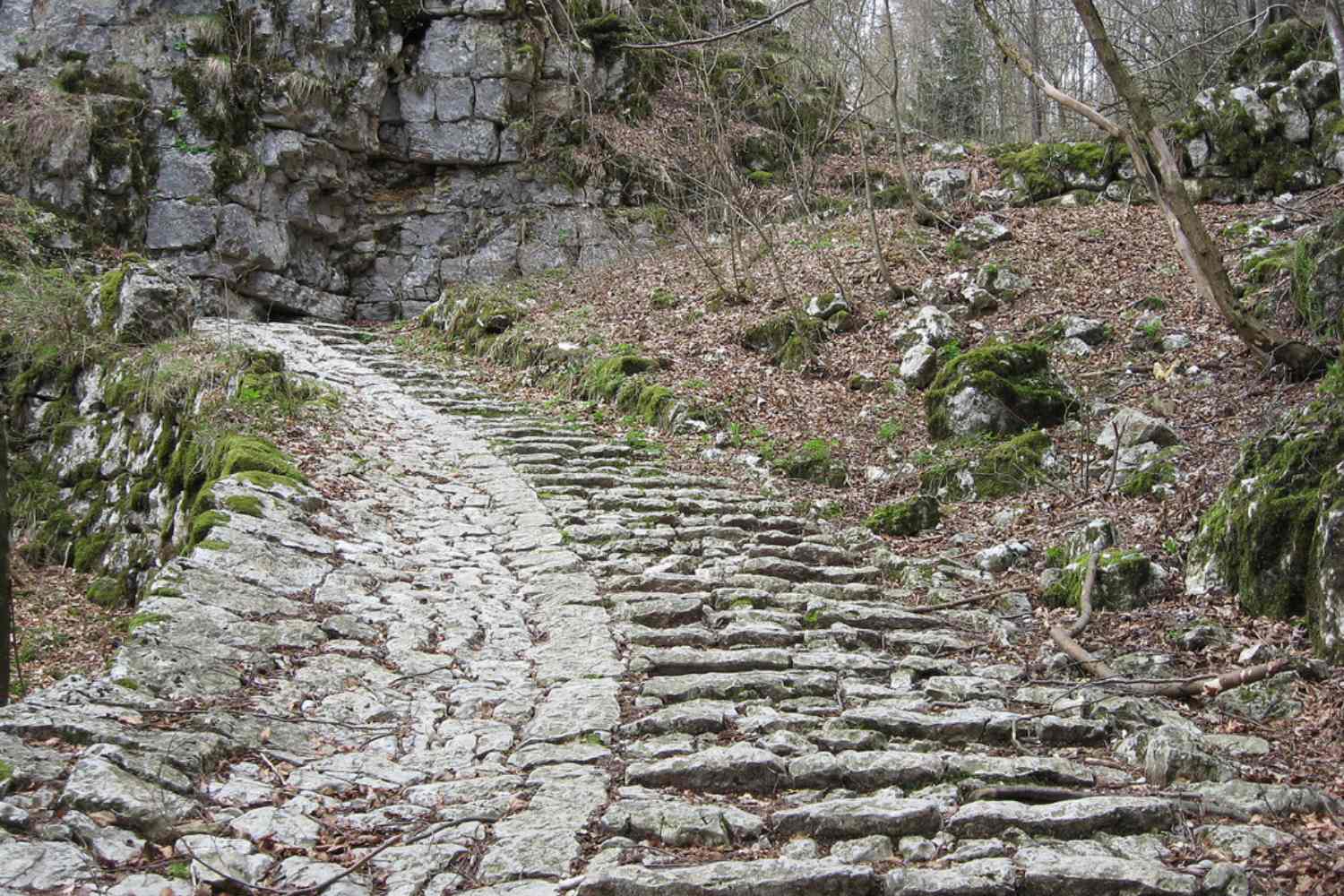
In the heart of Veneto, in the province of Vicenza, lies one of the most extraordinary staircases in Italy and among the longest in the world. It’s called Calà del Sasso, and those who don’t know it are missing something that’s difficult to put into words. It is not a postcard staircase, it was not built to embellish a square or frame a cathedral. It is something older and more concrete: a medieval infrastructure that changed the lives of entire communities, uniting the mountains to the plain for centuries, and which today returns to speak to those who want to listen to it.
A staircase born from necessity, not from aesthetics
There are human works that are born to be admired and works that are born to function. Calà del Sasso belongs to the second category, and for this reason it deserves respect and attention. Built in the 14th century under the rule of Gian Galeazzo Visconti, this long stone staircase was conceived with a precise and pragmatic objective: to create a safe and independent route to bring the timber from the Sette Comuni plateau down to the valley.
The name already says it all. “Calà” derives from the ancient Venetian and means descent, descent. There is no ambiguity, there is no forced poetry. It is the exact description of what this structure did: it allowed timber to descend from the mountain to the valley, and men to move between two worlds that would otherwise remain separated by steep slopes.
A large stone channel still runs next to the steps. There the woodcutters slid the logs, which were then collected in Valstagna, loaded onto rafts and transported along the Brenta river to Venice. A logistics system of surprising efficiency for its time, designed and built with a precision that today we would call engineering.
View this post on Instagram
The wood of the plateau and the power of the Serenissima
To understand the historical weight of Calà del Sasso you need to understand what the wood that passed through it was used for. It wasn’t just any raw material, the wood from the Altopiano dei Sette Comuni was among the most valuable in the Veneto, and its main destination was the Arsenal of Venice: the gigantic war and trade machine of the Serenissima Republic, which produced ships in such quantity and speed as to amaze visitors from all over Europe.
Without that timber, the Venetian fleet could not have existed on the scale that made it a Mediterranean power. And without Calà del Sasso, that wood would not have been able to reach Venice efficiently. The staircase was therefore an essential cog in a vast economic and political system, which connected the forests of the Venetian hinterland to the international trade of the Mediterranean.
The route was used intensively from the 15th to the 18th century, also to bypass alternative routes, which in those years were subject to heavy customs duties. The Calà del Sasso was a free, controlled, efficient route. Those who traveled it saved time, unnecessary effort and money.
The woodcutters, the raftsmen and the mountain life
It wasn’t tourists or hikers who walked up this staircase every day. They were workers. The woodcutters from the plateau came down accompanying or following the wood, then in Valstagna they stocked up on food and objects that were in short supply in the mountains: salt, fabrics, tools. Then they went back up, on foot, along the same 4444 steps, with the load on their shoulders.
The rafters from Valstagna were instead the protagonists of the next part of the journey: they collected the wood upon arrival at the Calà, tied it into rafts and took it along the Brenta to the lagoon. It was dangerous, physically very hard work, which required experience and in-depth knowledge of the river. These two figures, the woodcutter and the raftsman, were the silent protagonists of a production chain that supported the economy of an entire region.
Calà del Sasso was the meeting point between their worlds. It was the place where the mountain delivered its resources to the plain, where two different communities met, traded and understood each other. In this sense, it was much more than a staircase: it was a place of cultural and economic exchange.
The numbers of an extraordinary staircase
Talking about Calà del Sasso without mentioning the numbers would be a mistake. The staircase is made up of 4444 steps, a number that almost has the flavor of an invented round figure, but which is real and verified. It extends for approximately 2546 meters in length and overcomes a difference in altitude of 744 metres, starting from the hamlet of Lebo in Valstagna, today in the municipality of Valbrenta, at 221 meters above sea level, and arriving at the church of Sasso di Asiago, on the Sette Comuni plateau, at 965 metres.
It is marked by trail marker number 778 and can be explored all year round, although conditions change considerably with the seasons. In winter the steps can be slippery and the forest becomes quieter and more severe. In spring the vegetation explodes and the route becomes a green corridor of rare beauty. In summer you walk in the shade of the trees, protected from the heat of the plains. In autumn the colors of the leaves transform the staircase into something that seems to have come out of a story.
View this post on Instagram
From the Middle Ages to abandonment, up to recovery
Like many historic infrastructures, Calà del Sasso has also experienced its period of oblivion. Between the 19th and 20th centuries, the construction of new communication routes made the staircase progressively less useful from a practical point of view. Carriage roads, then carriage roads, then asphalt roads replaced the old walking paths. The lumber could travel on wagons and trucks, it no longer needed to slide down a stone channel.
The staircase fell into disuse, was forgotten, left to the neglect of time and vegetation. For decades it remained there, waiting, covered in moss and brambles, known only to the older inhabitants of the nearby villages.
Then came the recovery. Thanks to the work of local communities, associations and institutions, Calà del Sasso has been cleaned, reported, enhanced and reintegrated into the network of hiking routes in Veneto. Today it is a practicable and popular historical-tourist itinerary, capable of attracting walkers, history enthusiasts, families and curious people from all over Italy.
View this post on Instagram
How to travel the Calà del Sasso today
Anyone who wants to tackle Calà del Sasso must know that it is not a walk in the park. 4444 steps cannot be overcome without a minimum of physical and mental preparation. The 744 meter difference in altitude requires trained legs, appropriate shoes, enough water and the right frame of mind.
The most common starting point is the car park in Lebo di Valstagna, from where you take trail sign 778 in the direction of Sasso di Asiago. The route develops entirely in the woods, with the stone channel that accompanies the steps for a good part of the route. The hairpin bends follow one another, the slope varies, the forest changes character as you rise in altitude.
At the top, at Sasso di Asiago, you arrive tired but satisfied, with a completely different perspective on the landscape and on what you have just covered. The Altopiano dei Sette Comuni opens up ahead with its meadows, its mountain huts, its silence. The descent can be done along the same route or by organizing transportation from the summit.
For those who do not want to tackle the entire route in one go, it is possible to walk along the staircase in sections, going down and going up only part of the steps. The important thing is to respect the place, not leave waste and not underestimate the conditions of the path.
The legend of Nicolò and Loretta
Every self-respecting place has its legend, and Calà del Sasso is no exception. It is said that way back in 1638, a young man named Nicolò, an inhabitant of Sasso di Asiago, found himself faced with a desperate situation: his girlfriend Loretta had fallen seriously ill, and no remedy available on the plateau seemed capable of saving her.
Nicolò decided to go down to Padua to look for the necessary medicine. He traveled the Calà del Sasso at night, reached the plain, found what he needed and returned in time to save Loretta. The two married and lived happily.
Since then, popular belief has it that couples who walk along Calà del Sasso hand in hand are destined to love each other forever. It is a romantic legend that overlaps with the concrete and pragmatic history of the staircase, adding a further layer of meaning. Whoever goes up or down those 4444 steps together with their loved one brings with them something that goes beyond physical fatigue: they bring a gesture, a symbol, a shared story.
What does this staircase teach us
Calà del Sasso is not just a tourist attraction or a valuable hiking route. It is an applied history lesson, a concrete example of how human communities have been able to transform fatigue into collective intelligence.
Each step of this staircase was placed with a purpose. There was no waste, there was no ornamentation as an end in itself. There was a problem to solve, the distance between the mountain and the plain, and a solution found with the available resources: the stone of the territory, the work of men, the knowledge of the landscape.
La Calà del Sasso reminds us that great works are often born from concrete needs, not from abstract ambitions. Remember that connecting different places, allowing exchange between distant communities, building infrastructures that last over time is one of the smartest acts a society can perform.
And also remember that none of this is done alone. Each step is linked to the next. Every lumberjack needed the raftsman, every raftsman needed the merchant, every merchant needed the city. A centuries-long chain, built one step at a time.
How to reach Calà del Sasso
Valstagna can be easily reached by car along the SS47 Valsugana, which connects Bassano del Grappa to Trento following the course of the Brenta. The hamlet of Lebo, the starting point of the staircase, is located a few minutes from the center of Valstagna. Parking is available near the trailhead.
Those who prefer public transport can reach the area with the bus connections serving Valsugana, although for the flexibility needed to organize the excursion it is advisable to have your own transport.
The staircase is open and accessible all year round, without the need for a reservation or ticket. It is a common good, a local heritage, accessible to anyone who wants to face it.
