
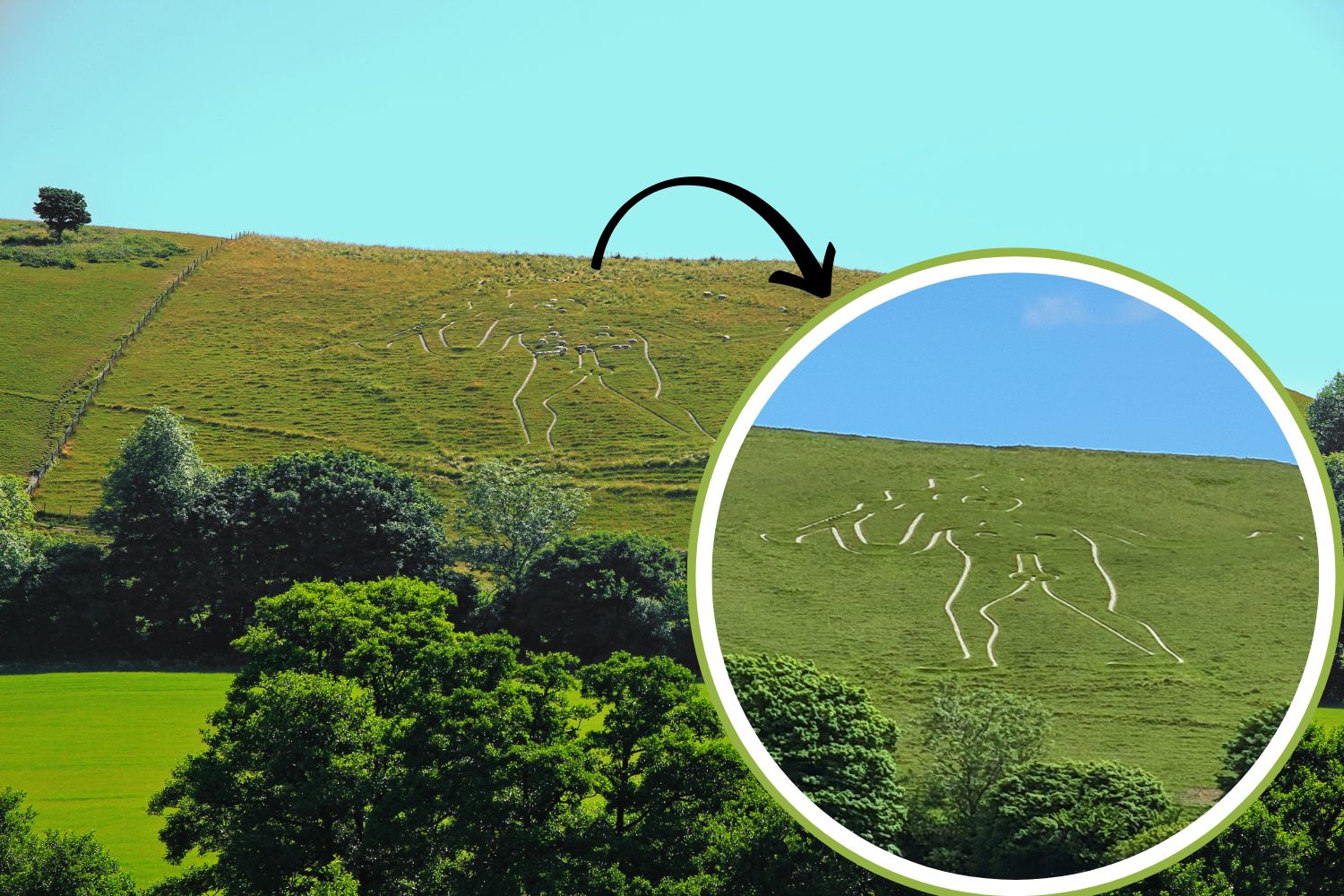
Above a small village in Dorset, south-west England, there has been a huge man lying on the grass for centuries. He is naked, holding a club, measures about 55 meters and can only be seen from afar when the white chalk still manages to win over the green hill. The Cerne Abbas Giant belongs to that category of monuments that seem to have come out of a legend poorly told in the pub and yet they are there, recorded, studied, restored, photographed, discussed with British seriousness and an inevitable half-smile.
Now that white profile must be redone before the hill takes it back. The National Trust, the body that protects historic places and natural landscapes in the United Kingdom, has started a new upsetting operation with around 17 tons of fresh plaster. The operation occurs more or less once every ten years, but this time it has a different urgency: more intense rains, water runoff on the slope, mild and humid periods, algae that dirty the white line and make it turn green. The site managers avoid clear attributions to the climate crisis, but the change can be seen in the field, given that maintenance becomes more and more frequent.
A body on the hill
@canva
The Cerne Abbas Giant dominates the countryside above the village of the same name, about thirty kilometers from Bournemouth and just over ten from Dorchester. Seen from Italy, it may resemble a large white incision in the landscape: a figure traced in the ground by digging furrows in the grass and filling them with crushed chalk. Up close it is the work of arms, stone, mud, cut grass. From afar he becomes a giant.
The figure is one of the most recognizable images of rural England: a naked, bald man with his arm raised and a club in his hand. It has made visitors smile, intrigued archaeologists, fueled legends about fertility and produced theories for all tastes. Some have read it as a prehistoric symbol, some as Roman Hercules, some as a seventeenth-century political mockery against Oliver Cromwell, the military and political leader who led the English republic after the civil war. For a certain period the satirical hypothesis was successful: the club recalled Hercules, the accentuated nudity transformed the hero into a caricature.
Then the data arrived. Analyzes conducted with sediment dating techniques have moved history much further back. The samples taken from the deeper layers indicate a probable origin between 700 and 1100 AD, in the middle of the Saxon period, long before the hypotheses linked to Cromwell. The discovery complicated everything in the best way: the Giant could be medieval, perhaps forgotten for centuries under the grass and then recovered, cut out, kept alive by those who came later.
Since 1920 the figure has been entrusted to the National Trust. Keeping it visible requires almost obstinate care. The old chalk is removed, the dirty and worn material is pulled out of the grooves, then new calcium carbonate is inserted, i.e. the chalk that gives the giant that clean postcard white. Put like that, it seems like an ordinary maintenance job. On site, however, everything changes: the slope is steep, around 18 degrees, and each section must be fixed by hand.
The white man who runs away
The problem, this time, comes from the water and the microscopic life that thrives where it finds space. The rangers observed a growth of algae capable of extinguishing the white of the profile. The chalk, instead of standing out, becomes opaque. It gets dirty. It blends in with the grass. Added to this are the more violent rains, which increase the flow of water on the hill and gradually take away the material inserted into the furrows. The National Trust talks about further monitoring and possible adaptations, including more frequent tracing in the future.
Luke Dawson, ranger in charge of the area, explained that in recent years algae growth has started to blur the clear line of the giant. The most conservative phrase is also the most useful: hotter, wetter conditions may be a factor, along with heavy rains that slowly wear away the chalk. Translated into practice: the monument should be looked at more often, restored better, perhaps even more quickly.
A lesson had already arrived in 2019, when heavy autumn rains quickly damaged some of the work that had just been done. To avoid the same scene repeating itself, the new intervention was planned earlier, with a slightly different technique: the plaster is mixed with water until it becomes a more compact paste, then it is pressed into the grooves. A kind of white dough to be pushed into the hill, centimeter by centimeter.
Around 300 people move around the giant, including specialized staff, volunteers and supporters involved through fundraising. The gesture is ancient: digging, cleaning, filling, beating the plaster with care. The scale, however, remains impressive. Seventeen tons of material brought up a slope, under an already summer heat, to highlight the body of a man carved into the ground more than a thousand years ago.
The hill is as good as the giant
The rematch comes just months after another major move. The National Trust raised 330,000 pounds in 60 days thanks to a public campaign, also supported by donations from various countries, and pooled funds, bequests and contributions to purchase over 130 hectares around the Cerne Abbas Giant. In Italian terms, we are talking about an entire piece of historic countryside, equivalent to hundreds of football pitches, removed from possible future pressures and destined for protection, public access, archaeological research and biodiversity.
The operation also concerns nature. The area includes species-rich limestone meadows, a Site of Special Scientific Interest under the British Classification, and important habitats for rare butterflies such as the Duke of Burgundy, a threatened species in England. The landscape around the giant also preserves wider archaeological traces: embankments, remains of settlements, a Bronze Age mound, the nearby Trendle, a structure on high ground whose function is still debated.
The giant, taken alone, tells only half the story. Around there are hills, soil, water, herbs, butterflies, paths, local memory, tourism, research. Protecting the figure without protecting the ground around it would have felt like saving a frame while leaving the wall to rot.
This is also why the 2026 restoration has a broader value than simple maintenance. It makes the profile white again, of course. But he also says that outdoor monuments, even the seemingly more robust ones, are entering a different phase. The stones heat up, the soil erodes, the water arrives with more violence, the plants grow where before they remained calmer. Conservation becomes less romantic and more physical. Material is needed. We need arms. Money is needed. An almost agricultural patience is needed.
The mystery remains
The Saxon dating has taken away the strength of some old theories, without really closing the question. The Giant of Cerne Abbas remains a difficult figure to place in a box. If he was really born between 700 and 1100, the silence of the sources of the nearby abbey becomes a cumbersome detail. Even the presence of a naked man engraved on a hill a few steps from a religious center causes more than one friction. One hypothesis is that the giant was created in medieval times, then abandoned, covered by grass and rediscovered centuries later, when the low light on the slope made its profile legible again.
Science has narrowed the field, the rest remains in that gray area where monuments become more interesting. The Giant may have had a religious, ritual, political or identity meaning. It may have been modified over time. It may have lost parts, acquired others, changed its body together with the generations that followed it. Every restoration, ultimately, preserves and alters at the same time. He puts a shape back, choosing which shape deserves to remain visible.
For now, the scene is concrete: volunteers on the slope, hands dirty with white, old chalk removed, new limestone paste pressed into the cuts in the hill. The giant emerges again because someone continues to struggle in his place. The English countryside, from afar, seems still. Up close, however, he works. Sweat. It is consumed. It repairs.
The Giant of Cerne Abbas has gone through centuries of history with his club raised and his body exposed to the wind. Now he needs trucks of chalk, monitoring, purchased land, rangers, volunteers and a little weather luck. Even legends, when it rains too much, end up under maintenance.
You might also be interested in:
