
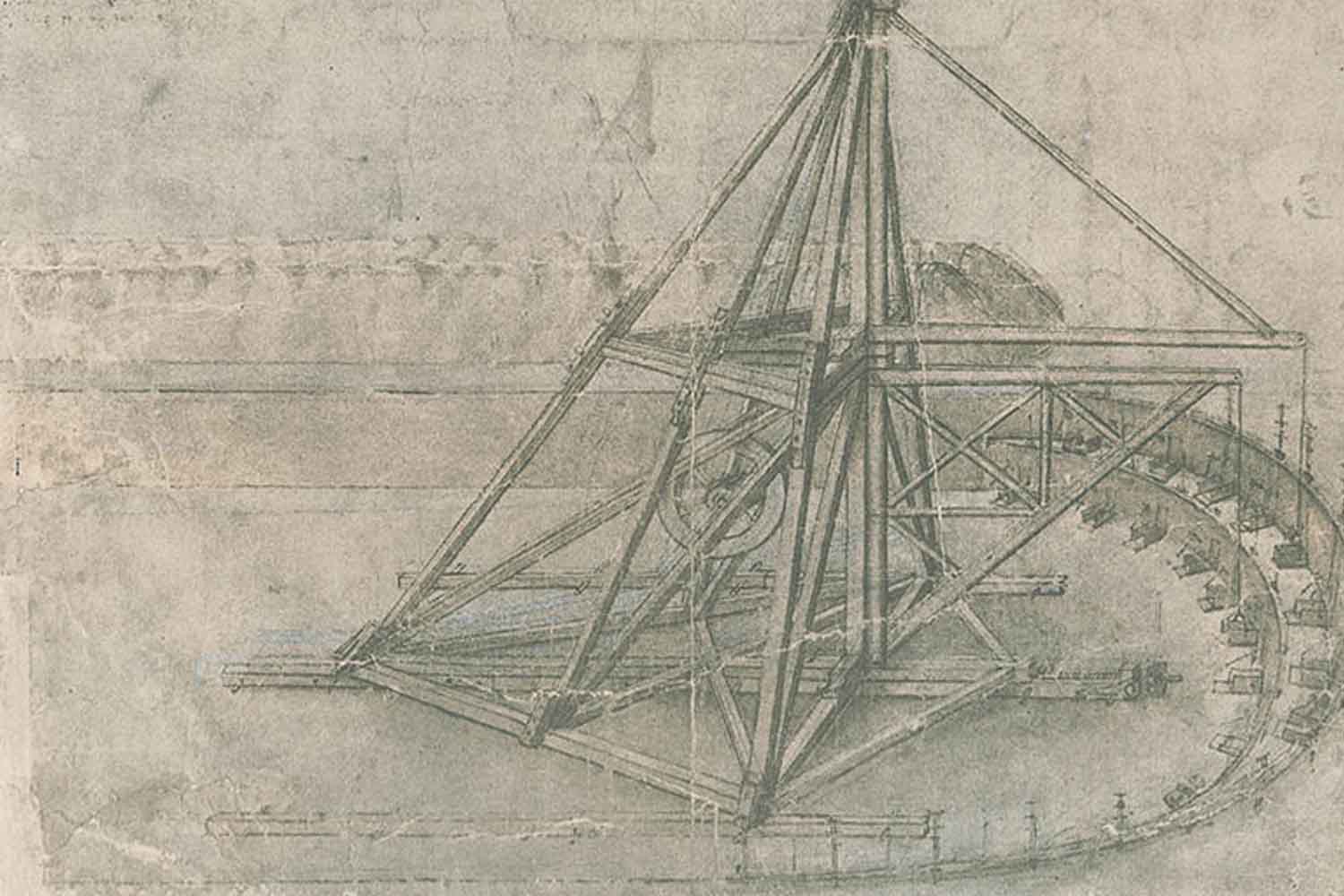
On a card by Leonardo Da Vinci, a horse, a gear, a note on water, a machine for digging canals and a barely visible human profile could fit together. The problem has always been this: Leonardo thought in connections, while for centuries a huge part of his papers were read through comfortable, orderly, very un-Leonardo-esque separations. Art on the one hand, science on the other. Figurative drawings in one place, technical notes in another. As if the same hand, in the same afternoon, could really change the brain depending on the subject.
The new Leonardotheka 2.0, accessible online from 8 June 2026, tries to mend that fracture at least digitally. The platform connects the sheets of the Atlantic Codex, preserved in the Ambrosiana Library in Milan, with those of the Royal Collection of Windsor, making a huge set of pages, images, transcriptions and study sheets available for consultation. The numbers help to understand the scale: over a thousand sheets of the Codex Atlanticus, approximately five hundred and fifty preserved in Windsor, for a total of thousands of manuscript pages that can now be cross-researched.
The ancient cut
The separation arose at the end of the sixteenth century, when Pompeo Leoni, sculptor and collector, intervened on the materials inherited after Leonardo’s death. He cut, disassembled, recomposed. He put the most technical and scientific studies in a large album, which later became the Codex Atlanticus, and collected elsewhere many figurative, anatomical, naturalistic and landscape drawings. Seen from afar, the operation had its own archive logic. Seen up close, it ended up forcing Leonardo into categories that were too narrow for him.
After the death of the master, in 1519, the manuscripts were passed to his student Francesco Melzi. From there began movements, changes of hands, dispersions. The Atlantic Code then reached Count Galeazzo Arconati, who donated it to the Ambrosiana Library in 1637. The other nucleus, with many figurative sheets, reached England in the seventeenth century and entered the Royal Collection around 1670. Since then, Milan and Windsor have kept two different parts of the same laboratory.
This division also weighed on the way Leonardo was told. The painter of faces and bodies. The machine engineer. The student of anatomy. The observer of water, of flight, of animals, of light. All true, of course. Taken in pieces, however, it becomes easier to sell and harder to understand. In his papers the drawing is often already a technical thought, the scientific note passes through the eye of the artist, the image serves to reason even before showing.
A partial mending
Leonardotheka does not physically bring those materials back together. The sheets remain in Milan and Windsor, protected by different institutions and specific conservation needs. The recomposition takes place on the screen, therefore with all the limits of digital: it does not restore the paper, the thickness, the smell, the actual scale of the sheet seen live. However, it gives back something that matters a lot to scholars: the possibility of comparing separate materials, following traces, verifying correspondences, reconnecting pages that once belonged to the same set.
Inside the platform you can search for subjects, techniques, supports, transcriptions, bibliographical references, links between sheets. The most concrete part concerns the digital reconstructions of original pages dismembered over the centuries. Scholars have identified at least fifty confirmed recompositions, combining fragments preserved in Windsor with sheets of the Codex Atlanticus. To do this they followed material clues: paper measurements, watermarks, preparation of the sheets, writing instruments, graphic signs, physical compatibility.
Among the most interesting examples is the reunion of a drawing of a horse with a reflection written on the Regisole, the ancient equestrian monument located in Pavia. According to scholars, that connection could help to read Leonardo’s work around the great monument to Francesco Sforza, the enormous never-completed horse which remains one of his most famous feats precisely because it remained suspended. Here digital is less used to amaze and more to do something almost humble: put two pieces together and see what happens.
Leonardo without showcase
The temptation, when faced with an archive like this, is to transform everything into an event. Leonardo always works: the name is enough, and every project risks becoming an automatic celebration. This time the most useful part lies elsewhere, in the possibility of seeing his work with fewer separations. The sheets show a mind that proceeds through attempts, accumulations, returns. A car next to an animal. A human body next to a mechanical problem. A beautiful drawing next to a practical note. No immobile museum of genius. Rather a work table, still cluttered.
This also matters for those who do not study Leonardo professionally. The myth of absolute genius often distances him, makes him a statue. Manuscripts do the opposite: they show effort, tests, notes, second thoughts, almost nervous curiosity. In Leonardo’s papers there is not only the successful work, there is the process. And the process is sometimes more interesting than the final pose.
The platform also makes visible a broader question: who manages cultural heritage when it goes digital. Museums, libraries and public institutions are entering a delicate phase, especially with the advance of artificial intelligence and large commercial platforms. Digitizing an archive means deciding how it will be searched, read, linked and interpreted. It’s not a neutral transition. In the case of Leonardotheka, at least, the responsibility remains in the hands of scientific and cultural institutions, with a system built around study and not just visibility.
The meeting, therefore, remains incomplete. No platform erases four centuries of cuts, movements and dispersions. But it allows those sheets to return to the same field of vision. A horse finds a phrase. A mechanism returns close to an intuition. A fragment stops for a moment from seeming like just a fragment. Leonardo, finally, returns a little less orderly. Much better this way.
You might also be interested in:
