
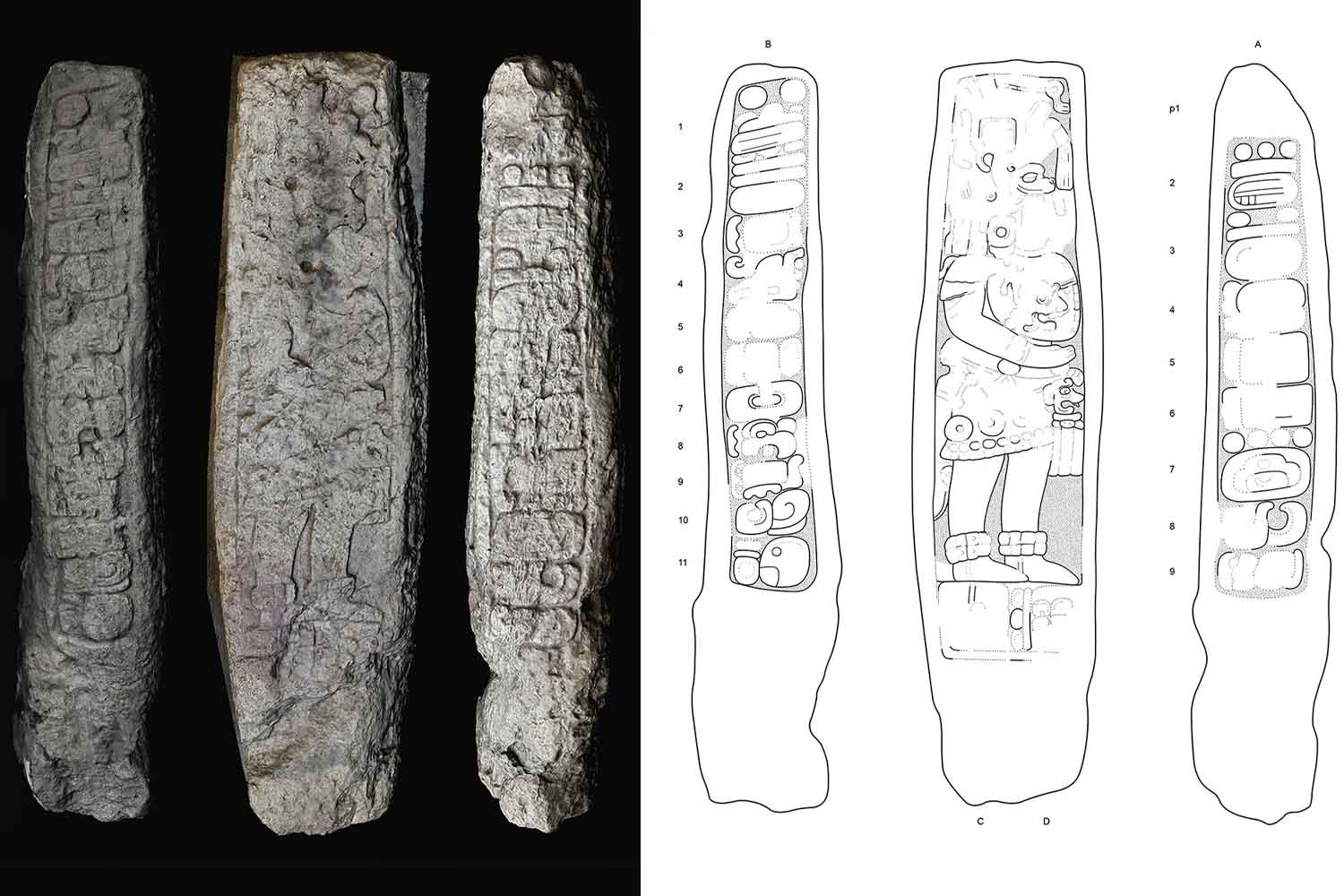
In the south-east of the Mexican state of Campeche, where the jungle takes back everything with an almost offensive patience, a worn stone has returned a date. Small thing, on paper. A sequence of barely legible signs, corroded by time, by rain, by the fragility of the limestone. Yet those signs carry the Mayan calendar more than a century behind the oldest reference so far recognized in the Lowlands, the Mayan lowlands that cross parts of southern Mexico, Guatemala and Belize.
The stone is the Stele 46 of El Palmar, an ancient Mayan center in Campeche. According to the new reading, it retains a Long Count date of 8.7.1.0.0corresponding to 31 August 180 AD in the Gregorian calendar. The data must be handled with caution due to a very eroded inscription, but the work indicates it as the oldest Long Count date known today in the Mayan lowlands, 112 years before Tikal Stele 29, dated to 292 AD
The stone spoke softly
Stele 46 belongs to that category of monuments that we observe today as archaeological finds and which then also functioned as public objects, almost stone posters. The Mayan stelae were vertical slabs, visible in ceremonial spaces, carved to tell genealogies, rites, dynastic passages, dates, names, victories, investitures. In essence: statements of authority left where the community could see them.
The problem here was being able to still read it. The limestone from southern Campeche tends to deteriorate easily and the surface of the stele has come down to us with worn reliefs, incomplete signs, barely perceptible figures. For this reason, the study combined epigraphy, iconography, photogrammetry and high-resolution 3D scanning on stelae 20, 45 and 46 of El Palmar. Photogrammetry allows you to reconstruct a digital model starting from many images; three-dimensional scanning instead allows us to capture minimal surface variations, even in the order of tenths of a millimetre.
Then comes the almost more material part of the matter: digitally illuminating the stone from different angles, bringing out an edge, an engraving, a feature that seems lost to the naked eye. Like passing a grazing lamp over an old wall and discovering that there was still writing under the plaster. Except that here the writing can move a threshold of Mayan history.
The previous reading assumed a different date, 8.7.0.0.0, i.e. 179 AD, but that count created problems of correspondence with the ritual day 4 Ajaw. The new 3D models have made the damaged coefficients more legible and have led scholars to consider the sequence 8.7.1.0.0, 4 Ajaw 8 Sotz, i.e. 31 August 180 AD, more probable. An alternative, but less plausible, possibility also remains indicated, precisely due to the incomplete state of the inscription.
Time as throne
The Long Count was a continuous, linear dating system used by the Maya to place events in an ordered historical sequence. To clarify: it served to say when something had happened within a broader chronology, going beyond the simple annual cycle. Alongside this system, the 260-day divinatory calendar, the tzolk’inlinked to rites, to the qualities of the days, to the sacred reading of time.
The strength of Stele 46 lies precisely in the connection between date and power. The inscription, although damaged, appears to link the calendar to royal events. Among these appears a possible accession to the throne: the sovereign Ajaw K’al Ubaah would have received authority in 131 AD and, forty-nine years later, in 180 AD, would have commissioned the erection of the stele during a public rite. The reference to the also appears in the images and signs Jaguar God of the Underworlda divine figure connected to royalty and the nocturnal and underground dimension of the sacred Maya.
Here the Mayan calendar it becomes a political tool. A date engraved in stone told the public that that sovereign moved within an order greater than himself. His authority was linked to the sky, to ritual cycles, to dynastic memory, to the gods. Power, put this way, appeared less like a human fact and more like something already written into the structure of time.
El Palmar, according to this reconstruction, would have had a kingship already defined in the 2nd century AD, in a phase of important transformation for the central Maya lowlands. The study links Stele 46 to a time when several kingdoms were emerging or reorganizing, while some large preclassic centers entered into crisis. In that unstable landscape, carving a date, a name and a ritual on a block of stone was equivalent to planting a flag. Just heavier.
©Ancient Mesoamerica
A four-ton stele
Stele 46 also has a recent history concrete enough to clear some of the dust from the imagination. After years of conservation and study, the monument was exhibited for the first time permanently in the Museo de Arquitectura Maya, in the Baluarte de la Soledad, in Campeche. The stone measures 2.96 meters in height, which becomes 3.64 meters including the lower insertion part, is approximately 70 centimeters wide, has a thickness of close to 50 centimeters and weighs around four tons.
Moving it, restoring it, assembling it, stabilizing it required complex conservation work: cleaning, consolidation, controlled additions, temperature and humidity monitoring. This detail also says something. A date of 180 AD comes down to us through ancient hands that have engraved it, rains that have almost erased it, archaeologists who have reread it, restorers who have prevented the stone from losing any further material.
Stele 46 preserves a rare combination: a very ancient date and an associated royal event. Other monuments may have ancient inscriptions, others may speak of rulers, but here the two seem to come together at a very early stage of lowland Maya kingship. In short, time was already used as a language of command.
The discovery also reduces a mental distance. We often imagine the Mayan calendar as an abstract, astronomical system, almost separate from everyday life. Instead, on that stele the count of days meets a very concrete scene of power: a sovereign, a ceremony, a square, a community watching, a deity evoked, a stone raised to last.
And indeed it lasted. Worn out, broken in her voice, difficult to question, but still able to say that time, for the Maya, was also a form of government. Once etched in stone, it just stopped passing. He remained there, in charge.
