
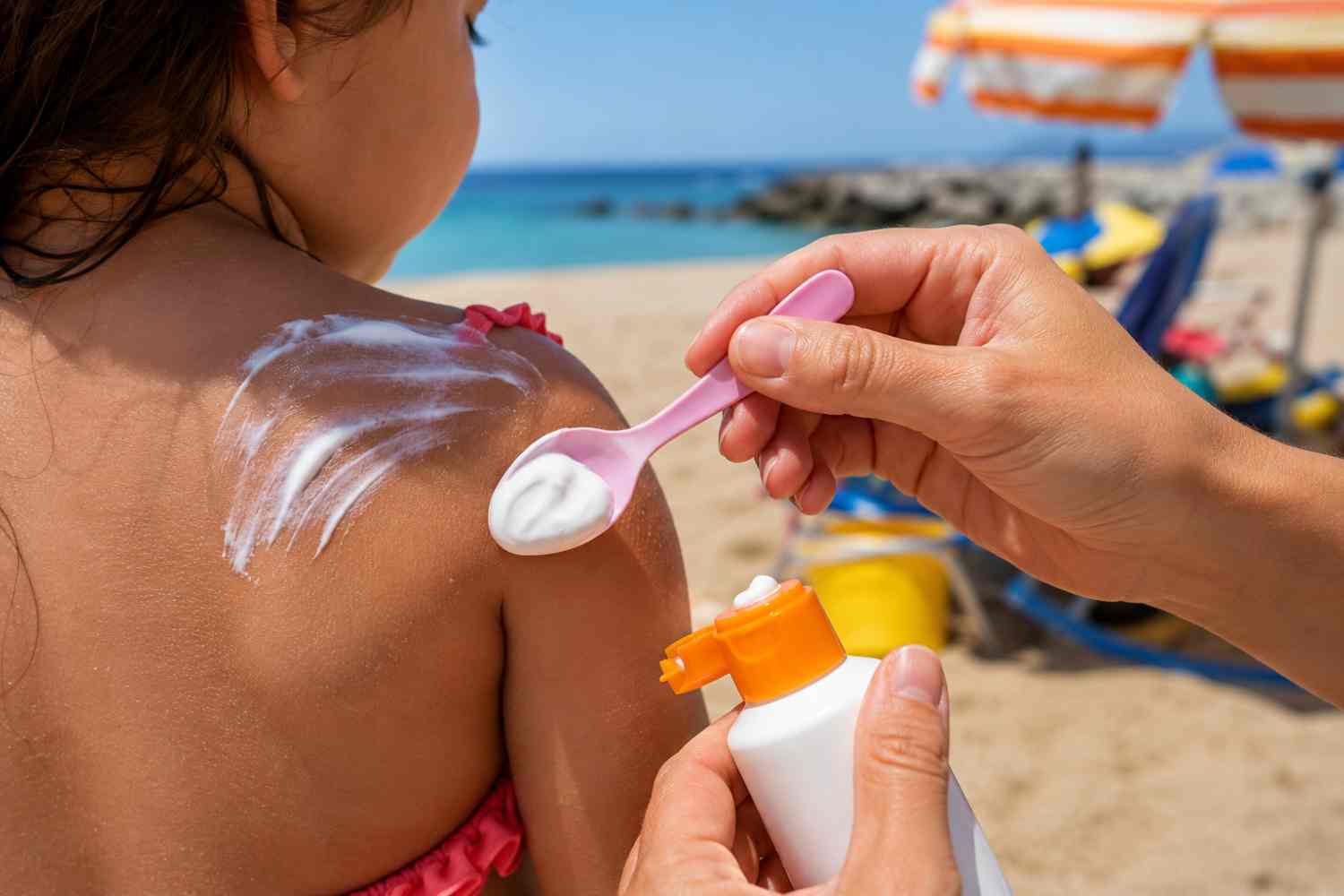
Two hours on the beach and then that question that every parent asks themselves with their hand on the bottle: how much cream to give. Antonio Di Mauro, a pediatrician with a huge following on social media, tried to respond with a post written—he says—lying under the umbrella, while his daughter chases the waves. The answer lies in two objects: a teaspoon and a tube of sunscreen. The right amount, he writes, is almost always more than we imagine.
The point is not marginal. Many parents spread the cream carefully but dose it with a dropper, and the result is a real protection that is much lower than that printed on the package. An SPF 50 applied at half the dose does not offer half protection: it offers much less, because the protection factor drops disproportionately compared to the quantity.
Because the quantity matters more than the number on the package
The SPF value reported on the bottles is measured in the laboratory by applying 2 milligrams of product for every square centimeter of skin. It is the standard that the US FDA uses for testing. Almost no one, in real life, reaches that threshold: studies cited in dermatological literature show applications around a quarter or half of the necessary amount. Hence the gap between what the label promises and what actually ends up on the skin.
Translating “2 mg/cm²” into a practical gesture is impossible by sight. This is where the teaspoon rule was born, which dermatologists have been using for years to give a concrete reference to those who don’t have a precision scale in their bag.
The teaspoon rule, district by district
For an adult’s face and neck you need about a teaspoon of cream. The American Academy of Dermatology indicates at least one teaspoon for the face, enough to cover the length of the index and middle fingers, and about an ounce for the entire uncovered body, i.e. the contents of a small glass.
For the little ones Di Mauro suggests thinking in areas:
If the child is wearing a swimsuit, the dose must obviously be calibrated on the truly exposed areas. No automaticity: the criterion remains to cover well what the sun can reach.
Not to stay in the sun more
There is a misunderstanding that the pediatrician is keen to dispel. The cream is not used to “get more sun”, it is used to let children experience the sea, the swimming pool or the park without the skin paying a bill that will arise years later. The CDC guidelines remind us of two other actions that the right dose alone does not replace: apply the product about fifteen minutes before going out and put it back on every two hours, as well as after every bath or heavy sweat.
An extra teaspoon today, writes Di Mauro, can make the difference for their skin tomorrow. It’s hard to blame him, scale in hand.
