
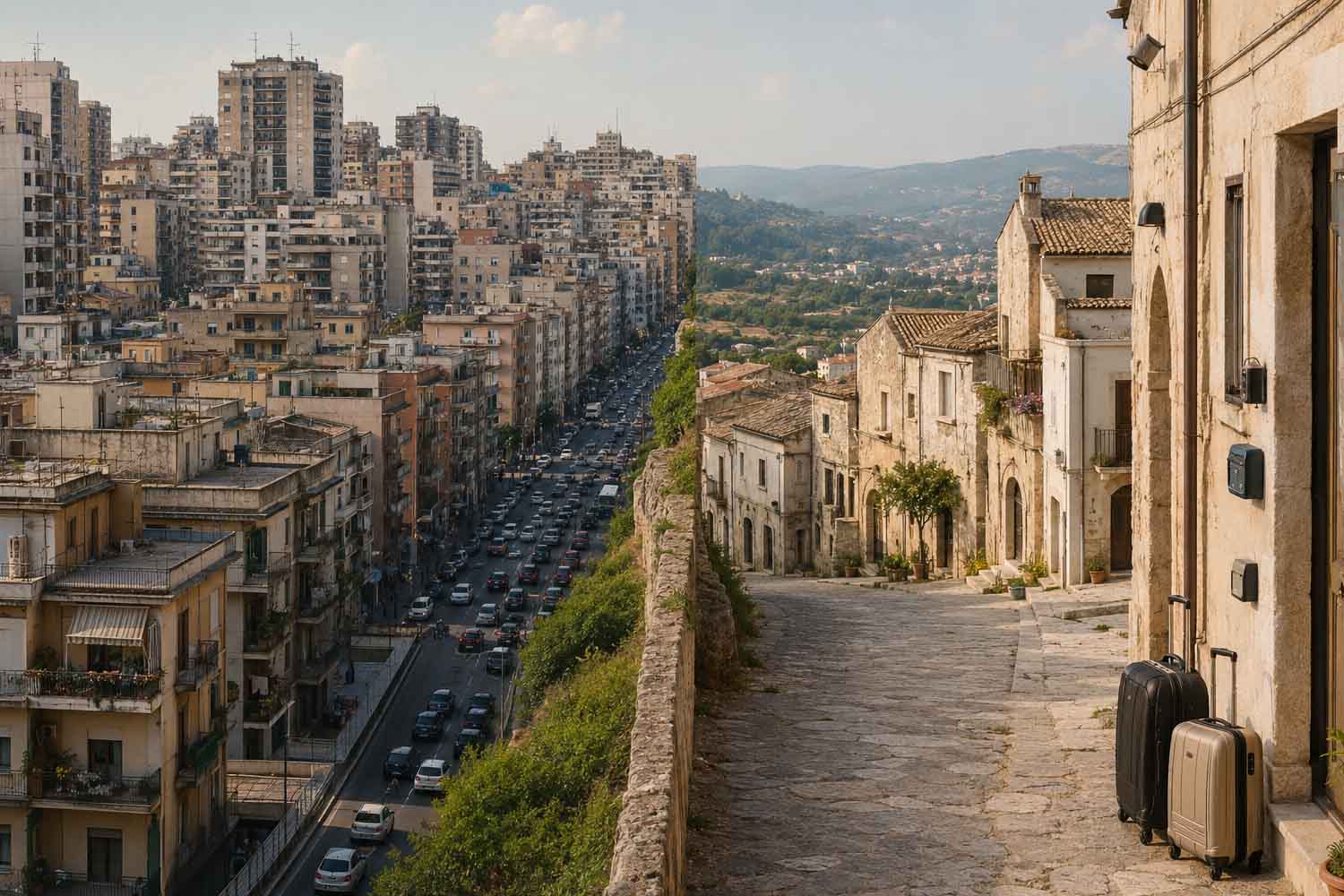
Certain transformations are understood better from the gate of a closed house than from a graph. The village with the shutters lowered for eleven months of the year, the internal road where yet another short-term rental sign appears, the historic center which has become a gentle setting for those who arrive on Friday and leave on Sunday. Then there is the other side, that of cities where people live increasingly cramped, with buildings, traffic, heat, rents that bite and neighborhoods that change their skin faster than the people who live in them. The technical word is urbanization. It looks clean, almost neutral. Inside, however, there are disappeared fields, second homes, commutes, suburbs, emptied hamlets and a very concrete question: how much territory have we transformed so that almost everyone can live in the same way?
According to the Istat photograph on the environmental and energy transformations of Italy, today over 9 out of 10 residents live in centres, while in 1931 more than a quarter of the present population, 26.4%, was distributed in municipal hamlets, i.e. outside the inhabited centres. Meanwhile, the population increased by almost 20 million between 1931 and 2025, and since the post-war period the density of buildings has grown from 140 to 575 per square kilometer in the centres, while outside the centers it has gone from 2 to 9 buildings per square kilometre. Outside the urban perimeter, this growth is also linked to second homes, with increases more than double the national average in Lazio, Campania, Basilicata and Sicily, and even higher in Sardinia.
Where did the fractions go?
The escape from Italian nature has a less romantic outcome than people say. No great novel exodus, no cardboard suitcase to put in a frame. More simply, in a century the country has concentrated lives, services, work, schools, hospitals and possibilities in inhabited centres, leaving the rest in a strange condition: less permanently inhabited, but increasingly intermittently occupied. The second house, seen from afar, seems like a small family achievement. Seen within the fabric of the territory it also becomes concrete, maintenance, roads, networks, land consumption, landscapes that remain lit in the bridges and turned off on Tuesdays in November.
The data on fractions tells precisely about this shift in weight. In 1931 a huge portion of the population lived outside the centres, in smaller nuclei, scattered houses, inhabited countryside, local economies still linked to proximity. Today that human geography has shrunk. People stay in the centres, while outside there remain pieces of territory transformed by new uses: holidays, investments, tourism, inherited houses, closed houses, houses made for income. The Istat document measures the buildings and the distribution of the population, but behind those numbers we can glimpse a change in function: the country ceases to be an everyday place and becomes, more and more often, an asset to be used for a limited period of time.
This is also where the gentrification of towns comes in, that quieter and less talked about version of urban gentrification. In tourist villages, in inland locations that have become “nice” again, in southern towns that double in size in summer and become empty in winter, the house loses part of its main job: hosting those who live there. It becomes a room, an experience, an income, a weekend, a showcase. Every new B&B may seem like good news, and often brings jobs, recovers properties, and puts fragile economies back into circulation. Then comes the bill: fewer homes available for those who remain, more prices out of scale compared to local incomes, more historic centers set up for passage rather than permanence. Istat, in this sheet, indicates above all the building growth outside the centers and the role of second homes; that thread is enough to understand how much the housing theme is already written in the landscape.
Denser cities, hotter cities
Concentration in centers has very physical environmental consequences. More buildings mean more artificial surfaces, more roads, more sealing, more infrastructure, more energy required to run ordinary life. In the European comparison reported by Istat, artificial coverage, i.e. buildings, roads and other transformed surfaces, reaches 6.5% of the territory in Italy; in Germany it is close to 8%, while Spain maintains the lowest level among the four large countries considered.
Meanwhile, Italian soil has changed its skin even outside the cities. Over the last hundred years, the agricultural area has reduced from 70% in 1925 to just under 40% in 2025, while the forest area has grown from just under 20% to 33.6%. Reading it like this it seems like a simple story, fields receding and woods advancing. Inside there are the evolution of the agricultural economy, the growth of productive and infrastructural settlements, the increase in population and urbanization. The landscape becomes more wooded in some areas and more artificial in others, with countryside, cities and infrastructures redistributing themselves without asking permission from those who then have to live there.
The city, however, adds another pressure: heat. In the period 2006-2023, compared to the 1981-2010 climate average, in the 21 Italian regional capitals the summer days increased from 101 to 114 and the tropical nights from 38 to 49. Ground temperatures in 2024 are 1.3°C higher in Italy compared to the period 1991-2020, while in urban areas the phenomenon of heat. In Rome, measured at the Collegio Romano, the average temperature has increased by around 3 degrees from the beginning of the 1980s to today; in Berlin, Madrid and Paris the increase observed is around 2 degrees.
This means that urbanization in Italy weighs twice: it consumes and it heats. It consumes territory when it multiplies buildings, infrastructures, artificial surfaces. It heats because the city retains heat, releases it at night, making it more tiring to live in the places where the majority of the population is concentrated. The tropical night, the one in which the minimum remains above 20 degrees, in a badly exposed apartment becomes broken sleep, fan on, air conditioner for those who can afford it, windows wide open to the noise. Environment and home meet there, on the pillow.
The half-used landscape
The Italian paradox lies in this double pressure. On the one hand, cities attract almost everyone, because there they can find work, services, schools, connections, hospitals and social networks. On the other hand, the territories outside the centers are abandoned as places of continuous life and then rediscovered as places of intermittent consumption. The village empties, then becomes desirable. The countryside loses inhabitants, then gains used houses every season. The city densifies, then expels those who struggle to bear the cost of their stay.
Talking about the environment here also means talking about habitability. An area with too many empty houses in the villages and too many people squeezed into the centers functions poorly. It produces travel, waste, services that are difficult to keep up, landscapes cared for only when they work, suburbs stretched to the point of exhaustion. Nature remains in the background of postcards, while daily life is concentrated in increasingly warm, expensive and built-up places.
The Istat numbers tell of an enormous transformation without the need to raise your voice: less agricultural surface area, more forests, more artificial cover, more residents in the centres, more buildings per square kilometre, hotter in the cities. Within this x-ray there are also the houses that disappear from the market of normal life and return disguised as income. The escape from nature, at that point, ceases to be a metaphor. It’s a new lock on a door that used to open onto a house.
You might also be interested in:
