
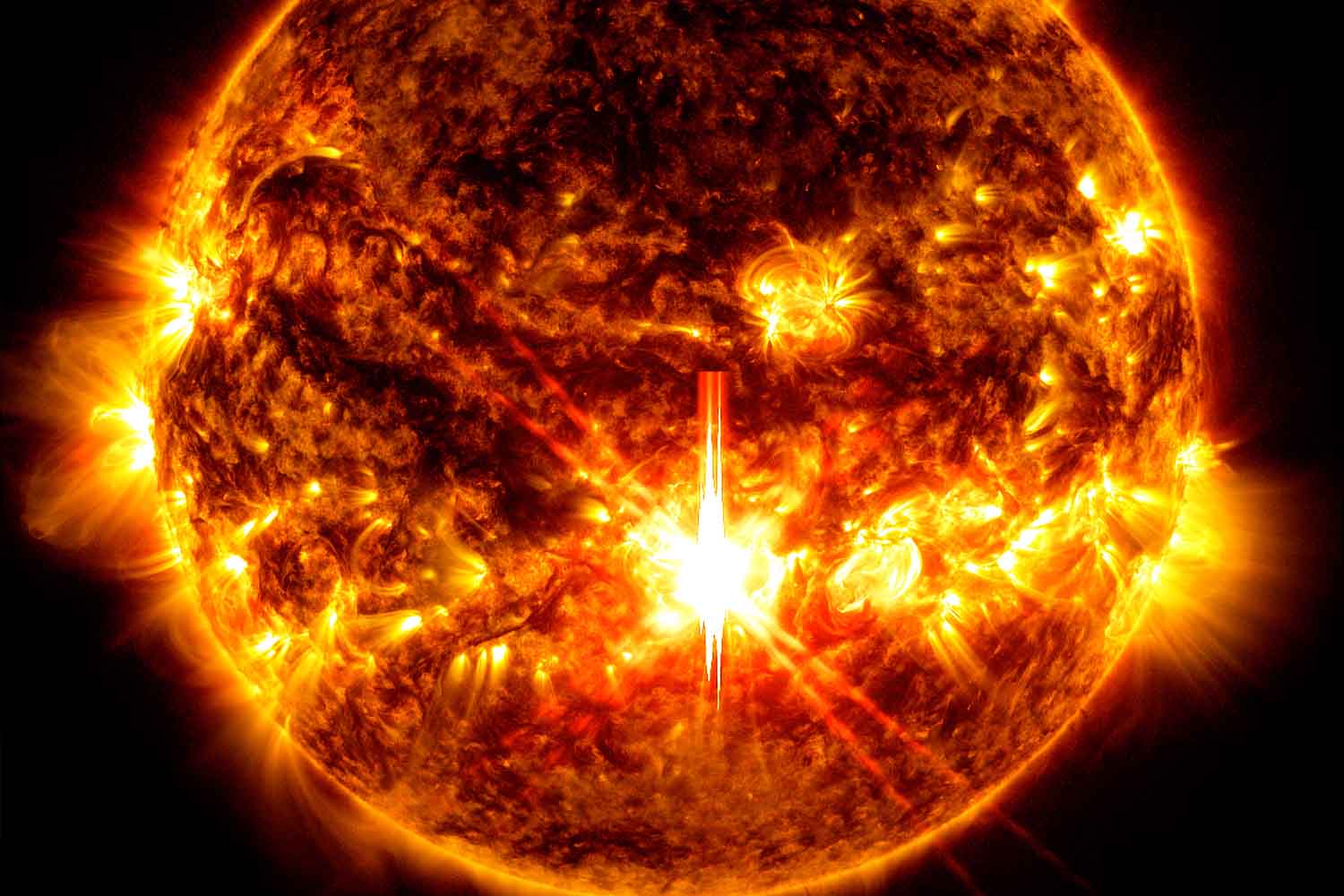
Three hours before the flash, the Sun had already begun to move differently. Nothing visible to the naked eye, obviously. From here, on Earth, the Sun remains that too bright disk that passes through the day and makes us squint. In the instruments observing it from space, however, its atmosphere told something else: brighter plasma, more agitated movements, growing turbulence, regular oscillations in a particularly unstable magnetic zone.
On October 3, 2024, NOAA active region 13842 produced a X9.0 solar flareone of the most powerful events recorded in that solar cycle. In images from NASA’s Solar Dynamics Observatory, the flare appears as a very violent white glow on the solar surface, a bright spot inside a mass of plasma that appears to be boiling. The X classification indicates the most intense category of flares. The number 9, in this case, says almost everything: events of this power are rare and for this reason precious to study.
A solar flare it is a sudden release of magnetic energy. It happens when the Sun’s magnetic fields deform, intertwine, build up tension and then release energy abruptly. The result is a burst of radiation that travels through space at the speed of light. For us on the ground, protected by the atmosphere and the Earth’s magnetic field, the direct physical risk remains out of the picture. For technologies, the situation changes: radio communications, satellites, navigation systems and space infrastructures can be affected by the most intense events, especially when the flare is associated with other solar eruptions.
The hours before the lightning
The interesting part of the study concerns what came before. Large flares are usually studied especially after the eruption, when the phenomenon has already started and the instruments can follow its evolution. Here the situation was different. The NOAA active region 13842 had already shown strong signals in the previous days, including an X7.1 flare on October 1, 2024 and an M-class event a few hours before X9. For this reason several solar observatories were already setting their sights on that area.
Among these was IRIS, Interface Region Imaging Spectrograph, a NASA space observatory designed to study in great detail a thin and restless portion of the solar atmosphere, between the chromosphere and the transition region. It is a kind of physical frontier, the point where energy and plasma move towards the outermost layers of the Sun. IRIS observes in the ultraviolet and allows you to read not only how bright an area is, but also how the solar material moves.
In the new study published on Solar Physicsresearchers analyzed nearly five hours of data from before the flare. They focused on three signals: the brightness of the plasma, its movement along the observation line and the so-called non-thermal velocity, that is, an indicator of turbulence and small disordered movements of the plasma. Translated without making it an astrophysics lesson: they looked to see if solar matter was becoming brighter, more agitated and more unstable.
The answer is yes. All three parameters began to increase approximately three hours before the explosion. The data suggests a slow destabilization of the magnetic field in the active region. A gradual preparation, almost a tension that accumulates beneath the apparent surface of the phenomenon. Then, about 15 minutes before the start of the flare, the solar atmosphere changed pace: the turbulence grew more sharply and the plasma showed outward movements, compatible with a more violent phase of energy release.
The rhythm hidden in the plasma
The most curious detail concerns the oscillations. The researchers saw that brightness, motion and turbulence rose and fell in fairly regular cycles. One repeated every 7-10 minutes, the other every 18-21 minutes. These oscillations were concentrated near the line of polarity reversal, that is, the area where magnetic fields oriented in opposite directions meet.
It’s a delicate boundary. A bit like a seam that’s pulled too tight: it stays put as long as it holds, then just a little more tension is enough and the fabric gives way. In the Sun, that breakdown comes through magnetic reconnection, a process in which magnetic field lines break and reconnect in a new configuration, releasing energy.
The authors of the study remain cautious about the precise causes of those oscillations. They could be waves passing through the solar atmosphere, or small episodes of magnetic reconnection that precede the main eruption. In both cases, the data is precious because it tells of a Sun already in motion before the great flash. The X9 solar flare, therefore, appears less like a sudden gesture and more like the outcome of a measurable preparatory phase.
Forecast still far away
From here to predicting solar flares hours in advance, however, the road remains long. The study concerns a single event, albeit important and very well observed. We need to understand if the same signals also appear before other powerful flares, with the same sequence, the same intensity and the same position with respect to the magnetic fields.
The most useful point lies precisely in the combination of signals. No parameter, taken alone, seems to be sufficient as a safe alarm. The possible pre-eruptive signature arises from the whole: increased luminosity, growth of turbulence, coordinated movements of the plasma, regular oscillations near the line where the magnetic fields collide. A package of clues, rather than a ready-made siren.
For the space weather it would still be a huge step. Today the Sun is monitored continuously, and space weather agencies estimate the probability of class C, M and X flares. Having more robust signals in the hours before major events would help protect satellites, communications, space activities and sensitive technological systems. Even a few extra minutes, in some cases, can make a difference. Three hours would be a much more comfortable margin.
