
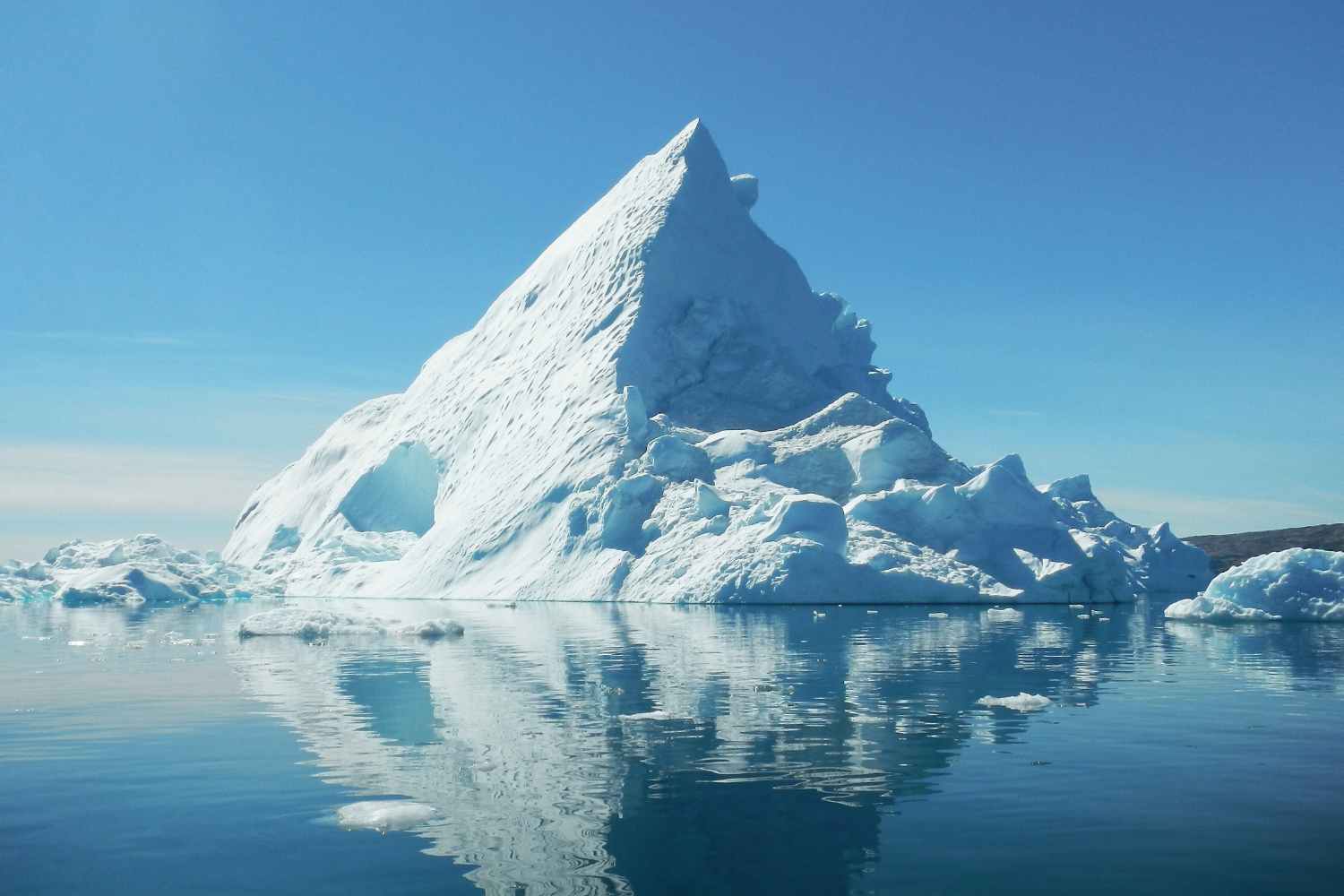
Global warming occurs twice as fast in the polar regions, but its consequences follow ramified trajectories that connect the atmosphere to the most remote sea depths. An international study published in the journal Nature, led by Thomas Krumpen of the Alfred Wegener Institute, reveals an unprecedented ecological phenomenon: the destabilization of the glaciers of north-eastern Greenland and the Russian Arctic has quadrupled the traffic of icebergs in the Fram Strait, the stretch of sea between Greenland and the Svalbard Islands. This increase, calculated by cross-referencing forty years of naval observations from the icebreaker Polarstern, satellite data and oceanographic drift models, is modifying the ecology of the abyss up to 2,500 meters deep.
@Nature
Drifting clods of rock
Icebergs that break off from polar fronts are not simply blocks of frozen fresh water. As they slide down the valley, the glaciers erode the mountain slopes, incorporating debris, pebbles and boulders that have been trapped for millennia. Melanie Bergmann, biologist at the Alfred Wegener Institute and one of the authors of the research, describes the visual anomaly detected in the field: “We immediately realized that tons of rock were floating in the Arctic Ocean, hundreds of kilometers away from any glacier.” Seen from above, these giants appeared dark due to the high load of surface debris. Driven by ocean currents, icebergs gradually melt as they drift and release materials. The largest debris, called in scientific jargon dropstonesplummet to the bottom, transforming once desolate mud plains into mosaics of rigid substrates.
Oasis in the darkness
The accumulation of rocks breaks the monotony of the soft sediments of the deep sea. According to published data, the percentage of groups composed of more than five icebergs has increased by 4.5% per decade since the beginning of the century. Kirstin Meyer-Kaiser, researcher at the Woods Hole Oceanographic Institution, highlights the biological impact of this mineral rain: “Where before there were only isolated stones of various sizes, we now find much larger accumulations, often in small groups. And with each new rock a permanent settlement is created on the seabed.” Sponges and anemones, organisms that prefer hard surfaces to anchor themselves and filter nutrients, are colonizing these new stable habitats, resulting in a local increase in abysmal biodiversity.
A change, not a remedy
This ecological dynamism should not be interpreted as a positive outcome of the climate crisis. Shfaqat Abbas Khan, professor at the Technical University of Denmark (DTU) and co-author of the study, invites an overall reading: “The consequences are not limited to rising sea levels, but directly affect abyssal ecosystems. The changes affect the entire Arctic system.” At the same time, the disappearance of the sea ice is opening up new trade routes for cargo and cruise ships in the far north, exposing shipping to a quadrupled presence of icebergs compared to the beginning of the millennium. The rapidity of these transformations, we read in the study, requires the immediate adoption of advanced monitoring and early warning systems for ice conditions, an indispensable tool to guarantee the safety of human activities in an increasingly unstable geographical quadrant.
