
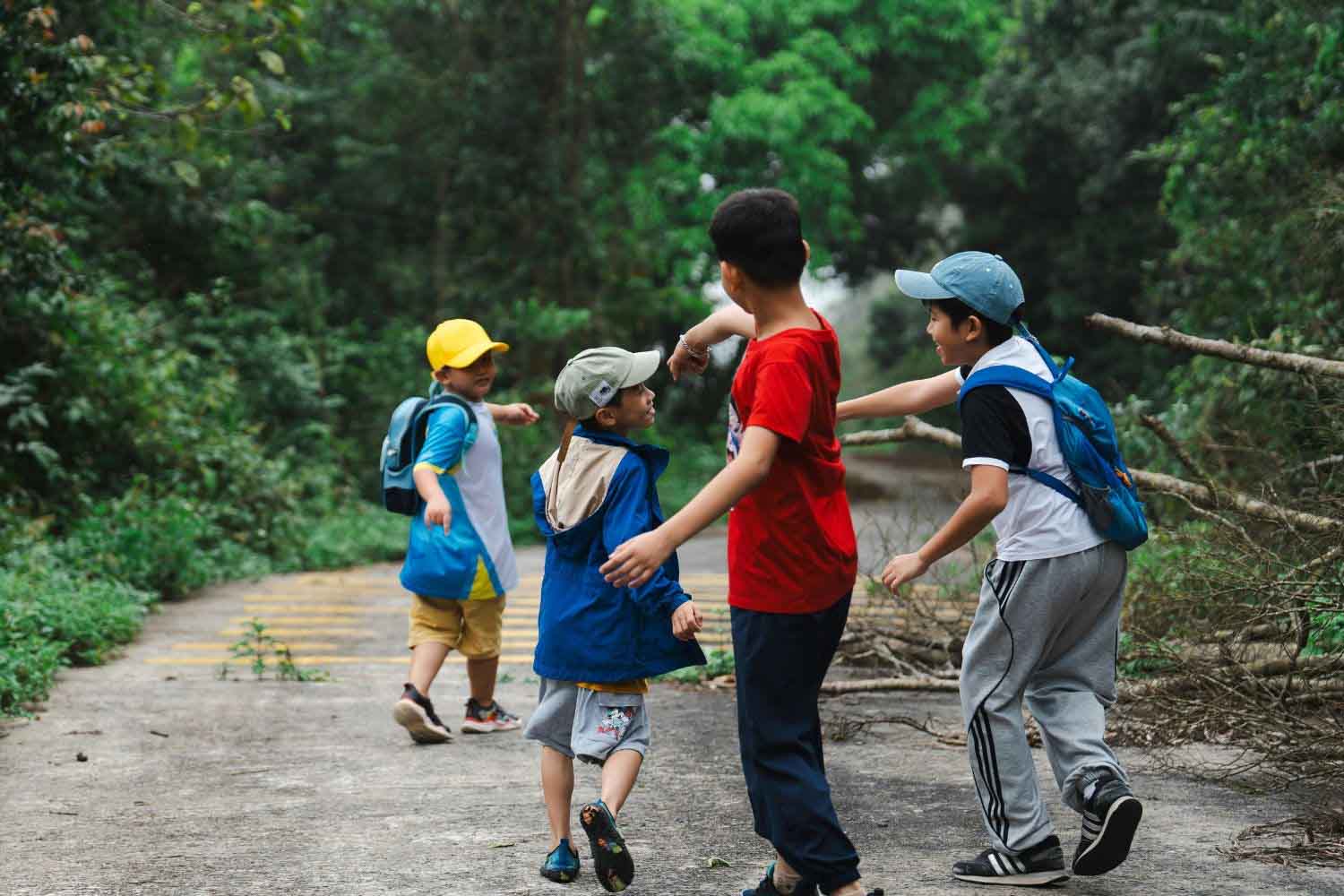
In the Netherlands there is a very simple thing that gets thousands of children lining up every year: going out after school and walking. Four nights in a row. With classmates, parents, teachers, volunteers at the crossroads, comfortable shoes, a waterproof jacket thrown on because in those parts the sky always has a certain personality. It’s called Avondvierdaagse, “four-day evening walk”, and it is a tradition that in Italy seems almost surprising precisely because there is nothing spectacular about it. You walk, you arrive, you leave again the next day.
The format is that of a neighborhood party with legs instead of rides. Children generally travel 5 or 10 kilometers per evening, depending on age and local organisation, along roads, parks, canals, residential streets, parts of the city that are often crossed without looking. In the end, after four evenings, the medal arrives. Sometimes also flowers, sweets, small food rituals, choirs, class t-shirts and parents with the moved expression of someone watching an Olympic marathon, even if the finish line is the schoolyard. The national initiative is promoted by Koninklijke Wandelbond Nederland, the Dutch walking federation, and is organized locally with schools, associations and volunteers.
Four evenings on foot
The strong point of the Avondvierdaagse is its normality. Every year over 500 thousand children participate, an enormous figure for a country of around eighteen million inhabitants. Translated: it is not the niche event for sporting families, high-performance parents and children already enrolled in three courses. It’s a collective, deep-rooted habit that takes something as basic as walking and turns it into a shared experience.
The effort remains, and perhaps that’s what it’s for. A child who walks for kilometers with his class learns that the body holds up more than it seems, that boredom passes, that someone stays behind and someone else waits, that the neighborhood can be a space to cross calmly instead of a backdrop seen from the window. There is movement, of course. There is physical health. But there is also something more difficult to measure: the sense of belonging. The school leaves the building and becomes a group of people who occupy public space without having to buy anything, without having to win anything, without having to prove who knows what.
It’s an almost banal scene, and that’s why it works. Children wet from the rain, adults acting as escorts, time cards stamped, different routes every year, a goal to reach together. In a time when childhood is often compressed between screens, cars, organized activities and family calendars as full as a minister’s, this tradition puts something much less elegant at the center: being outside and moving with others.
Happier children?
Dutch children are often mentioned when talking about child welfare. In the latest Report Card 19 by UNICEF Innocenti, the Netherlands ranks first among 43 OECD and EU countries for overall well-being of children and adolescents, ahead of Denmark and France. The report assesses mental health, physical health and skills, and at the same time points to widespread deterioration in many rich countries since the pandemic.
Attributing everything to a walk would be convenient, and also a little silly. Children’s well-being depends on school, family, relationships, economic security, urban spaces, health, free time, trust, educational culture. The Avondvierdaagse, however, demonstrates well an ingredient that we often treat as an accessory: everyday community. The one that is built with adults present, passable roads, schools capable of leaving the gates, children left a little more free to use their bodies and space.
The international HBSC study, linked to the World Health Organization, also monitors the health and well-being of adolescents taking into account their social context: family, school, friends, the environment in which they live. That’s where certain habits take root. An evening walk alone does not change a child’s life, but it can fit into a wider network of healthy practices: moving, being together, feeling part of something, having adults who accompany without turning every step into control.
A simple lesson
The history of the Avondvierdaagse comes from afar. The great four-day Nijmegen march began in 1909 as a military exercise and over time has become one of the largest walking events in the world, with routes of 30, 40 and 50 kilometres. The evening version for children is its more domestic relative: less solemn, more scholastic, more linked to the neighborhoods. An old idea of physical discipline was transformed into a popular celebration with medals, oranges, songs and sneakers.
In Italy, little would be enough, at least on paper: schools, town halls, neighborhood associations, parks, volunteers, safe routes, some manned crossings, a simple medal, a final party. The difficult part would be precisely what seems natural in the Netherlands: trusting public space, using it, making it practicable for the little ones, accepting that a community is built even with very unspectacular things, because to get children to move, sometimes, it is enough to make movement normal. Not as a punishment, not as a performance, not as a compulsory sport. As a common habit.
You might also be interested in:
