
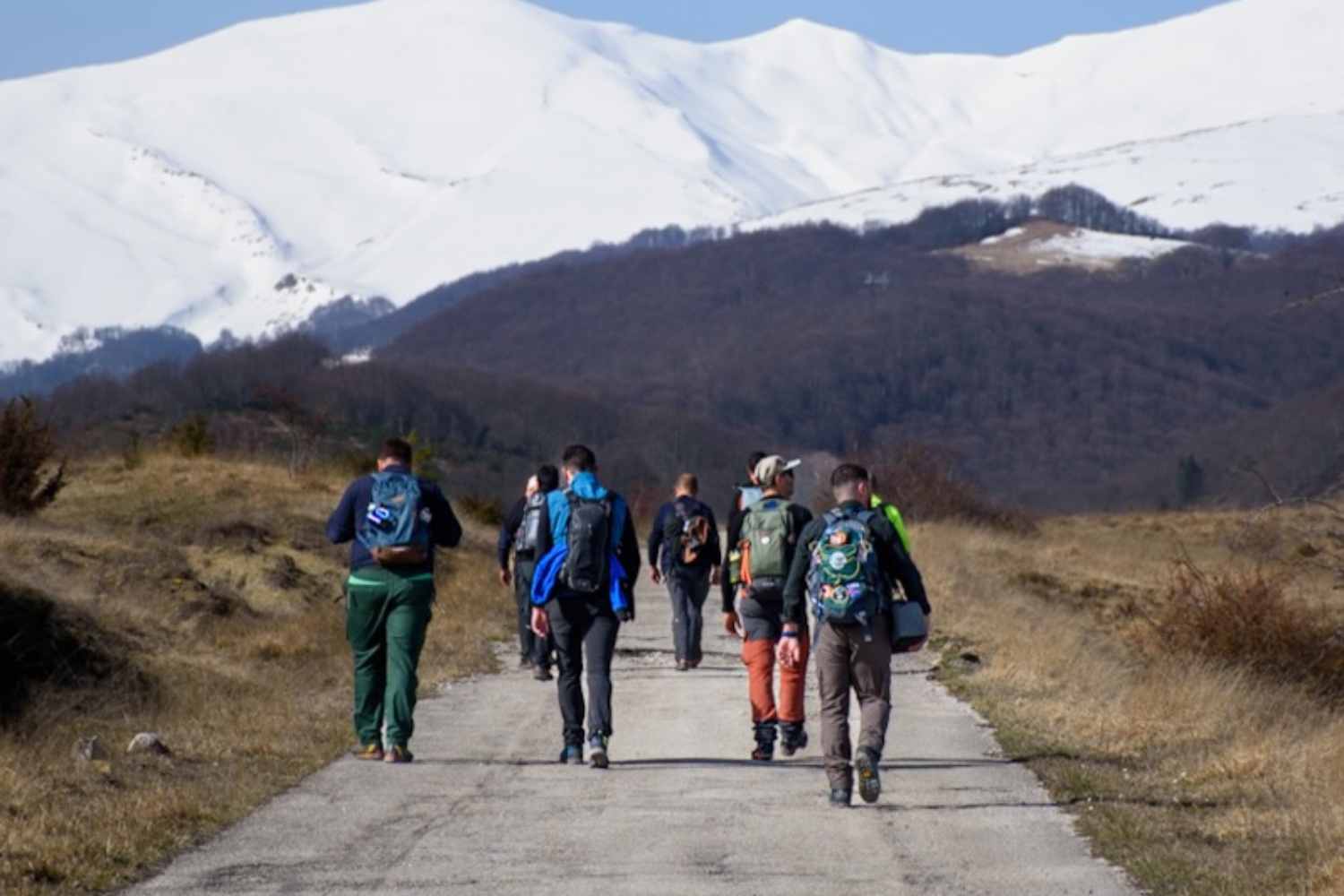
A part of Abruzzo still to be discovered that does not end on the glossy covers, and begins where the asphalt road gives way to the path. The Camino delle Sette Sorelle extends for approximately 130 kilometers in a ring in the heart of the Gran Sasso and Monti della Laga National Park, in a landscape that the promoters themselves define as authentic, wild and uncontaminated. Seven stages, far from the most popular routes.
@camminosettesorelle / instagram
Seven stages between Gran Sasso and Monti della Laga
The route runs almost entirely on a path, with fractions ranging from 15 to 25 kilometers and daily differences in altitude between 500 and 1000 metres. In total we are talking about a positive difference in altitude of more than 5400 meters and about thirty hours of walking, spread over seven days. The difficulty is classified as hiking, the letter E in Alpine jargon, nothing extreme, but you need good strength and a minimum amount of experience with the trail. The recommended period to travel it is from May to November.
View this post on Instagram
Thirty villages between Teramo and L’Aquila
The route passes through thirty small villages and districts, spanning the provinces of Teramo and L’Aquila, touching the territories of Fano Adriano, Pietracamela, Crognaleto, Cortino, Campotosto and Montorio al Vomano. Along the way it is possible to encounter wildlife, ancient sheep tracks, tholos (the dry stone buildings typical of Apennine sheep farming), megalithic walls and Roman remains, in an alternation of woods, waterfalls, rivers and plateaus. The common thread, rather than the single panorama, is the contact with communities that still live far from mass tourism.
The legend of the Madonna Sisters
The name of the path is rooted in an ancient popular tradition of the Upper Vomano Valley, that of the so-called Madonna Sisters, sacred figures, each venerated in a different church. Those churches stood in strategic points of the valley, arranged so that they seemed to look at each other, a belief linked to the protection of the territory. Hence the idea of a path that intertwines hiking and popular devotion, and which today can be used as a slow tourism experience.
How to get information
The Camino has an official website with the description of the individual stages, the downloadable GPX tracks, the pilgrim’s credentials, information on hospitality and luggage transport.
