
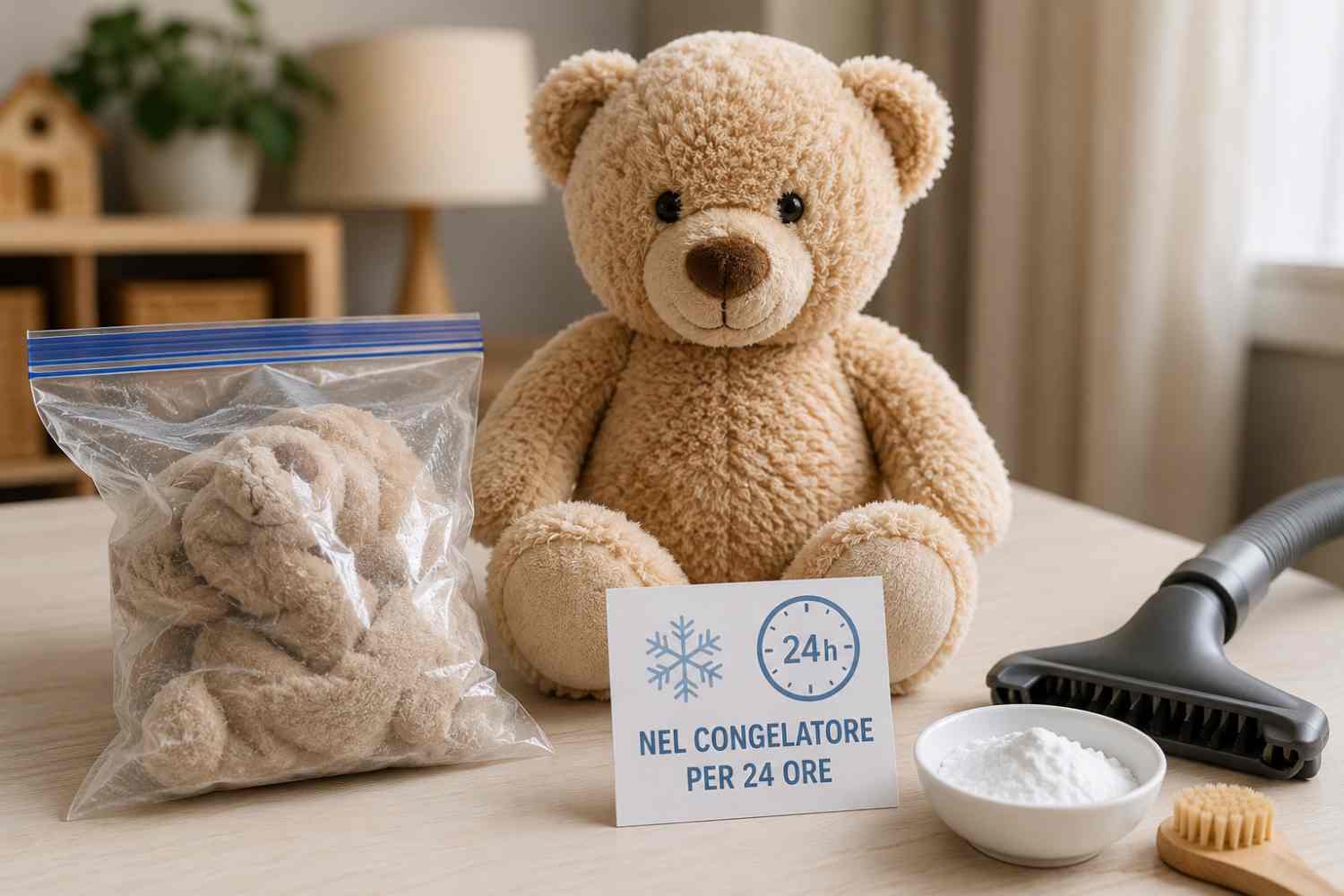
Ah, the stuffed animal of the heart, that entity that keeps your child company every night, then follows him to the park and is occasionally “tasted” by the child. Well, if you are aware of the situation, we are talking about a real receptacle of dirt, as well as one of the most difficult objects to wash. The label discourages washing, the padding never dries and the plastic eyes risk coming off at every attempt. Meanwhile, dust and mites accumulate right there, a few centimeters from the sleeping child’s face. Luckily there is an alternative to washing, and it comes from the freezer.
Because cold works
Dust mites do not survive low temperatures. It’s the same principle that recommends keeping stuffed animals away from hot, humid environments, where they thrive. Closing the toy in an airtight bag and leaving it in the freezer for twenty-four hours is enough to eliminate them, because the cold kills them without the need for water or detergents. Placing soft toys in a tightly closed plastic bag and leaving them for 24 hours in the freezer at home is an effective method for eliminating mites and many bacteria. The bag is used to prevent the fabric from absorbing odors from the freezer and the humidity from forming frost on the fur. Better to choose one for food, resealable, of the right size so that the stuffed animal fits in without being compressed.
The step that almost everyone forgets
Here we are at the delicate point, the one that many articles gloss over: the freezer kills the mites, but does not take away the dust. The particles remain trapped in the fur, together with the residues of the mites, which are the real culprits of allergic reactions, therefore, taking the toy out of the freezer and putting it back on the bed means leaving the job half done. After thawing, a vacuum cleaner with the soft nozzle is needed, or a vigorous brushing with a non-stiff bristle brush, such as a hair brush. It is at this stage that the dust really goes away.
The baking soda trick, for the most stubborn dust
If the stuffed animal is particularly dusty, it is best to combine the cold with a second dry method, which involves the following: place the toy inside a bag, add a generous splash of bicarbonate of soda, tie a knot and shake for a few minutes. This is because baking soda absorbs dirt and captures particles. Leave to act for a few hours, then remove by shaking the doll and vacuuming it. The fur will return clean and odor-free, without a drop of water.
The two treatments can be combined: first bicarbonate for dust and odors, then the freezer for mites. Or alternate them over time, reserving the actual washing for occasions when the toy is really dirty.
When washing remains unavoidable
The dry method is perfect between one wash and another, but it must be said that it cannot replace it forever. For soft toys used every day, or in case of allergies, sooner or later you will have to switch to water. In that case you will have to check the label: most are machine washed at 30 degrees, inside a white pillowcase to protect the fur, without spinning. Drying should be done in the air, never in the dryer and never on the radiator, which hardens the fabric.
Between one wash and another, however, the bag in the freezer remains the simplest weapon you have at home. Zero cost, no risk for the puppet, and a child who will finally hug something clean in the evening.
