
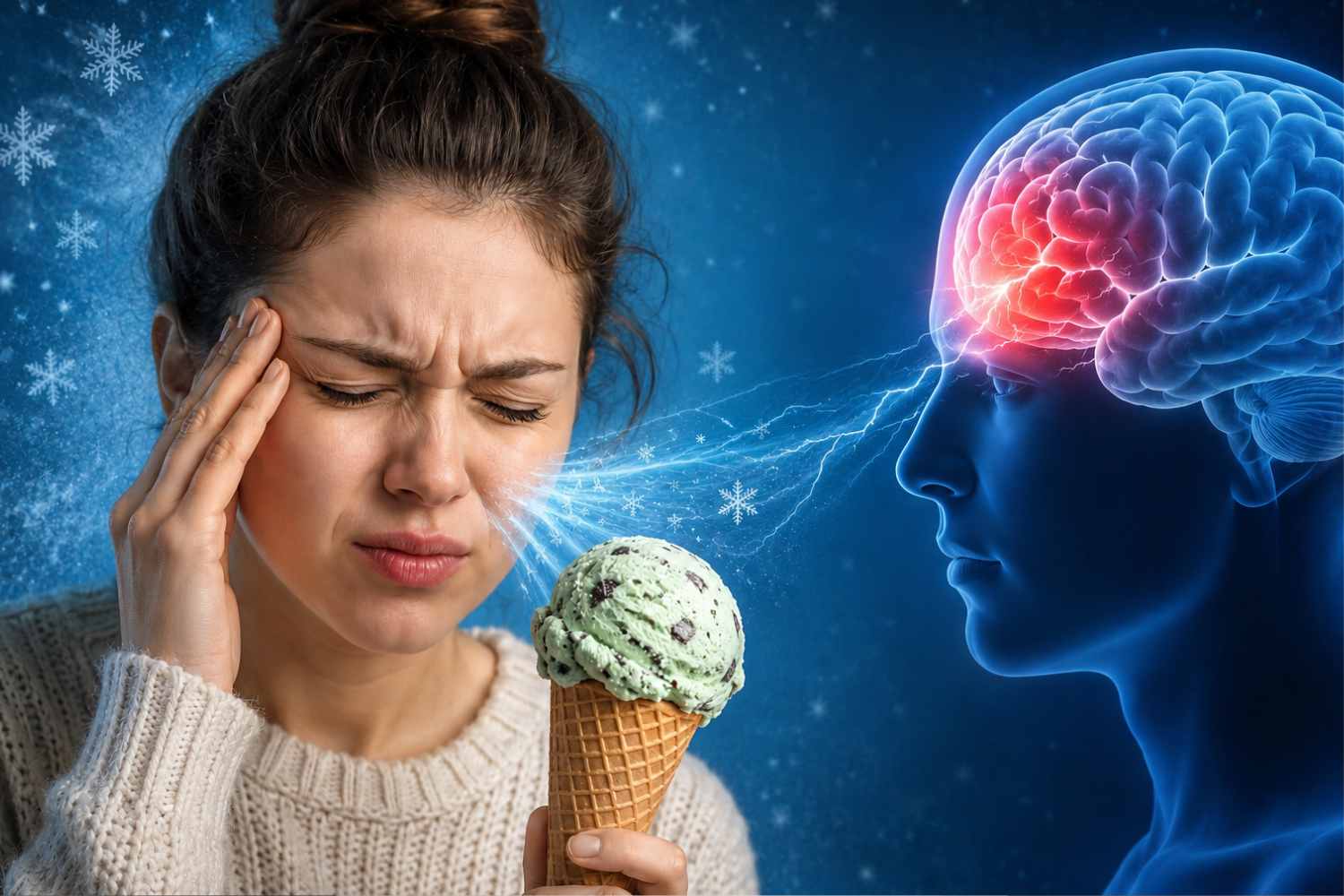
A spoonful of ice cream swallowed too voraciously can trigger the typical short and violent pang that starts from the palate and lands straight on the forehead, destined to last a few seconds and vanish as soon as it came. It happens to almost everyone and the technical name is almost scarier than the pain, sphenopalatine ganglioneuralgiacommonly known as cold headache. The culprit resides at the point where the ice cream touches the palate, towards the back of the mouth, where the sphenopalatine ganglion is located, a cluster of nerve cells involved in the sensitivity of the face, particularly reactive to cold. When a sudden low temperature hits that area, the nerves send an alarm signal to the brain that translates into pain. The discomfort is felt on the forehead or temples, even if the origin is elsewhere, in the brain, which simply misdirects itself. It’s a phenomenon that doctors call referred pain, and it explains why we clutch our temples when the problem is in our mouth.
What really happens in the brain
The most convincing explanation comes from a study conducted by Jorge Serrador, of Harvard Medical School, presented in 2012 at the Experimental Biology conference in San Diego. The research team recruited thirteen healthy adults and asked them to drink ice water with a straw pointed to the roof of their mouths while their cerebral blood flow was monitored with a transcranial Doppler. The volunteers raised their hand when the pain arrived and raised it again when it vanished. What emerged was clear: one artery in particular, the anterior cerebral artery, dilated rapidly, flooding the brain with blood just when the volunteers felt pain. Shortly after this dilation, the same vessel contracted, and the discomfort disappeared, so much so that the researchers managed to stop the pain by making the participants drink hot water, which brought the artery back to its normal size. The reason for this reaction has its own logic: given that the skull is a closed structure, the rapid influx of blood could cause internal pressure to rise and generate pain. The contraction that follows would be the brain’s method of lowering that pressure before it reaches dangerous levels, essentially a kind of safety valve.
The link with migraines
This is where things get interesting. Serrador’s study on ice cream was not random, because other previous studies had already observed that migraine sufferers are more likely to develop cold headaches than those who do not suffer from them. Hence the hypothesis that the two phenomena share a common mechanism. And ice cream headaches, unlike migraines, have an advantage for researchers because they are easy to induce and resolve quickly, without drugs or expensive equipment. In practice, a perfect laboratory test to observe pain from start to finish that would otherwise be undetectable. If local changes in cerebral blood flow were confirmed to be at the root of other types of headaches, new drugs capable of preventing or reversing vasodilation could help treat them. It also applies to headaches related to head trauma, a front Serrador works on through the New Jersey Veterans’ War Related Illness and Injury Study Center.
How to let it pass (and how to avoid it)
The good news is that ice cream headaches are not dangerous, last from a few seconds to a couple of minutes and go away on their own, without the need for medicine or rest. Children suffer from it more often, perhaps because they have not yet learned to slow down when faced with a popsicle. If the pang were to arrive, the most immediate remedy would be to quickly warm the palate: methods may include pressing the tongue against the roof of the mouth, or covering the mouth and nose with the hands, accompanied by rapid breathing to bring hot air to the palate. To avoid risking it at all, simply reduce the cold stimulus, that is, avoid ingesting large quantities of frozen food and drinks all together.
