
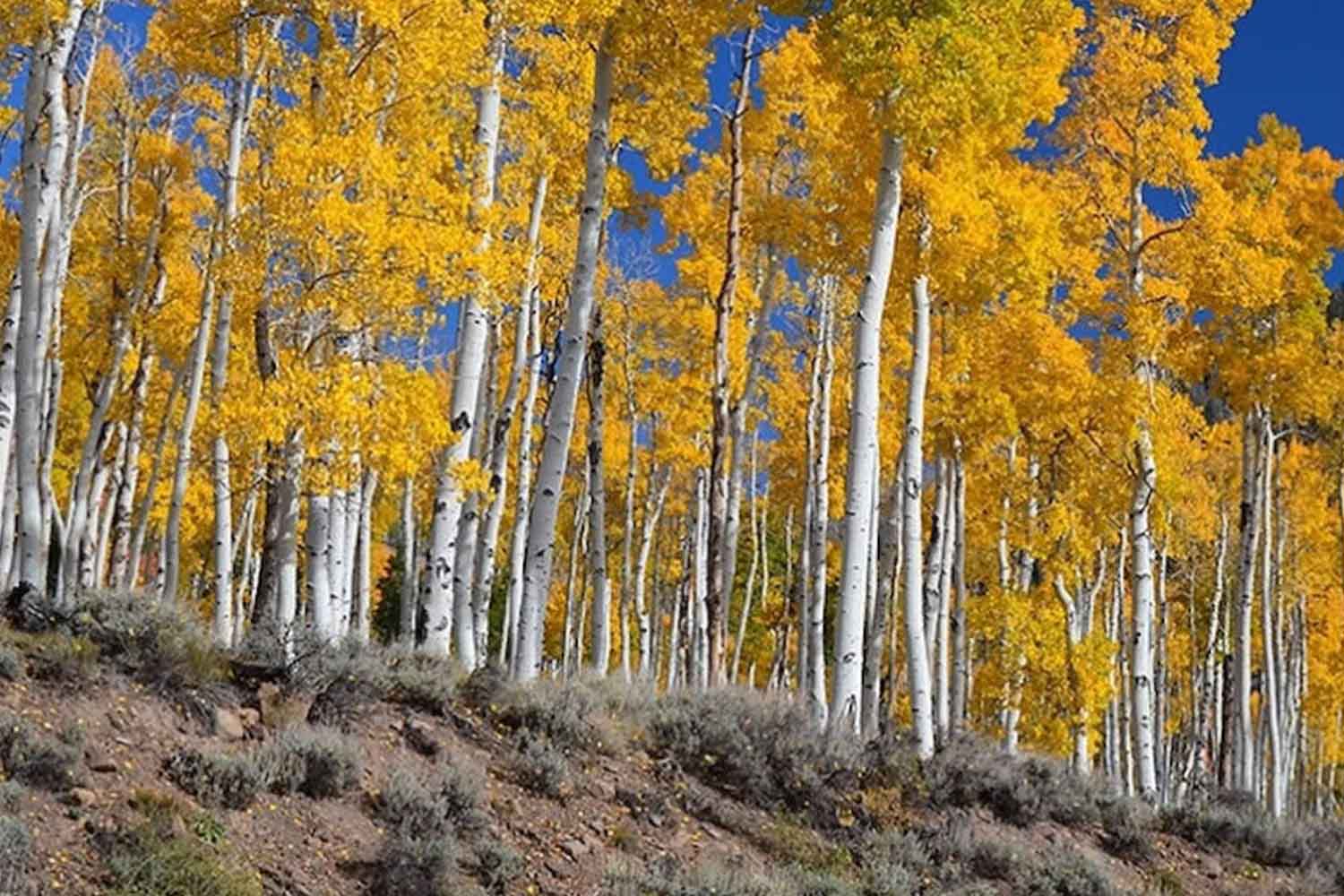
On the side of the road, in the heart of Utah, you pass by Pando with the ease with which you pass any row of rows. Light-colored trunks, leaves trembling in the wind, mountain light, that air of an orderly forest that in the United States immediately becomes a postcard landscape. Except here the postcard lies. What seems like thousands of separate trees belong to the same organism: a single clone of cottonwood, born from a single seed and then expanded over time through a shared root system. The name, Pando, comes from Latin and means “I extend”. Quite precise, given that this organism occupies approximately 106 acres, just under 43 hectares, and is indicated by the US Forest Service as the largest organism ever found by mass, with almost 13 million pounds, or approximately 5,900 tons.
We are in the Fishlake National Forest, about a mile southwest of Fish Lake, along State Highway 25. In summer the green leaves seem to move even in the lightest wind, thanks to the flattened stem typical of the aspen; in autumn they turn gold and orange and attract visitors, photographers, curious people, people convinced they are entering a forest and instead inside a solitary creature, enormous, very old, much less invincible than it seems.
A lonely forest
Pando works in a way that undermines the common idea of a tree a bit. Each stem has the shape, bark and short life of its own tree. The real body, however, is underneath. The roots produce new shoots, genetically identical to each other. The trunks grow, age, fall, are replaced by others. The clone remains. This is why Pando can be ancient even if the individual living stems are often little more than a century old and some are over 130 years old.
Its unity was recognized in the 1970s by observing characteristics such as leaf shape, color and timing of seasonal change; then genetic analyzes confirmed that that “wood” was a single clone. Estimates speak of over 40 thousand barrels, with some scientific reconstructions close to 47 thousand. The data changes depending on the counting method and the state of the shoots, because Pando lives like a modular organism: it loses pieces, tries to produce others, reacts to damage, sends signals from the roots.
His age remains the most slippery and fascinating part. For years the figure of 80 thousand years has been repeated, suggestive and difficult to pin down. Recent genetic work has tried to narrow the gap further by sequencing more than 500 samples of leaves, roots, bark and nearby plants, looking for somatic mutations accumulated over time. The result proposes a wide range, between approximately 16 thousand and 80 thousand years, with the most conservative hypothesis already sufficient to make Pando one of the oldest living organisms known.
What’s also interesting is how Pando appears to retain remarkable genetic uniformity, despite having gone through thousands of years of change. The researchers found only a modest correlation between spatial distance and genetic distance: in simpler words, neighboring stems are a little more similar, as expected, but the organism as a whole appears less fragmented than one would expect from such an ancient and widespread creature.
The problem is young people
Pando has overcome fires, climate change, changes in the landscape and enormous ecological pressures. The current trouble has a much more ordinary aspect: new shoots are eaten before they become trees. A study published in PLOS ONE indicated that mule deer browsing was one of the strongest factors in limiting the successful regeneration of Pando. In some areas, cattle and elk also weigh in, with an easy-to-understand effect: tender shoots emerge from the ground and disappear before they reach the critical height.
The result is an organism full of mature trunks and with too few young people capable of taking their place. The Western Aspen Alliance at Utah State University has been describing this imbalance for years: in parts without protection, the loss of mature stems proceeds much more rapidly than useful regrowth. Pando continues to produce new shoots. The problem lies in the stretch between the ground and the safe height, when a seedling is still easy food.
The Forest Service points to two main pressures: poor regeneration and attack by insects and diseases, including bark beetles, root rots and cankers that weaken older trees. The combination is concrete: if the adult trunks die and the young shoots disappear under the teeth of the herbivores, the organism becomes thinner. Slowly, without scene. And this is precisely why we need to look at it better.
The new data
The most recent information shifts the story from “he is dying” to something more precise: Pando is fragile, followed better than before, still capable of reacting. As of 2025, approximately 80% of its surface area has been brought into care and protection, according to Friends of Pando. In the same year, passive monitors recorded 8,300 visitors, with a net increase compared to 4,456 in 2024. A growth also linked to autumn leaf tourism, which is very strong in the area.
In 2026, monitoring is expected to become more accurate, with new detection points and more defined entries into some areas that were previously difficult to measure. This detail matters because Pando now also lives within the pressure of his success: the more people know him, the more people want to see him, photograph him, walk through him. The visit can become education, funds, public attention. It can also add foot traffic, disturbance and need for management.
Another major update comes from the ground. Friends of Pando began an extensive study of the soil chemistry of the entire clone, sampling multiple areas of its surface. Available data indicates that the soil is chemically suitable, with available calcium and conditions compatible with aspen. Regeneration, therefore, seems to be blocked above all by manageable factors, starting from the pressure of herbivores, rather than by a problem hidden in the soil.
Also in recent years, a fauna monitoring program has been activated with camera traps and bioacoustic devices, created with Fishlake National Forest and the Utah Division of Wildlife Resources. The goal is to observe deer, elk and other animals year-round, understand where they come in, how they move, when they graze the most and how to adapt protection. In short, today Pando is treated less and less as a Guinness curiosity and more and more as a living organism within a complex landscape.
Fences, visits, maintenance
To protect Pando, we worked above all on fences, targeted cuts, monitoring areas and regrowth management. The point is very practical: when the young stems are protected from browsing, they can grow and re-enter the clone structure. When the barriers give way or animals manage to enter, regeneration stops. Friends of Pando reconstructs a history of interventions that began in the 1990s and reached a broader protection plan in 2025, with rapid fences and areas to be protected on a rotational basis.
This is perhaps the least spectacular and most important part: Pando’s salvation depends on maintenance, checks, gates closed well, repeated monitoring, data shared. No epic image of the giant who saves himself because he is ancient. Here antiquity matters up to a certain point. An organism can be thousands of years old and remain vulnerable to a gate left open, to a herd that is too present, to an underestimated tourist pressure.
A giant with bare feet
Pando’s greatness risks deceiving. A creature weighing thousands of tons appears to have off-scale, almost geological strength. Then just look at the sprouts. They are small, tender, easy to tear. The giant’s entire survival depends on it: from young trunks protected enough to cross the mouth of a deer, from fences repaired in time, from better guided visitors, from continuous monitoring, from management capable of correcting itself when an intervention loses effectiveness.
Pando has resisted for thousands of years, always starting from the same point: from the bottom, from the roots, from the shoots. Today that point is the most fragile. The Utah giant, in the end, depends on a few centimeters of greenery left alone.
You might also be interested in:
