
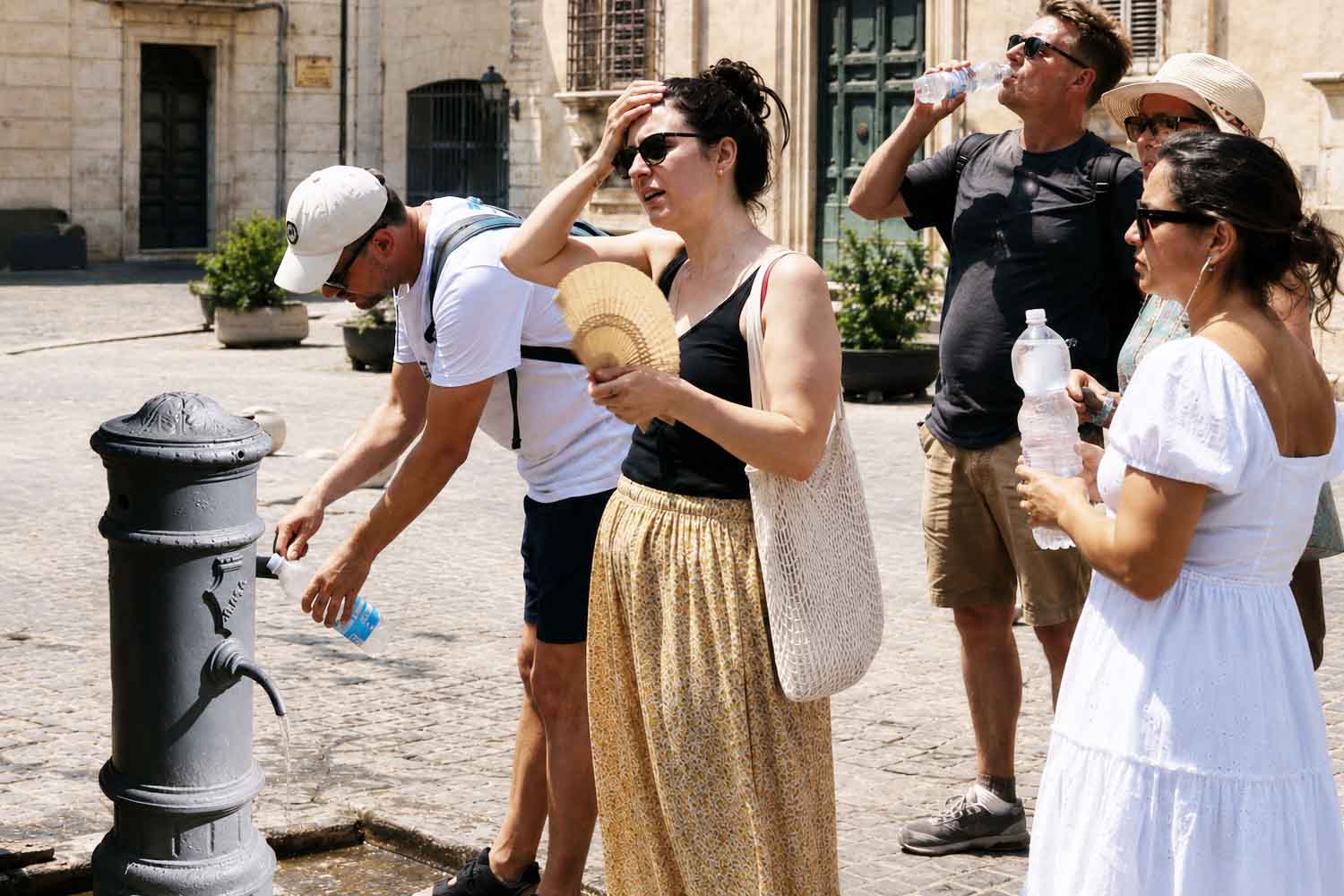
The frightening heat is best recognized when the sun has already set. During the day we make do: a fountain in Rome, a fan in Rennes, an empty bottle on a bench in Berlin, the shade sought by crossing Westminster Bridge in London. Then night comes and the house remains warm, the body remains warm, the air seems still inside the rooms. It is there that the heat dome stops being a meteorological expression and becomes a very concrete thing: sleeping badly, breathing worse, waking up already tired.
Europe has entered an early new heatwave, with France, Italy, Spain and the UK experiencing off-the-charts temperatures for the end of June. In France, Météo-France indicated Tuesday 23 June 2026 as the hottest day ever measured in the country, with a national average temperature of 29.8 °C, higher than the absolute records of 2003 and 2019. In the United Kingdom the Met Office issued a rare red warning for extreme heat between Wednesday 24 and Thursday 25 June, while in Italy the Ministry of Health continues to update heat wave bulletins for 27 city.
The lid over the cities
The heat dome arises when a high pressure system remains stationary over the same area for days. The air sinks downwards, compresses and heats up. Above, the high pressure works like a cover: it limits the formation of clouds, reduces the mixing of the air, lets the sun work for hours on asphalt, roofs, walls and already dry countryside. Each day adds heat to the previous day.
In this European phase we also speak of an omega block, an atmospheric configuration that takes its name from the Greek letter Ω: an area of high pressure remains stuck between two areas of low pressure and the flow of the jet stream slows down, bends and blocks. The result, for those who live under that bell, is easy to recognise: very hot days, often stable skies, stagnating air, temperatures that struggle to drop even after sunset. This dynamic also explains this Reuterswhich linked the intensity of the current European wave to this atmospheric configuration.
The difference between a heat dome and a heat wave is right here. The first is the atmospheric mechanism that traps and fuels heat. The second is what reaches the ground: hot sidewalks, schools that shorten lessons, slower trains due to the risk of deformation of the tracks, hospitals under pressure, cities that discover they have too many mineral surfaces and little shade.
The heat that Europe is struggling to cope with
The European problem also has a cultural and material part. Many cities on the continent were built to retain heat in the winter, less so to reject it in the summer. Poorly ventilated houses, exposed upper floors, historic centers full of stone, neighborhoods without enough trees, crowded public transport, unequally distributed air conditioning. In France the wave is taking a particular toll: over half of the country has been affected by very high level alerts and the authorities have reported dozens of drownings in a few days, while many people sought relief in rivers, lakes and unsupervised bathing areas.
Italy also knows this scene well. The red dots from the Ministry of Health also indicate risk conditions for healthy and active people, as well as for the elderly, children, pregnant women, people with chronic diseases and those who work outdoors. The city, with extreme heat, changes function: a bus stop without a shelter becomes a critical point, a top floor apartment can turn into a trap, a short journey under the sun weighs like a disproportionate effort.
The most insidious part remains the night. The body needs to cool down to recover. When the temperature remains high, especially with high humidity, the organism accumulates thermal stress. Sleep gets worse, the heart works harder, dehydration progresses more easily. For this reason, the so-called tropical nights, with minimum temperatures above 20°C, are an important health signal, especially in homes without cooling and in neighborhoods where concrete and asphalt slowly release the heat absorbed during the day.
The climate raises the starting point
A heat dome can form due to precise weather dynamics, related to high pressure and the jet stream. Climate change acts on another level: it makes the background on which these phenomena develop warmer. When the global average temperature rises, the extremes also start from a higher base. The same atmospheric configuration today can produce a more intense wave than it would have produced in a colder climate.
The IPCC has already indicated that human activities have increased the frequency and intensity of hot extremes since the 1950s, while the World Meteorological Organization recalls that with further warming the intensity, frequency and duration of heat waves increase. The question, therefore, also concerns persistence: events that remain longer, with fewer breaks, fewer cool nights, less margin to recover.
This explains why the heat in June makes more noise than a normal summer blaze. It arrives early, hits countries that had partly adapted to different summers, brings together public health, energy, work, transport, schools, tourism. Every additional degree becomes more practical: exhausted fans, rising electricity consumption, shifts to be rethought, events cancelled, fragile people to be monitored.
How to defend yourself without improvising
During a heat dome, useful information seems trivial until it is actually needed. Drink often, even without waiting for thirst. Avoid physical activity in the middle of the day. Look for shade and cool places. Close the windows during the hottest hours and open them only when the air drops outside. Keep an eye on lonely elderly people, children, people with medical conditions, pets. Be careful with water: seeking refreshment in rivers, lakes or the sea can become dangerous if you enter unsupervised areas, with currents, irregular seabed or thermal shock.
Extreme heat also requires collective adaptation. More trees, fewer impervious surfaces, schools and hospitals designed to withstand the new summers, public housing and fragile homes made safe, serious plans for those who work outdoors. Personal protection helps, but a city without shade leaves people to get by one by one, with a bottle of water in their hand and too much asphalt under their feet.
The heat dome will pass. What will remain are the cracks that it has made visible: rooms that retain the heat, streets without shelter, nights incapable of cooling the bodies. The lid moves. The summer we are building for ourselves stays here.
You might also be interested in:
